
TL;DR

Get garden gear delivered free with Prime
- Fast, free delivery on millions of items
- Prime Video, Amazon Music and more included
- Member-only deals all year
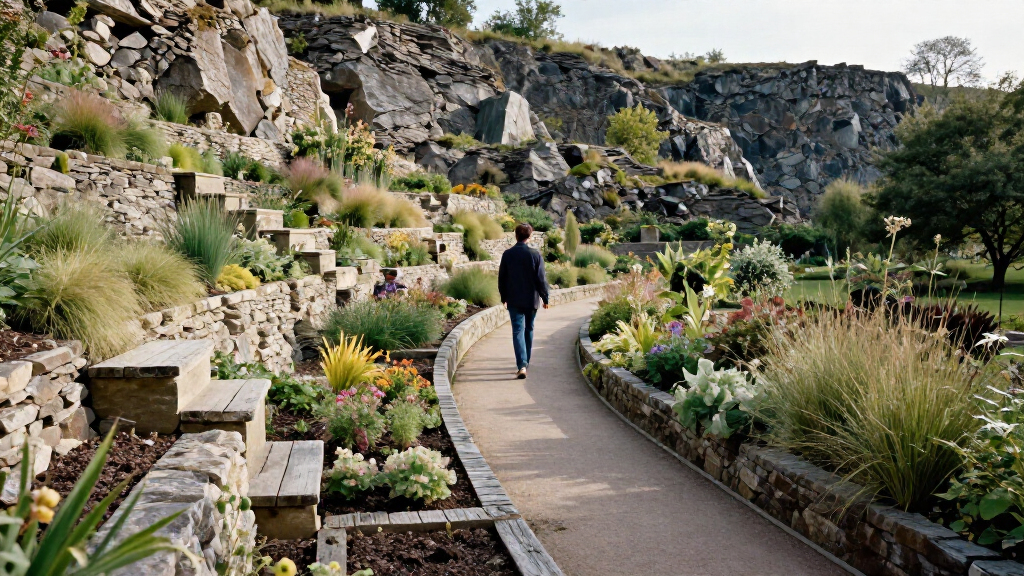
Garden designer Fi Boyle won the People’s Choice category at the Society of Garden and Landscape Designers’ Awards for a garden created on a steep former quarry site. The project uses terraces, accessible routes, repeated materials and planting suited to each area to turn difficult ground into a more usable garden.
Garden designer Fi Boyle has won the public-voted People’s Choice category at the Society of Garden and Landscape Designers’ Awards for a garden built on a steep former quarry site, with ideas that echo broader garden design trends. The project shows how terracing, routes between levels and planting selected for local conditions can make challenging ground more accessible and usable.
The garden had been a private space, but earlier attempts to create usable areas had left parts of it overgrown, crumbling and difficult to access, Boyle told Amateur Gardening. The owners, described in the report as keen gardeners, wanted to make more of the site and needed a design that could be maintained without relying solely on steps.
Boyle said a key part of the brief was that machinery and wheelbarrows needed to move between levels. The design therefore combines steps with sloped access, with the number and placement of terraces shaped by the site’s contours, much like the planning involved in designing a raised-bed garden. Several retaining-wall approaches were used, including natural stone gathered on site, rendered breeze blocks, and a combination of steel and sleepers.
The design also varies by level, reflecting the kind of thoughtful choices featured in garden design products. The sunniest terrace has a Mediterranean-inspired planting scheme, with gravel and stepping stones; the stones are offset to slow movement along the path. Boyle says that kind of route needs a firm surface beneath the feet, with softer material such as gravel or planting around it. In shaded areas, wood, logs or bark can better suit a woodland-style treatment.
Making Steep Ground Work
The project offers a practical example for gardeners facing steep slopes, drainage problems and limited access. Boyle cautions that planting directly into a sharp bank can be difficult: soil and added compost may move downhill, leaving upper ground dry and the base wetter. Terraces can create flatter areas for planting and use, while routes designed for equipment can make ongoing care more manageable.
The approach is not a single template for every garden. The site’s slope, exposure, soil and intended use all affect what will work. The award-winning design instead illustrates how a designer can use those conditions to shape different areas, while repeated materials help them read as one connected garden.
Popular right now

Ninja CM401 Specialty Coffee Maker with 10-Cup Carafe and Fold-Away Frother

Samsung 65-Inch The Frame Pro Neo QLED 4K TV (2026) Bundle with Modern Brown Bezel, HDMI Cables, and Home Theater Guide

Bose QuietComfort Wireless Noise Cancelling Headphones, Black
As an affiliate, we earn on qualifying purchases.
From Quarry Slope to Terraces
Boyle advised gardeners to survey the levels before designing, saying that a slope’s height change can be harder to judge by eye than it appears. She warned that borders on slopes above 30 degrees are particularly difficult to manage, although her comments are design guidance rather than a universal engineering threshold.
On the quarry project, the setting informed the material choices. Limestone paving was used across paths and paved areas, while stone found on the site formed walls. Rounded Cotswold gravel was selected to coordinate with those materials; Boyle said it compacts well, works as mulch and allows planting to spread across it.
Planting was planned to shift from more cultivated areas near the house or terrace toward native or near-native varieties at the outer edges, taking account of soil and aspect. The report also describes the use of wildflower turf on steep banks as a lower-maintenance option. These choices reflect the particular garden and do not establish that the same plants or materials will suit every site.
“Anything over 30 degrees is very hard to look after. In reality this is still much too steep to work comfortably.”
— Fi Boyle, garden designer, speaking to Amateur Gardening
Project Details Not Published
The source report does not specify the garden’s location, the project’s cost, its construction timeline or the exact date of the awards ceremony. It also does not provide technical details such as wall heights, drainage design or the engineering requirements for the retaining structures. Those matters depend on the individual site and are not established by the design advice in the report.
The award is identified as the public-voted People’s Choice category, but the report does not give vote totals or information about other entries. Its description of the garden’s maintenance and planting reflects the designer’s account; there is no independent assessment of long-term performance in the supplied material.
Applying the Lessons at Home
For gardeners considering similar work, Boyle’s advice points first to understanding the slope through a survey, then planning how people and equipment will move between levels. The report gives no indication of a further project announcement or upcoming award milestone. Any retaining-wall construction or major level changes will need to be planned for the conditions and requirements of the individual property.
Key Questions
What award did Fi Boyle’s garden win?
It won the People’s Choice category at the Society of Garden and Landscape Designers’ Awards, according to the Amateur Gardening report.
How did the design make the steep site more usable?
It used terraces and retaining walls to create usable levels, alongside steps and sloped routes intended to allow machinery and wheelbarrows to move through the garden.
What should gardeners do before designing a sloping garden?
Boyle recommends getting a survey of the level changes, since the slope can be difficult to judge by eye. Her advice is to use the site’s actual contours to guide terraces and access routes.
Can the quarry garden’s materials and plants be copied directly?
Not necessarily. The report says planting and materials were chosen in response to the garden’s sun, shade, soil and quarry setting. Other gardens may need different choices.
Source: amateurgardening.com