
TL;DR

Get garden gear delivered free with Prime
- Fast, free delivery on millions of items
- Prime Video, Amazon Music and more included
- Member-only deals all year
Gardening Know How advises inspecting plants that spent summer outdoors before bringing them inside for fall, when scale insects can move onto houseplants. The report recommends isolating affected plants, removing small numbers by hand and, for heavier infestations, using labeled treatments against vulnerable young insects with repeat checks.
Gardening Know How’s fall guidance urges people to inspect plants that spent summer outdoors for scale insects before bringing them inside, because an infested plant can carry the pests onto indoor plants. The report recommends isolating affected plants, removing small infestations by hand and repeating labeled treatments when needed, since protected adults and newly hatched insects can make control difficult.
Scale insects feed on plant sap through a narrow mouthpart and often appear as small bumps on stems, leaf veins or leaf undersides. Their coverings may be brown, tan, white or black. The report distinguishes soft scales, whose covering is part of the insect’s body, from armored scales, whose separate cover can come away when lifted. A magnifying glass can help with inspection.
Soft scale can leave sticky honeydew on foliage and nearby surfaces; sooty mold may grow on the residue. Yellowing leaves, leaf drop and stunted growth can indicate a serious infestation. The report cautions that dead scales may remain attached for months and suggests checking a bump with a toothpick: a wet smear can indicate that it is alive.
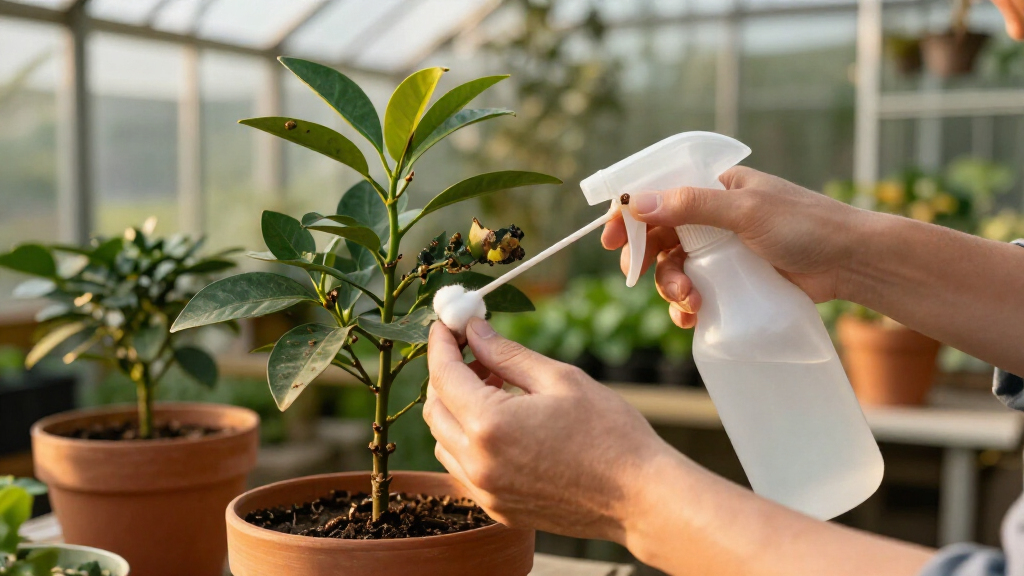
For a few insects, the report recommends physically removing them with a cotton swab and isopropyl alcohol, after testing a small area of the plant and waiting a day or two for damage. A fingernail, toothpick or soft toothbrush may help dislodge stubborn insects. For heavier infestations, horticultural oil or insecticidal soap may be used if the product label permits it; thorough coverage of stems and both leaf surfaces is advised. Follow the product label, including directions on protective equipment, plant suitability and repeat applications.
Why Fall Plant Checks Matter
Moving an infested plant indoors can bring scale into a setting where, according to the report, outdoor cold and predators no longer limit it in the same way. The insects can spread to nearby plants when leaves touch and may also be carried on hands or tools. Early inspection and isolation can reduce the chance that one outdoor plant becomes a problem across a collection of houseplants.
Control can take time because adult scale insects are sheltered beneath hard or waxy coverings that may keep sprays from reaching them. Newly hatched crawlers lack that covering and are more vulnerable, but the report says hatching continues over winter. Readers should treat a spray as one step in a monitoring plan, not a guaranteed one-time fix.
Care is especially relevant for edible plants such as citrus and bay laurel. The report says some products are not labeled for plants intended for consumption. Check the label before applying anything, and do not use a product on a food plant unless its directions specifically allow that use.
handheld magnifying glass for inspecting plant pests
As an affiliate, we earn on qualifying purchases.
As an affiliate, we earn on qualifying purchases.
How Scale Spreads Indoors
The report says scale’s mobile stage is the young crawler: a tiny insect, often yellow or orange, that wanders briefly before settling to feed. Crawlers can move between pots where foliage touches and may travel on hands or pruning tools. Adults generally remain attached to a stem or leaf under a protective cover, which can make them look like rough spots rather than insects.
Plants singled out for careful checks include citrus, jade, hibiscus, ficus, bay laurel, oleander and orchids, as well as other tropical houseplants. Plants that spent summer close together outdoors deserve particular attention. The report recommends beginning inspections before cold nights prompt the move indoors, then checking plants weekly through winter—including those with no previous visible signs.
Its treatment guidance says a common schedule for oil or soap is two or three applications 10 to 16 days apart, but the product label takes precedence. The report also warns that insecticidal soap can damage jade plants and ferns. It advises testing products on a few leaves first and avoiding broad-spectrum insecticides indoors when hand removal and labeled oil or soap can address the problem.
““The best time for controlling scale insects is before the pots come inside.””
— Gardening Know How report
cotton swabs for applying isopropyl alcohol to houseplants
As an affiliate, we earn on qualifying purchases.
As an affiliate, we earn on qualifying purchases.
What Treatment Can’t Guarantee
The source provides general prevention and treatment advice, not a forecast of how common scale is in any particular area or a guarantee that a specific method will work on every plant. Results can depend on the scale species, the extent of infestation, plant sensitivity and the product used. Adults may survive spraying, and further crawlers can hatch after an application.
The report does not identify a single treatment appropriate for every houseplant or edible crop. Product labels determine permitted plants, application rates, protective equipment and timing. It also says that plants heavily covered with scale may be better discarded, but does not set a precise threshold for when a plant is beyond treatment. Readers should assess the plant and follow the label rather than assume that one spray or one inspection resolves the problem.
ready-to-use horticultural oil spray for houseplants labeled for scale insects
As an affiliate, we earn on qualifying purchases.
As an affiliate, we earn on qualifying purchases.
Inspect and Recheck Through Winter
Before moving outdoor plants inside, inspect stems, new growth, leaf joints and the undersides of leaves, using a magnifying glass if available. Separate any plant with suspected scale from the rest and clean hands and tools after handling it. For limited infestations, remove visible insects and check the plant again; for heavier cases, use only a treatment labeled for that plant and follow its instructions.
Continue weekly checks throughout winter, including on plants that initially appeared clear. Keep an affected plant separate until several weekly inspections find no new scale, as the report advises. A strip of double-sided tape around a stem may catch crawling insects, but the report says sticky traps designed for flying pests are not a useful way to monitor scale.
insecticidal soap spray for houseplants labeled for scale insects
As an affiliate, we earn on qualifying purchases.
As an affiliate, we earn on qualifying purchases.
Key Questions
What should I look for before bringing plants indoors?
Check stems, leaf veins and the undersides of leaves for small brown, tan, white or black bumps. Use a magnifying glass where possible, and look for sticky honeydew, yellowing leaves or leaf drop.
Can I remove a small number of scale insects without spraying?
The report recommends trying careful hand removal with a cotton swab and isopropyl alcohol, or using a fingernail, toothpick or soft toothbrush. Test alcohol on one leaf and wait a day or two to check for damage.
How often should a plant be treated?
The report describes two or three rounds spaced 10 to 16 days apart as a common schedule for oil or insecticidal soap. The product label takes precedence, and the report advises testing the product on a few leaves first.
Are oil and soap treatments suitable for every plant?
No. The report warns that insecticidal soap can damage jade plants and ferns, and says some products are not labeled for edible plants. Check the label for the plant, use and required protective equipment before applying a treatment.
Source: rss
Fall yard work Picks
leaf blowers
As an affiliate, we earn on qualifying purchases.