
The best soil aerators loosen compacted ground in a way that matches your lawn size, soil condition, and willingness to do the work. My best overall pick is the Manual Lawn Aerator with Non-Clogging Hollow Tines, which pairs core aeration with a design aimed at reducing a common chore: clearing plugged tines. For larger lawns, the Brinly 40-Inch Tow-Behind Spike Aerator covers more ground behind a compatible riding mower, while the Bigwish Stainless Steel Manual Lawn Core Aerator is a focused option for small areas that need soil plugs removed. The main tradeoff is between core aeration, which extracts plugs, and spike tools, which make holes without removing soil; powered coverage, ease of handling, and upkeep also differ. Read on for the full breakdown and help matching an aerator to your yard.

Get garden gear delivered free with Prime
- Fast, free delivery on millions of items
- Prime Video, Amazon Music and more included
- Member-only deals all year
Complete the kit


Key Takeaways
- Hollow-tine tools lead this roundup for compacted lawns: the non-clogging manual core aerator and Bigwish’s four hollow tines remove soil plugs rather than only puncturing the surface.
- Large lawns change the value equation: the 40-inch Brinly tow-behind covers more width per pass, but it requires a compatible mower and is less suited to tight or obstacle-filled yards.
- Spike count alone does not tell the whole story: 21-spike and 42-spike designs can make many punctures, but they do not extract cores, and their usefulness depends on soil moisture and ground conditions.
- Rolling designs trade foot pressure for repeated passes: VEVOR and the Walensee 42-spike roller suit users who prefer walking the lawn, while manual foot-operated tools focus effort on smaller patches.
- Liquid treatment is a different kind of choice: LawnStar avoids mechanical puncturing, but buyers seeking visible soil cores or direct physical holes should choose a mechanical aerator instead.
| Manual Lawn Aerator with Non-Clogging Hollow Tines |  | Best for Compacted Soil | Tine count: 3 | Maximum aeration depth: 4 inches | Tine type: Hollow, clog-ejecting, replaceable | VIEW LATEST PRICE | See Our Full Breakdown |
| YIYOUPENG Manual Lawn Aerator with 21 Tines |  | Best for Faster Manual Coverage | Tine count: 21 | Tine length: 2.4 inches (6.1 cm) | Frame material: Metal with rust-resistant powder coating | VIEW LATEST PRICE | See Our Full Breakdown |
| Brinly 40-Inch Tow-Behind Spike Aerator with Transport Wheels |  | Best for Large Lawns and Tow Vehicles | Working width: 40 inches | Tine design: 11 galvanized steel stars with 3-D tines | Maximum penetration depth: 2 inches | VIEW LATEST PRICE | See Our Full Breakdown |
| VEVOR Rolling Lawn Core Aerator, 16.6-in Anti-Clog Tines, Rust-Resistant | 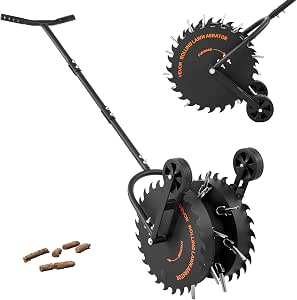 | Best Rolling Core Aerator | Tine length: 16.6 inches | Stated soil plug depth: 2 inches | Maximum drum weight capacity: 46 pounds | VIEW LATEST PRICE | See Our Full Breakdown |
| Lawn Core Aerator with Three Replaceable Hollow Tines |  | Best Simple Maintenance Pick | Type: Manual core aerator | Tines: 3 hollow, replaceable tines | Tine material: Heat-treated hollow steel | VIEW LATEST PRICE | See Our Full Breakdown |
| Myrvok Manual Lawn Aerator with 21 Metal Spikes |  | Best for Broad Spike Coverage | Spike count: 21 | Material: High-strength metal | Dimensions: 14.4 x 3.55 x 38.6 inches | VIEW LATEST PRICE | See Our Full Breakdown |
| Bigwish Stainless Steel Manual Lawn Core Aerator with 4 Hollow Tines |  | Best for Removing Soil Plugs | Tines: 4 hollow tines | Material: Stainless steel | Power source: Manual | VIEW LATEST PRICE | See Our Full Breakdown |
| Manual Lawn Aerator with 11 Steel Spikes |  | Best for Serviceable Spike Aeration | Spike count: 11 | Tine depth: Up to 3.5 inches | Material: Reinforced steel | VIEW LATEST PRICE | See Our Full Breakdown |
| Walensee 15-Spike Manual Lawn Aerator |  | Best Lightweight Pick for Small Lawns | Spike count: 15 | Spike length: About 2.8 inches | Handle length: 34.6 inches | VIEW LATEST PRICE | See Our Full Breakdown |
| SENVERT Rolling Lawn Aerator with Auxiliary Wheels |  | Best Rolling Option for Larger Lawn Passes | Aerator weight: 32 pounds | Maximum weight with added sand or stones: 55 pounds | Item weight: 38.3 pounds | VIEW LATEST PRICE | See Our Full Breakdown |
| Jardineer 36-Inch Manual Lawn Spike Aerator |  | Best for Easier Upright Use | Spike count: 12 | Spike length: 2.75 inches | Overall height: 36 inches | VIEW LATEST PRICE | See Our Full Breakdown |
| LawnStar Liquid Lawn Aerator and Soil Conditioner, 32 fl oz |  | Best No-Spike Alternative | Form: Liquid | Liquid volume: 32 fluid ounces | Application method: Spray | VIEW LATEST PRICE | See Our Full Breakdown |
| Walensee Rolling Lawn Aerator with 42 Spikes |  | Best for Rolling Coverage | Spike count: 42 | Spike length: 2 inches | Spike material: Heat-treated reinforced steel | VIEW LATEST PRICE | See Our Full Breakdown |
| Heavy-Duty Steel Hollow-Tine Lawn Aerator, Blue |  | Best Manual Core Aerator | Material: Industrial-strength steel | Tine type: Hollow, beveled, replaceable | Number of tines: 3 | VIEW LATEST PRICE | See Our Full Breakdown |
| Qsxou Manual Lawn Aerator with 11 Steel Spikes |  | Best for Mixed Soil Types | Brand: Qsxou | Model: SPLA-01 | Material: Powder-coated steel | VIEW LATEST PRICE | See Our Full Breakdown |
| soil aerator | Model | Dimensions | Material |
|---|---|---|---|
| Manual Lawn Aerator with Non-C | LR-ALT4-Yellow-V1 | 15.6 x 10.5 x 2.8 inches | — |
| YIYOUPENG Manual Lawn Aerator | S | 15 x 5 x 39 inches | — |
| Brinly 40-Inch Tow-Behind Spik | — | — | — |
| VEVOR Rolling Lawn Core Aerato | TI-038 | — | Iron with powder-coated finish |
| Lawn Core Aerator with Three R | LV-ALT4-ORANGE-Z0 | 15 x 10 x 2.8 inches | — |
| Myrvok Manual Lawn Aerator wit | AERATOR02 | 14.4 x 3.55 x 38.6 inches | High-strength metal |
| Bigwish Stainless Steel Manual | BW-dakong-T4 | — | Stainless steel |
| Manual Lawn Aerator with 11 St | STQ-001 | 16.34 x 10.24 x 6.1 inches | Reinforced steel |
| Walensee 15-Spike Manual Lawn | GTL-111 | 3.62 x 1.54 x 13.62 inches | Iron |
| SENVERT Rolling Lawn Aerator w | JX-002 | 20.5 x 14 x 49 inches | — |
| Jardineer 36-Inch Manual Lawn | — | — | Powder-coated steel |
| LawnStar Liquid Lawn Aerator a | — | — | — |
| Walensee Rolling Lawn Aerator | — | — | — |
| Heavy-Duty Steel Hollow-Tine L | HC-ALT-Blue-Z0 | 15.7 x 10 x 2.7 inches | Industrial-strength steel |
| Qsxou Manual Lawn Aerator with | SPLA-01 | — | Powder-coated steel |
More Details on Our Top Picks
Manual Lawn Aerator with Non-Clogging Hollow Tines
For a small or medium lawn with firm, compacted patches, this manual core aerator has a useful advantage over spike tools: its three hollow tines remove soil plugs rather than simply pressing holes into the ground. The ejecting design helps clear plugs as you work, while the 4-inch maximum depth reaches deeper than the Brinly tow-behind aerator’s 2-inch penetration. A wide footplate and reinforced steel frame give you a solid platform for applying body weight, and the 37-inch handle keeps the working posture more upright. That pressure still comes from you, though, so dry soil needs watering first and repeated stepping can be hard work. Compared with the three-tine Lawn Core Aerator with Three Replaceable Hollow Tines, this model specifies its clog-ejecting action and reinforced frame, making it the stronger fit for tougher ground.
Pros:- Hollow tines remove soil plugs instead of only puncturing the surface.
- Cloj-ejecting tine design helps limit buildup during use.
- Replaceable tines support maintenance over time.
- Wide footplate and reinforced steel frame support forceful stepping.
Cons:- Dry or hard soil needs watering before the tines can penetrate effectively.
- Manual stepping takes sustained effort, especially across larger areas.
Best for: Homeowners treating compacted lawn patches who want a manual core aerator with deeper stated reach and replaceable, clog-ejecting tines.
Not ideal for: People aerating a large lawn or unwilling to use body weight repeatedly; choose a tow-behind tool such as the Brinly instead if you have a suitable tow vehicle.
- Tine count:3
- Maximum aeration depth:4 inches
- Tine type:Hollow, clog-ejecting, replaceable
- Construction:Welded steel with reinforced triangular structure
- Handle:37 inches tall, T-handle with non-slip rubber grips
- Dimensions:15.6 x 10.5 x 2.8 inches
- Weight:3.54 pounds
- Model:LR-ALT4-Yellow-V1
Our verdict“Choose this model for compacted areas where plug removal and a stated 4-inch reach matter more than avoiding manual effort.”
YIYOUPENG Manual Lawn Aerator with 21 Tines
The YIYOUPENG suits buyers who want to cover more ground per step without moving to a tow-behind machine. Its 21 sharp tines spread the work across a wider contact area than the three-tine Manual Lawn Aerator with Non-Clogging Hollow Tines, so it can make many openings in each pass. The five-spring mechanism resets after a step, and the adjustable foot pedal offers room to adapt the stance to different users or soil conditions. Those advantages do not make it a core aerator: its 2.4-inch tines loosen soil but do not have the specified hollow plug-removal action of the three-tine tools. The metal frame and powder coating favor repeated seasonal use, but the tool still requires stepping, and the instructions call for moist soil. Choose it for broad, routine coverage rather than deep compaction relief.
Pros:- Twenty-one tines create many openings with each step.
- Five-spring mechanism resets between steps.
- Four-position adjustable foot pedal helps accommodate different working stances.
- Powder-coated metal frame is designed to resist rust.
Cons:- The 2.4-inch tines are shorter than the stated reach of the four-inch manual core aerator.
- Requires repeated stepping and moist soil for easier penetration.
- Spike-style action does not remove soil plugs.
Best for: Lawn owners with small or medium yards who want many surface openings per step and prefer a spring-reset manual tool.
Not ideal for: Buyers seeking deep core aeration or removal of soil plugs; the three-tine hollow-core models are better aligned with that job.
- Tine count:21
- Tine length:2.4 inches (6.1 cm)
- Frame material:Metal with rust-resistant powder coating
- Spring design:Five-spring, double-layer mechanism
- Foot pedal:Four-position adjustable
- Dimensions:15 x 5 x 39 inches
- Weight:7.7 pounds
- Model:S
Our verdict“Pick the YIYOUPENG for wider manual spike coverage, not for deep core aeration or plug extraction.”
Brinly 40-Inch Tow-Behind Spike Aerator with Transport Wheels
For a broad lawn and a compatible tractor or other tow vehicle, the Brinly trades hand-stepping for a 40-inch working width. Its 11 independently rotating stars keep turning through tractor turns, while the lever-engaged transport wheels make it easier to cross hard surfaces without dragging the tines. A tray that holds up to 150 pounds of added weight lets you increase pressure when the ground calls for it, although that added weight is not included. This is a spike aerator, not a core tool: its 3-D tines penetrate up to 2 inches, while the Manual Lawn Aerator with Non-Clogging Hollow Tines removes plugs and lists a deeper reach. The Brinly is the more practical choice for covering extensive turf, but only if you already have the tow equipment and accept a shallower, spike-based result.
Pros:- Forty-inch working width covers broad areas in fewer passes.
- Weight tray accepts up to 150 pounds to increase tine pressure.
- Lever-engaged transport wheels help cross sidewalks and driveways.
- Galvanized 3-D steel tines and a solid steel axle support durable use.
Cons:- Requires a compatible tow vehicle.
- The 150-pound tray load is additional weight, not included.
- Maximum stated penetration is 2 inches, and the tines do not extract soil plugs.
Best for: Owners of large lawns who already have a compatible tow vehicle and want broad, tow-behind spike aeration.
Not ideal for: Small-yard owners without a tow vehicle or anyone prioritizing deep plug removal; a manual hollow-tine aerator is a better match for those needs.
- Working width:40 inches
- Tine design:11 galvanized steel stars with 3-D tines
- Maximum penetration depth:2 inches
- Weight tray capacity:150 pounds
- Axle:5/8-inch solid steel
- Frame:All steel with double tow bar
- Transport wheels:Turf-tread, lever-engaged
- Warranty:2 years
Our verdict“Choose the Brinly for large lawns when tow equipment is available and wide coverage outweighs deeper core aeration.”
VEVOR Rolling Lawn Core Aerator, 16.6-in Anti-Clog Tines, Rust-Resistant
The VEVOR offers a middle ground between hand-stepped hollow tines and the Brinly tow-behind spike aerator: it rolls under your guidance and uses angled tines to pull soil plugs. Its drum can take up to 46 pounds of sand or water, adding downward pressure without requiring you to press each tine into the ground with a foot. Rubber wheels and a 58-inch handle help with rolling and upright operation, a meaningful contrast with the smaller handheld Lawn Core Aerator with Three Replaceable Hollow Tines. The tradeoff is bulk: the unit itself weighs 36.6 pounds, and filling the drum adds setup and handling demands. Its stated plug depth is 2 inches, shallower than the 4-inch reach listed for the Manual Lawn Aerator with Non-Clogging Hollow Tines. This is a better fit for rolling across accessible lawn areas than for tight spaces or frequent carrying.
Pros:- Angled anti-clog tines pull soil plugs for core aeration.
- Fillable drum adds up to 46 pounds of pressure.
- Rubber wheels support rolling rather than repeated foot placement.
- 58-inch handle supports a more upright working posture.
Cons:- The 36.6-pound unit is cumbersome to carry, especially with the wheels removed.
- Adding sand or water takes time and increases handling weight.
- Manual rolling can still be tiring across a large lawn.
Best for: Homeowners who want a rolling, weighted core aerator and can manage a heavier tool across open lawn.
Not ideal for: People with narrow or obstacle-filled yards, frequent stairs, or a need for deeper-than-two-inch plug extraction; a lightweight manual core tool is easier to maneuver.
- Tine length:16.6 inches
- Stated soil plug depth:2 inches
- Maximum drum weight capacity:46 pounds
- Item weight:36.6 pounds
- Handle length:58 inches
- Material:Iron with powder-coated finish
- Wheel type:Removable rubber wheels
- Model:TI-038
Our verdict“Choose the VEVOR if you want rolling core aeration with added drum pressure and have room to maneuver a heavy tool.”
Lawn Core Aerator with Three Replaceable Hollow Tines
This is the straightforward choice for routine core aeration on a modest lawn: three hollow, replaceable tines remove plugs, and a non-slip ergonomic handle gives you control as you step the tool into the ground. Its design resembles the Manual Lawn Aerator with Non-Clogging Hollow Tines, but the available product details do not specify that model’s clog-ejecting action, reinforced triangular frame, or four-inch maximum depth. That makes the orange model a simpler pick rather than the more clearly equipped option for dense soil. It also needs careful use: water dry ground first, keep the plastic inserts in place for plug release, and avoid rocking or twisting the tool while it is embedded. Those handling limits and the manual effort make it less suited to hard, extensive lawns, but replaceable tines are useful for ongoing upkeep.
Pros:- Hollow tines remove soil plugs for core aeration.
- Replaceable tines support maintenance when parts wear.
- Ergonomic non-slip handle supports grip and control.
- Metal frame and heat-treated tines provide a sturdy basic construction.
Cons:- Dry soil needs watering before use.
- Must not be rocked, twisted, or pried while embedded.
- Plastic inserts need to remain in place to aid plug release.
Best for: Homeowners maintaining a small lawn who want a basic manual core aerator with replaceable hollow tines.
Not ideal for: Buyers tackling very compacted ground or seeking a specified deep reach and clog-ejecting design; the yellow three-tine model provides clearer support for those demands.
- Type:Manual core aerator
- Tines:3 hollow, replaceable tines
- Tine material:Heat-treated hollow steel
- Frame material:Metal
- Handle:Ergonomic, non-slip
- Dimensions:15 x 10 x 2.8 inches
- Color:Orange
- Model:LV-ALT4-ORANGE-Z0
Our verdict“Pick this model for routine small-lawn core aeration if you value replaceable tines and can follow its careful-use requirements.”
Myrvok Manual Lawn Aerator with 21 Metal Spikes
The 21-spike layout gives this Myrvok a wider working pattern than the 11-spike Manual Lawn Aerator, which can mean fewer placements across a small lawn. Its spring-assisted handle is intended to soften the effort and impact of pressing the spikes into soil, while the debris-separating base helps limit buildup between passes. That combination makes it a useful pick for homeowners who want a manual spike tool with extra coverage and easier cleanup. It is not a plug-removing core aerator like the Bigwish, however: the spikes make holes without extracting soil, so it suits routine surface aeration better than lawns needing soil cores removed. Dry, dense ground should be watered ahead of use, and the tool still calls for bending and repeated manual work. Its 8.3-pound weight and disassembly option balance portability with a sturdy feel.
Pros:- 21 metal spikes cover a wider pattern per placement than the 11-spike Manual Lawn Aerator.
- Spring-assisted handle is designed to reduce effort and impact during use.
- Debris-separating base helps limit soil buildup and simplify cleaning.
- Disassembles for compact storage and transport.
Cons:- Spikes do not remove soil cores, unlike the Bigwish four-hollow-tine model.
- Dry, dense soil should be watered one to two days before use.
- Manual operation still involves bending and repeated physical effort.
Best for: Homeowners with small to medium lawns who want broad spike coverage, easier cleanup, and a tool that stores compactly.
Not ideal for: People who need core aeration to remove soil plugs, or who cannot bend and apply repeated downward pressure.
- Spike count:21
- Material:High-strength metal
- Dimensions:14.4 x 3.55 x 38.6 inches
- Weight:8.3 pounds
- Handle:Ergonomic, spring-assisted
- Assembly time:About 3 minutes
- Model:AERATOR02
Our verdict“Choose the Myrvok if you want wide spike coverage and compact storage, but pick a hollow-tine aerator if removing soil plugs is your priority.”
Bigwish Stainless Steel Manual Lawn Core Aerator with 4 Hollow Tines
The Bigwish earns its place for buyers who want core aeration, not just holes pressed into the ground. Its four hollow tines remove soil plugs, and the automatic ejection design releases them without the same manual clearing routine associated with simpler tools. That makes it a different choice from the Myrvok 21-spike aerator, which covers a broader pattern but leaves soil in place. Stainless steel construction is designed to resist rust, while the adjustable T-handle and padded grip give users more flexibility in hand position. The tradeoff is that four tines work a smaller pattern at a time than a multi-spike tool, and pushing them into firm ground takes physical effort. Watering the lawn one to two days before use can help. I’d favor this for targeted core work, not for someone seeking the quickest way to cover a large lawn.
Pros:- Four hollow tines remove soil plugs rather than merely pressing holes into the lawn.
- Automatic core ejection reduces manual clearing between placements.
- Stainless steel construction is designed to resist rust.
- Adjustable-height T-handle with padded, non-slip grip supports a more tailored hold.
Cons:- Four tines cover a smaller pattern per placement than the Myrvok 21-spike tool.
- Manual insertion takes physical effort, especially in firm soil.
- Watering one to two days beforehand is recommended for easier penetration.
Best for: Homeowners who want to remove soil plugs from compacted lawn patches and prefer an adjustable, padded handle.
Not ideal for: Buyers covering a large lawn quickly or anyone who wants a low-effort tool for very firm, dry ground.
- Tines:4 hollow tines
- Material:Stainless steel
- Power source:Manual
- Handle:Adjustable-height T-shaped handle with padded, non-slip grip
- Design feature:Automatic soil-core ejection
- Color:Deep green
- Model:BW-dakong-T4
Our verdict“Pick the Bigwish for targeted aeration that removes soil plugs; choose a spike tool instead if wider coverage matters more than core removal.”
Manual Lawn Aerator with 11 Steel Spikes
This 11-spike model is a practical choice for compact residential lawns where serviceable construction matters as much as penetration. Its spikes reach up to 3.5 inches, and the kick-to-unclog feature is meant to clear soil buildup during use. Unlike the Walensee 15-Spike Manual Lawn Aerator, it offers fewer spikes per placement but a stated deeper reach and a bolt-on base that can be serviced or replaced. The adjustable handle and pre-assembled setup make it approachable for routine spot work, though the user must step on the tool to drive it into the soil. That repeated pressure can become tiring over a larger area. It is also positioned for compact lawns rather than extensive aeration jobs. I’d choose it over the Myrvok when a replaceable base and specified tine depth matter more than a higher spike count.
Pros:- 11 reinforced steel spikes reach up to 3.5 inches.
- Kick-to-unclog design helps clear soil buildup during use.
- Bolt-on base and hardware can be serviced or replaced.
- Arrives pre-assembled and has an adjustable handle.
Cons:- Requires repeated stepping to drive the spikes into the lawn.
- Designed for compact lawns and residential work, not large areas.
- Creates spike holes rather than removing soil cores.
Best for: Owners of compact residential lawns who want a manual spike aerator with a stated 3.5-inch reach and serviceable base.
Not ideal for: People aerating a large lawn or those unable to repeatedly step down on a tool to penetrate the soil.
- Spike count:11
- Tine depth:Up to 3.5 inches
- Material:Reinforced steel
- Base construction:Bolt-on
- Handle:Adjustable
- Dimensions:16.34 x 10.24 x 6.1 inches
- Weight:8.34 pounds
- Model:STQ-001
Our verdict“Choose this model for maintainable, deeper-reaching spike aeration on a compact lawn, but skip it if you need core removal or broad-area speed.”
Walensee 15-Spike Manual Lawn Aerator
At 4.49 pounds, the Walensee is the lightest, straightforward choice in this group for spot aeration and small lawns. Its 15-spike layout covers more ground per placement than the 11-spike Manual Lawn Aerator, while the foot pedal and 34.6-inch handle give the user leverage without making the tool a heavy carry. A cushioned T-handle and detachable design add comfort and easier storage. The compromise is its intended use: spike length is about 2.8 inches, and the product is not recommended for rocky ground, heavy clay, or large areas. Compared with the Myrvok, it is lighter and has a foot pedal, but it has fewer spikes and no stated spring-assisted handle or debris-separating base. Softened soil is the better setting; hard or dry ground should be watered before use.
Pros:- 15 spikes cover more ground per placement than the 11-spike Manual Lawn Aerator.
- Foot pedal and long handle provide leverage while reducing the need to bend.
- Cushioned T-handle supports a more comfortable grip.
- Detachable design makes carrying and storage easier.
Cons:- Not recommended for heavy sticky clay, rocky ground, or large-scale aeration.
- Spikes are about 2.8 inches long, shorter than the stated 3.5-inch reach of the 11-spike model.
- Hard or dry soil should be watered before use.
Best for: People with small lawns or isolated compacted patches who value a lightweight tool, foot-pedal leverage, and easy storage.
Not ideal for: Owners of large lawns, rocky yards, or heavy sticky clay who need deeper or more extensive aeration.
- Spike count:15
- Spike length:About 2.8 inches
- Handle length:34.6 inches
- Material:Iron
- Design:Three-row spike layout with cushioned T-handle and foot pedal
- Dimensions:3.62 x 1.54 x 13.62 inches
- Item weight:4.49 pounds
- Model:GTL-111
Our verdict“Choose the Walensee for lightweight spot aeration on softer soil, but select a more robust tool for clay, rocky ground, or a large lawn.”
SENVERT Rolling Lawn Aerator with Auxiliary Wheels
The SENVERT suits buyers who would rather push an aerator across the lawn than repeatedly place a handheld tool. Its spiral-pattern spikes are designed for rolling passes, and added sand or stones can raise the working weight from 32 pounds to a maximum of 55 pounds for greater pressure on the soil. Auxiliary wheels help move it over hard surfaces without dragging the spikes, a useful distinction from the stationary Myrvok and Walensee tools. The rolling format can make longer passes more natural, but it does not remove soil plugs like the Bigwish hollow-tine aerator. It also requires manual pushing, and the added load means this is not the light, easy-carry choice. The main body arrives assembled, though the handle still needs attachment. Use sand or stones only; the product instructions specify not to add water.
Pros:- Rolling format supports continuous passes instead of repeated handheld placements.
- Can be loaded with sand or stones to increase weight for soil penetration.
- Auxiliary wheels help move it over hard surfaces without dragging the spikes.
- Main body arrives assembled; only the handle needs attachment.
Cons:- Still requires manual pushing and can weigh up to 55 pounds when loaded.
- Does not remove soil cores like the Bigwish four-hollow-tine aerator.
- Must not be filled with water, and the handle needs attachment before use.
Best for: Homeowners with a lawn suited to rolling passes who want adjustable downward weight and wheels for moving the tool between work areas.
Not ideal for: People who need plug-removing core aeration, cannot push a heavy tool, or want a compact, lightweight option for spot work.
- Aerator weight:32 pounds
- Maximum weight with added sand or stones:55 pounds
- Item weight:38.3 pounds
- Dimensions:20.5 x 14 x 49 inches
- Spike pattern:Spiral-pattern spikes
- Wheel material:TPR
- Setup:Main body assembled; attach handle
- Model:JX-002
Our verdict“Choose the SENVERT if you want a weighted rolling tool for longer lawn passes, but opt for a handheld core aerator if soil-plug removal is the goal.”
Jardineer 36-Inch Manual Lawn Spike Aerator
The 36-inch handle and standing, step-on design make this a sensible choice for lawn owners who want to aerate without repeatedly bending down. Its 12 steel spikes are longer than the Walensee roller’s 2-inch spikes, while the foot plate lets you use body weight to drive them into suitably moist soil. Unlike a rolling aerator, it works in targeted steps rather than covering ground by pushing a drum, so it may suit smaller areas or spots that need attention. The tradeoff is pace: you must step and reposition it across the lawn, and the manufacturer recommends moistening soil first. At 4.69 pounds, it is lighter to store than the stone-weighted Walensee roller, but it still requires physical effort for each placement.
Pros:- 36-inch handle supports a more upright working posture.
- 12 spikes measuring 2.75 inches long reach deeper than the Walensee roller’s 2-inch spikes.
- Steel foot plate helps transfer body weight into the soil.
- Detachable, pre-assembled design makes setup and storage straightforward.
Cons:- Step-by-step operation is slower than rolling across a lawn.
- Dry or hard soil can make spike penetration difficult; moistening the lawn is recommended.
Best for: Homeowners with small to medium lawns who want a long-handled manual tool for spot aeration and easier upright use.
Not ideal for: People aerating large lawns quickly or those who cannot repeatedly step down and reposition a manual tool.
- Spike count:12
- Spike length:2.75 inches
- Overall height:36 inches
- Material:Powder-coated steel
- Grip:Rubber
- Product dimensions:15 x 11 x 5 inches
- Item weight:4.69 pounds
- Assembly and storage:Pre-assembled; detachable for storage
Our verdict“Choose the Jardineer for upright, targeted aeration on a manageable lawn, but pick a roller for faster coverage.”
LawnStar Liquid Lawn Aerator and Soil Conditioner, 32 fl oz
The LawnStar takes a different route from the manual tools in this roundup: it is a spray-applied liquid conditioner, not a device that physically drives spikes or hollow tines into the ground. That makes it a possible fit for lawn owners seeking an application that does not involve stepping across the yard with a tool, and its stated 30,000-square-foot coverage suits broad areas. By comparison, the Jardineer and Qsxou require repeated manual placement but provide direct mechanical soil penetration. LawnStar must be diluted at a 1:1024 ratio before spraying, so application depends on careful mixing and suitable spray equipment. Coverage information is also inconsistent, listed as both 30,000 and 32,000 square feet. Buyers who specifically want core removal or spike-made openings should choose a mechanical aerator instead.
Pros:- Liquid format avoids operating a step-on or rolling aerator.
- Concentrated formula is listed to cover up to 30,000 square feet.
- Spray application can cover a broad lawn without repositioning a manual tool.
- Designed to support water uptake, drainage, and soil oxygenation.
Cons:- Must be mixed at a 1:1024 ratio before application.
- Listed coverage is inconsistent between 30,000 and 32,000 square feet.
- Does not use spikes or hollow tines to mechanically penetrate soil or remove cores.
Best for: Owners of larger lawns who prefer a spray-applied soil conditioner over walking and operating a manual aerator.
Not ideal for: Buyers who want physical spike penetration or extracted soil cores, or who do not want to measure and mix a concentrate.
- Form:Liquid
- Liquid volume:32 fluid ounces
- Application method:Spray
- Mixing ratio:1:1024
- Listed coverage:30,000 square feet; product information also lists 32,000 square feet
- Target species:Lawn grass
- Item weight:2.2 pounds
- Included components:Bottle
Our verdict“Choose LawnStar if you want a spray-applied alternative for a large lawn, not if your priority is mechanical aeration.”
Walensee Rolling Lawn Aerator with 42 Spikes
For buyers who would rather push than repeatedly step down on a tool, the Walensee offers 42 spikes across a rolling drum and an adjustable handle. Its spiral tine layout is designed to keep the roller moving smoothly, giving it a different workflow from the Jardineer, which is better for targeted step-by-step work. The Walensee’s 2-inch spikes are shorter than the Jardineer’s 2.75-inch spikes, and the roller’s results depend partly on adding weight: it can be filled with stones, but sand is forbidden. That setup adds preparation and handling, while the 11.82-pound frame is heavier to store than the Jardineer. The maker also advises against hard, clay, root-covered, or stony ground, so this is best for a prepared lawn with moist, workable soil rather than difficult terrain.
Pros:- 42 spikes let the roller work across a broader path with each pass.
- Spiral tine layout is designed for smooth, stable rolling.
- Adjustable handle and rubber grip support a more comfortable working posture.
- Stone-filled roller can add weight to help spikes penetrate.
Cons:- Requires moist soil and is not recommended for hard, clay, root-covered, or stony ground.
- Roller may be filled with stones only; sand is forbidden.
- At 11.82 pounds, it is heavier to move and store than the Jardineer manual spike tool.
Best for: Owners of open, workable lawns who want to roll across the grass instead of repositioning a step-on aerator at every spot.
Not ideal for: People with hard, clay, root-filled, or stony soil, or buyers who do not want to load and handle a stone-weighted roller.
- Spike count:42
- Spike length:2 inches
- Spike material:Heat-treated reinforced steel
- Roller material:High-grade steel
- Handle:Four-part adjustable handle with non-slip rubber grip
- Roller filling:Stones only; sand is forbidden
- Item weight:11.82 pounds
- Package dimensions:17.25 x 12 x 9.75 inches
- Included accessories:Tools and two extra cotter pins
Our verdict“Choose the Walensee for rolling coverage on a moist, open lawn if you are willing to add stones and avoid unsuitable ground.”
Heavy-Duty Steel Hollow-Tine Lawn Aerator, Blue
This is the mechanical pick in this group for buyers who want to remove soil plugs rather than make spike holes. Its three hollow, beveled tines extract cores, setting it apart from the Jardineer and Qsxou, which use solid spikes to open the soil without removing material. The replaceable tines are a useful long-term feature: wear does not automatically mean replacing the whole tool. A wide foot plate helps apply pressure, though the three-tine layout covers less ground per placement than the Walensee’s 42-spike roller. It also calls for deliberate technique: the tines should move vertically, since sideways twisting or prying can damage them. Simple assembly is required, and manual core aeration still takes repeated effort across the lawn.
Pros:- Three hollow, beveled tines remove soil cores rather than only puncturing the ground.
- Replaceable tines can extend the useful life of the tool.
- Wide foot plate helps apply downward pressure.
- Comfort-grip handle is designed to reduce hand fatigue.
Cons:- Manual operation requires repeated effort and repositioning.
- Sideways twisting or prying can damage the tines.
- Requires simple assembly before use.
Best for: Lawn owners who specifically want a manual core aerator with replaceable hollow tines for compacted spots or smaller areas.
Not ideal for: People seeking fast coverage across a large lawn, or anyone unwilling to use careful vertical strokes and assemble the tool.
- Material:Industrial-strength steel
- Tine type:Hollow, beveled, replaceable
- Number of tines:3
- Dimensions:15.7 x 10 x 2.7 inches
- Weight:3.52 pounds
- Color:Blue
- Model:HC-ALT-Blue-Z0
Our verdict“Choose this model over the Jardineer or Qsxou when removing soil cores matters more than the faster setup of a spike tool.”
Qsxou Manual Lawn Aerator with 11 Steel Spikes
The Qsxou is a straightforward step-on spike aerator for buyers who need a tool described as suitable for clay, sand, and loam. Its 11 spikes and foot bar make the basic job clear: press into the lawn, then lift and reposition. That is similar to the Jardineer, though the Jardineer has 12 spikes and a specified 36-inch overall height, while the Qsxou’s listed details focus on its T-handle and soil compatibility. Compared with the Walensee roller, the Qsxou is more compact in use and does not require filling a drum with stones; the tradeoff is that it covers ground one placement at a time. Dry soil should be watered before use, and spike penetration still takes physical effort. The powder-coated steel construction is designed for strength and rust resistance.
Pros:- 11-spike layout supports step-in aeration across several points per placement.
- T-handle and step-on foot bar help reduce bending.
- Powder-coated steel is designed for strength and rust resistance.
- Product information lists compatibility with clay, sand, and loam soils.
Cons:- Manual step-on operation requires repeated physical effort.
- Dry soil should be watered first for easier spike penetration.
- Step-by-step placement is slower for broad lawns than rolling the Walensee aerator.
Best for: Homeowners with clay, sand, or loam lawns who want a simple manual spike tool for spot or routine aeration.
Not ideal for: People with large lawns who want to finish in fewer passes, or buyers who cannot repeatedly press a foot bar into the soil.
- Brand:Qsxou
- Model:SPLA-01
- Material:Powder-coated steel
- Number of spikes:11
- Handle:Ergonomic T-handle
- Foot bar:Step-on foot bar
- Listed soil types:Clay, sand, and loam
- Unit count:1
Our verdict“Choose the Qsxou for targeted manual aeration across the listed soil types, but favor a roller for faster coverage on open ground.”
How We Picked
I ranked these 15 options by how well their design addresses the central job of a soil aerator: relieving compaction in a way that fits the lawn and the person using the tool. I gave more weight to core-removing hollow tines for compacted ground because they extract plugs, then considered spike aerators for buyers who want a simpler puncturing tool. I also weighed coverage, effort, handling, clog resistance, construction materials, replaceable parts, and likely maintenance needs. A high tine count or wide frame could not outweigh a mismatch between the tool and the buyer’s lawn.
The order reflects practical tradeoffs rather than a claim that one tool works best for every yard. Manual core aerators rank well for targeted work, while the Brinly tow-behind earns a distinct place for broad coverage when a suitable mower is available. Rolling and spike models rank lower for buyers who need core extraction, though they may suit lawns where a simpler tool is enough. The LawnStar liquid conditioner is treated as a different approach, not as a mechanical substitute, since it does not create holes or remove plugs.
Factors to Consider When Choosing Best Soil Aerators
Before choosing, match the aeration method to the problem you are trying to solve. A tool that is easy to store may suit a small patch but make a large lawn laborious; a wide attachment may cover ground quickly yet struggle around beds, trees, and narrow gates. These distinctions matter more than a headline tine count.
Choose Core Removal or Puncturing
Core aerators use hollow tines to pull out small soil plugs, creating openings while removing some compacted material. Spike aerators press solid points into the ground, so they can make holes without extracting soil. That difference matters most when compaction is the problem: a spike tool may be easier to use, but it does not do the same job as removing cores. Buyers sometimes choose a spike model because it has many points, then expect core-aerator results. Match the tool to the soil problem, and do not treat tine count as a substitute for tine type.
Match the Tool to Lawn Size and Obstacles
For a compact lawn or isolated worn patches, a manual tool offers control without requiring a mower attachment or storage for a wide implement. Larger open lawns favor rolling or tow-behind designs because each pass can cover more ground. The tradeoff is maneuverability: wide equipment can be awkward near borders, trees, and tight turns. Measure narrow access points and think about where the tool will be stored before choosing a large frame. A smaller tool can be the more practical choice even if it requires more passes.
Account for Effort, Not Just Coverage
Manual aeration relies on your body weight, walking pace, and repeated pressure, so the same design can feel manageable on a small area and tiring across a whole yard. Rolling tools reduce the need to press down at every individual spot, but still require steady walking and multiple passes. Tow-behind models shift much of the work to a compatible mower, though setup and turning remain part of the job. Consider your strength, mobility, and how much lawn you can realistically cover in one session. A tool that sits unused because it is too demanding is poor value regardless of its design.
Check Tine Maintenance and Replacement
Hollow tines can collect plugs, and clogged tines reduce the tool’s ability to penetrate and extract soil. Designs that address clogging may save interruptions, but they still need cleaning after use, especially in damp or sticky ground. Replaceable tines are useful when wear or damage affects one part rather than the entire tool. Before buying, check whether replacement parts are available and whether the tine layout allows access for cleaning. Treat maintenance access as part of performance, not an afterthought.
Use Soil Conditions to Set Expectations
Soil condition affects how readily tines enter the ground, so a sturdy tool cannot make every session easy. Very dry, hard ground can resist penetration, while overly wet soil can cling to tines and make the lawn messy. A common mistake is to judge an aerator only by how many spikes it carries without considering when the lawn can be worked. Plan around workable soil rather than forcing the tool through unsuitable conditions. If you are unsure, try a small area first and adjust your timing based on how the soil responds.
Treat Liquid Conditioners as a Separate Approach
A liquid soil conditioner is applied rather than pushed or rolled into the lawn, so it avoids the physical labor of making holes with a tool. That convenience does not make it interchangeable with a hollow-tine or spike aerator: it does not extract soil plugs or create mechanical punctures. Buyers who need to address compacted ground directly should decide whether they want physical aeration, a liquid treatment, or both as part of a broader lawn-care plan. Read the product directions and check lawn compatibility before applying any conditioner. Choose by the result you want, not by assuming every product labeled an aerator works the same way.
Frequently Asked Questions
Should I choose a hollow-tine aerator or a spike aerator for compacted soil?
If your main concern is compacted soil, a hollow-tine tool is usually the more direct choice because it pulls out plugs rather than only pressing holes into the ground. Spike models can suit lighter-duty or targeted puncturing, but they do not remove soil. Do not decide by the number of tines alone; a high spike count does not turn a spike tool into a core aerator. Think about how much area you need to treat and whether you can manage the effort of manual core removal.
Is a tow-behind aerator worthwhile if I already own a riding mower?
A tow-behind model can make sense when you have a large, relatively open lawn and a mower that can handle the attachment. Its wider working path reduces the need to walk each section with a manual tool. It is less appealing for small, irregular yards where trees, beds, and tight turns limit the usable width. Check the attachment and towing requirements before buying, and account for storage space. If you need precise work in scattered patches, a manual aerator may be easier to manage.
Can a rolling spike aerator replace a manual hollow-tine aerator?
Not if you specifically need to remove soil plugs: a rolling spike design punctures the ground but does not extract cores. It can be a better fit when you want to cover a lawn by walking behind a tool instead of pressing a manual device into each spot. The choice is about both method and effort, not simply whether one tool is easier to push. If you are comparing these types, decide first whether core removal is a requirement. A rolling tool’s wider coverage cannot change what its spikes do.
Do I need a different aerator for a small lawn with narrow gates?
A compact manual tool is often easier to carry, store, and position in a small or narrow-access yard than a wide tow-behind or rolling model. A large frame may not pass through gates or turn comfortably between garden beds. On the other hand, manual work can take longer if the lawn is more extensive than it first appears. Measure the tightest access point and compare it with the tool’s width before choosing. For scattered compacted patches, a targeted manual core aerator can avoid moving bulky equipment across the yard.
Can a liquid lawn aerator replace a mechanical aerator?
A liquid conditioner offers an application-based approach, but it does not physically pierce the ground or pull out soil cores. It therefore does not replace a mechanical tool when your goal is direct puncturing or plug removal. Some buyers may prefer a liquid product because it avoids manual exertion, while others want the visible, physical action of tines. Check the label for application directions and intended use rather than assuming the word aerator means the product works like a machine. Choose according to the result you need from the lawn treatment.
Conclusion
For the broadest fit, I recommend the Manual Lawn Aerator with Non-Clogging Hollow Tines as the best overall choice because it pairs core removal with attention to a common maintenance frustration. The best value depends on your lawn: the Walensee 15-Spike Manual Aerator is a straightforward pick for buyers who want a simple spike tool, while buyers seeking core removal should favor a hollow-tine design instead. For a best premium-style choice, the Brinly 40-Inch Tow-Behind Aerator makes the most sense for a large, open lawn and a compatible riding mower. Beginners with a small area may prefer a manageable manual tool and should choose hollow tines if removing plugs matters. For specific needs, pick the Bigwish four-tine core aerator for targeted manual core work, a rolling model for walk-behind coverage, or LawnStar only if you want a liquid treatment rather than mechanical aeration.