
TL;DR

Get garden gear delivered free with Prime
- Fast, free delivery on millions of items
- Prime Video, Amazon Music and more included
- Member-only deals all year
A Nov. 3 report from Laidback Gardener reviews Crassula’s mainly southern African origins, several popular species and straightforward indoor growing guidance. It describes the plants’ range of forms and explains that light, watering and drainage are central to care; specific conditions vary by species and growing environment.
Laidback Gardener published a Crassula growing guide on Nov. 3, outlining the succulent genus’s southern African origins, well-known varieties and basic indoor-care needs. The report describes Crassula as a group of plants with varied shapes, from compact trailing forms to tree-like jade plants, and says they are generally easy to grow indoors.
The report says the genus contains about 200 species and belongs to the Crassulaceae family. Crassulas come mainly from Africa, particularly South Africa and Mozambique, where they grow in rocky areas and scrubland, often in poor soils. Botanist Carl Linnaeus described the genus in 1753, according to the article. The name comes from the Latin crassus, meaning thick, a reference to the plants’ fleshy leaves and stems.
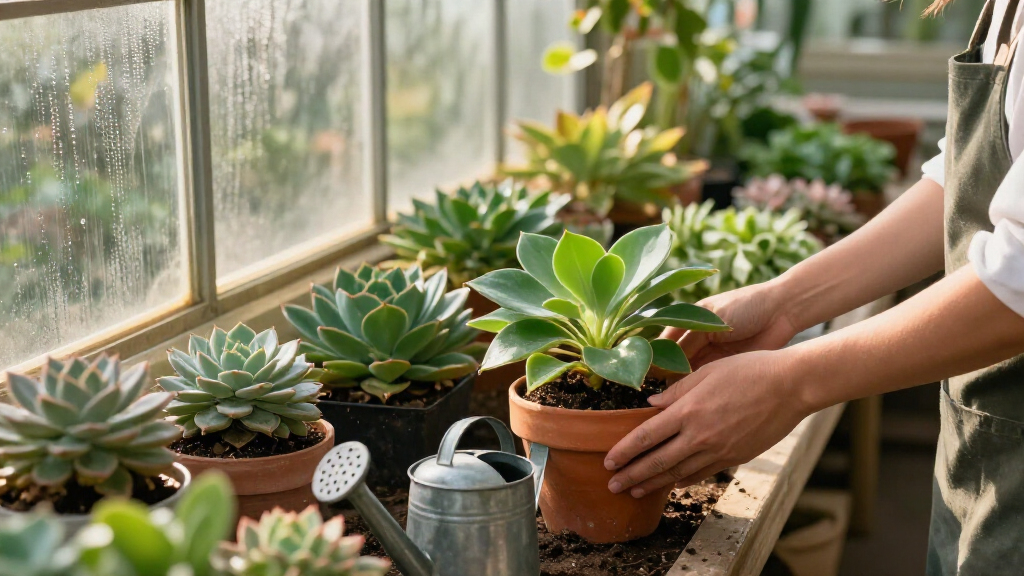
The best-known species in the report is Crassula ovata, commonly called the jade plant. It has thick brown stems and glossy, spoon-shaped green leaves; with abundant light, leaf edges can turn red. Mature plants may produce clusters of small, star-shaped flowers in pink or white. Cultivars include variegated forms and ‘Hobbit’ and ‘Gollum’, whose leaves are tubular. The report also notes that C. portulacea is an older name for C. ovata.
Other examples include C. arborescens, a tree-like plant with rounded, powdery blue-gray leaves and red margins, and C. perforata, whose paired leaves appear stacked along the stem. C. perforata can trail as it grows, and is also called string of buttons. The report distinguishes it from C. perfoliata, particularly the form formerly known as C. falcata, which has thick bluish leaves and vivid orange or red flowers.
Choosing a Crassula for Home
The variety of forms means the genus can suit different indoor displays: upright jade plants can develop into branching, tree-like specimens, while trailing C. perforata offers a different shape. Knowing which species is being grown also helps prevent confusion, particularly between C. perforata and C. perfoliata, which have similar names but distinct appearances.
The report’s practical relevance is its emphasis on understanding these succulents as plants adapted to relatively dry conditions. It says Crassulas are appreciated for being easy to grow indoors, but ease does not mean every variety has identical needs. Differences in shape, light response and eventual size can affect where a plant fits and how it is managed. The guide also mentions the jade plant’s association with good luck and money as a popular belief, not as a horticultural fact.
Popular right now

Hisense 43-Inch E6SR Series Hi-QLED 4K UHD Smart Roku TV (2026 Model)

De'Longhi La Specialista Touch Semi-Automatic Espresso Machine with Grinder

TCL 43-Inch 4K UHD Smart LED Roku TV (43S435, 2021 Model)
As an affiliate, we earn on qualifying purchases.
A Genus From Dry Landscapes
Crassula is part of the wider Crassulaceae family, which also includes familiar succulents such as echeverias, aeoniums, pachyphytums, sedums and kalanchoes. The report says many members of this family are adapted to arid environments. Some use crassulacean acid metabolism (CAM), a photosynthesis strategy in which stomata open primarily at night to take in carbon dioxide while reducing water loss in cooler conditions. The article notes that CAM also occurs in plants outside this family.
Names and classification can change as botanical knowledge develops. The report gives C. portulacea as an older synonym for C. ovata and C. falcata as a former name for C. perfoliata var. falcata. It also lists C. argentea as a synonym for C. ovata. These naming differences are useful to keep in mind when comparing plant labels or descriptions.
The source presents the plants as suitable for home cultivation and describes the overall difficulty as very easy. Its species descriptions offer visual clues: C. arborescens tends to have more silvery, larger leaves than C. ovata, while C. perforata’s joined leaf bases create the appearance of beads threaded along a stem.
“Difficulty level: Very easy.”
— Laidback Gardener
Care Needs Vary by Species
The supplied report gives descriptions of the genus and selected species, but it does not provide a full, species-by-species care schedule. It does not specify watering intervals, soil mixtures, temperature ranges or recommended light levels for each plant. Those details can depend on the plant and its growing conditions, so the report’s general description of Crassula as easy to grow should not be read as proof that all varieties require identical care.
The article says C. perforata can spread aggressively and that its stems may become trailing, especially in low light, but it gives no growth-rate measurements or conditions for that description. It also discusses the jade plant’s good-luck and money associations as something the plant is “said to” bring; the report does not establish that belief as fact. No new research findings, sales figures or expert statements beyond the article are provided in the source material.
Check Conditions Before Growing
The report provides a reference for identifying common Crassula forms, but readers choosing a plant should match its mature shape and growth habit to the space available. Species identification matters: labels may use older names, and similar-looking or similarly named plants are not necessarily the same species. The article does not announce a follow-up study, new care standard or additional publication milestone.
For growers, the next step is to consult care guidance tailored to the particular Crassula and local indoor conditions, rather than relying on a single routine for the whole genus. The source’s central guidance remains that Crassulas are succulents from dry environments and that their forms and light responses differ. Further details about exact watering, potting and temperature recommendations are not included in the supplied report.
Key Questions
Where do Crassula plants come from?
The report says the genus is native mainly to Africa, especially South Africa and Mozambique, where plants grow in rocky areas and scrubland.
Is the jade plant a Crassula?
Yes. The jade plant is Crassula ovata, the best-known species discussed in the report. It may also appear under older names, including C. portulacea and C. argentea.
How can C. arborescens be distinguished from the jade plant?
The report says C. arborescens generally has larger, more silvery, sometimes wavy leaves and tends to grow taller than C. ovata. The two can otherwise have a similar tree-like shape.
What is the difference between C. perforata and C. perfoliata?
They are separate species. C. perforata has paired leaves joined at their bases along the stem, giving a stacked or beaded appearance. C. perfoliata var. falcata has thick, bluish, triangular leaves and can produce orange or red blooms.
Does the report give a specific watering schedule?
No. It describes Crassulas as succulents adapted to dry environments and generally easy to grow, but does not give exact watering intervals or a complete care schedule for each species.
Source: laidbackgardener.blog