
TL;DR

Get garden gear delivered free with Prime
- Fast, free delivery on millions of items
- Prime Video, Amazon Music and more included
- Member-only deals all year
A patio umbrella catches wind like a sail, and sudden monsoon gusts can tip, twist, or break it even when its base feels heavy. Match the base and pole hardware to the umbrella, inspect the whole setup, and close and secure the canopy before strong winds arrive; remove it to safe storage when severe weather is expected.
One gust can turn a shady patio umbrella into a flying hazard. In an Arizona monsoon, wind can swing around a house, slap a canopy from the side, and pull at the pole before you have time to react. A base that felt rock solid at breakfast may start shifting by midafternoon.
This guide explains how to match your umbrella to its base, check the pole and patio setup, and prepare for storms before thunderheads build over the mountains. You’ll also see why closing early matters more than adding improvised weight, and what to do if an umbrella becomes unstable when the wind is already up.
Think of anchoring as everyday stability, not storm protection. Your best monsoon plan is simple: close, secure, and store the umbrella when strong or severe weather is expected. Heat is part of the routine here, so make your storage plan while the patio is still calm—not when a hot, dusty gust is already rattling the screen door.
Use the base and anchoring system specified for your umbrella model; universal weight rules cannot account for size, style, and installation.
Close and secure the canopy before strong monsoon winds arrive, and remove it to safe storage when severe weather is expected.
Give cantilever umbrellas extra attention because their offset canopy creates more leverage on the stand.
Inspect the pole fit, locks, base condition, pavers, and nearby windows or walkways as one complete setup.
If an umbrella is already shifting in dangerous wind, keep people away and wait until it is safe before approaching.
ARIZONA MONSOON FIELD GUIDE · PATIO SAFETY
Anchoring Patio Umbrellas Against Monsoon Gusts
A patio umbrella catches wind like a sail. Match its base and hardware to the model, inspect the entire setup, and close and secure the canopy before strong winds arrive. Store it safely when severe weather is expected.
01 / WHY STABILITY CAN FAIL
A gust can turn a calm patio into a hazard
Steady breezes and sudden, changing gusts put different demands on the umbrella. A calm-weather check cannot predict how it will behave in a storm.
Wind finds the fabric
A wide canopy gives wind more area to push. Gusts may hit from the side or curl over a wall from an unexpected direction.
Force travels downward
Pressure moves through the ribs and pole into the base. Repeated bursts can strain hardware, tip a stand, or move the whole setup.
Leverage increases
A cantilever canopy hangs away from its stand. Wind on the far edge can twist the support with greater leverage than a centered umbrella.
A compatible base can help stabilize an open umbrella in ordinary breezes. Storm preparation means closing it early, securing it, and storing it when severe weather is expected. A wind rating is not a promise of storm safety.
02 / BEFORE WINDY SEASON
Match the base to the whole setup
There is no universal base weight that makes every umbrella safe. Size, style, installation, exposure, and the manufacturer’s requirements all matter.
Find the model guidance
Check current instructions for the base type, pole diameter, installation, and any stated wind limits.
Match the support
Confirm the pole fits firmly and every lock engages. A table opening is useful only when the setup is designed for it.
Check the surface
Look for level, stable ground, shifting pavers, deck movement, and a base that could slide.
Plan secure storage
Choose where the umbrella will go and how you will secure its closed canopy before weather arrives.
A lightweight glass table or a makeshift rope tied to a railing may move, loosen, damage the structure, or create a trip hazard.
If anchoring to a deck or patio, use a system approved for that umbrella and surface. Extra weight alone is not a storm plan.
03 / THE STORM ROUTINE
Close, secure, and store before the gusts
Make the patio check part of the forecast routine—while the sky is still calm and you can work without rushing.
Check ahead
When storms are forecast, check the patio before work or the evening meal. Do not wait for the first gust.
Close and secure
Lower the canopy and fasten its strap so a passing breeze cannot flap it open.
Remove for severe weather
When it is safe to do so, take the umbrella down and store it in a protected location.
Keep people clear
If it is swaying, lifting, or sliding in dangerous wind, keep away and wait until conditions are safe before approaching.
04 / INSPECT & POSITION
Give cantilever stands extra attention
Check the umbrella after moving it or rearranging furniture, and again before monsoon season. Heat and sun can wear straps and exposed hardware.
Look for movement
Check for cracks, corrosion, loose fasteners, shifted base pieces, and a pole that wobbles in its socket.
Check every connection
Engage all locks and inspect the canopy strap. Replace worn parts before storms make them matter.
Leave room to move
Position it away from windows, walkways, vehicles, power lines, and people if the umbrella shifts.
Use the specified weighted base or approved anchoring system. Do not improvise with ropes tied to a tree, chair, or railing; an unapproved tie-down can damage the setup or create a hidden trip line.
QUICK DECISION GUIDE
Choose the safest next step
When in doubt, use the manufacturer’s instructions and close the umbrella. No extra weight can guarantee safety in turbulent gusts.
Stabilize as designed
Use a compatible base, firm pole fit, engaged locks, and a stable surface. Check that the setup matches the product guidance.
Reduce exposure
Close and secure before winds arrive. Remove the umbrella to protected storage when severe weather is expected and it is safe to do so.
Why a monsoon gust can overpower a heavy umbrella base
Anchoring patio umbrellas against monsoon gusts starts with one fact: an open canopy catches wind like a sail, transferring force through the ribs and pole into the base and nearby surroundings. A strong, shifting gust can tip the stand, strain the frame, or move the whole umbrella, even if the base seems steady in a normal breeze.
Canopy size and shape matter because more exposed fabric gives wind more to push against. An offset cantilever umbrella adds leverage: its canopy hangs away from the stand, so the force has a longer arm to twist against the support. For instance, a wide umbrella beside a pool may look sheltered behind a block wall, yet wind curling over the wall can hit its canopy from an unexpected direction.
That’s why a calm-weather test can fool you. A steady breeze pushes consistently; monsoon gusts arrive in bursts and may switch direction quickly, working the pole and fasteners from different angles. The patio can go from still to noisy in seconds, with dust skittering across pavers and cushions lifting at the edges.
A base helps resist movement only when it matches the umbrella and sits correctly. It cannot stop every failure, and a wind rating is not a promise that a model can remain open in a storm. Treat ordinary-breeze stability and storm preparation as two separate jobs.
Popular right now

Dyson W1 PencilWash Cordless Wet and Dry Floor Cleaner with Dock

De'Longhi Magnifica XS ECAM22110B Automatic Espresso Machine

Shark PowerDetect Corded Stick Vacuum with HEPA Filtration, Purple (HZ4001AMZ)
As an affiliate, we earn on qualifying purchases.
Choose a base that fits your umbrella and patio
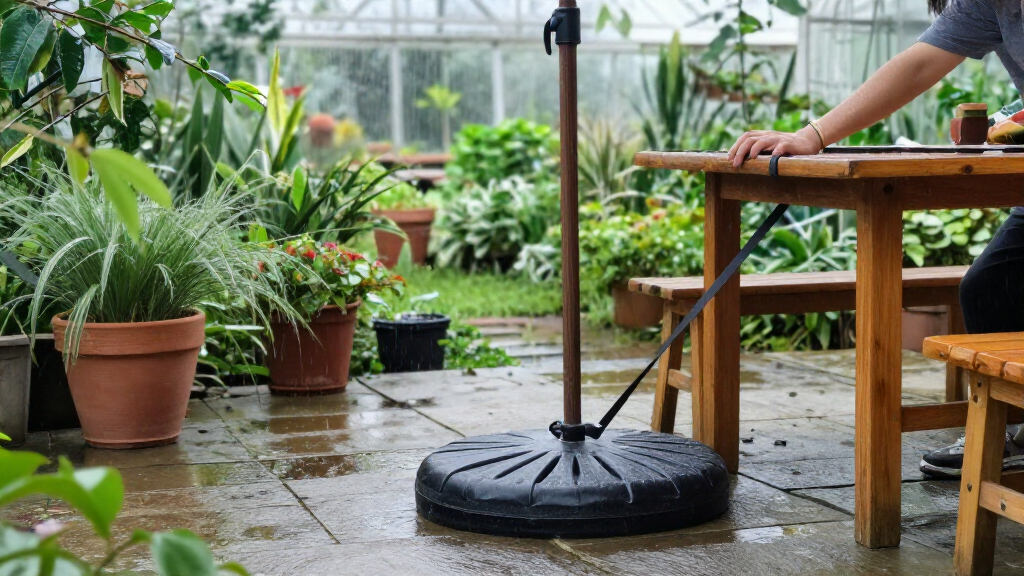
Anchoring patio umbrellas against monsoon gusts begins with the base specified for your umbrella’s size and style. Check the manufacturer’s guidance for the base type, pole diameter, installation, and any stated wind limits; there is no universal weight that makes every umbrella safe.
A market umbrella mounted through a compatible patio-table opening has different support needs from a cantilever model standing on its own. The table may add stability if the design is intended to work that way, but a table is not automatically a substitute for the prescribed base. For example, a homeowner who slides a pole through a lightweight glass table may discover that the table moves before the umbrella base does.
Use this quick check before the windy season:
- Find the model guidance. Check the manual or manufacturer’s current instructions for the base and installation requirements.
- Match the pole and support. Make sure the pole fits firmly in its sleeve or opening and the locking hardware engages fully.
- Check the surface. Place the base on stable, level ground; look for loose pavers, deck movement, or a slope that could let it shift.
- Plan for storms. Decide where you can store the umbrella and how you’ll secure the closed canopy before weather arrives.
If you want to anchor a base to a deck or patio, use a system approved for that umbrella and surface. A random strap or fastener can loosen, damage the structure, or become a tripping hazard. Compatibility is the useful starting point; extra weight alone is not a storm plan.
Close the canopy before the storm reaches your yard
Close and secure your umbrella before strong monsoon winds arrive; if severe weather is expected, remove it and store it securely when you can do so safely. Lowering the canopy cuts the amount of fabric exposed to the wind, while taking the umbrella down keeps the pole and frame from being pushed or carried by a gust.
Make closing part of your weather routine, not a last-second reaction. When the forecast points to storms, check the patio before you leave for work or before the evening meal. In practice, that might mean closing the umbrella while the sky is still bright and calm, then tying the canopy with its strap so a passing breeze cannot make it flap open.
Do not wait until the first gust hits. A large canopy can be difficult to control when wind is already pulling at it, and reaching for a shifting umbrella can put you in its path. If the umbrella is swaying, lifting, or sliding in dangerous conditions, keep people away and wait until it is safe to approach.
A closed umbrella is less exposed, but it is not automatically storm-proof. Secure the canopy and follow the manufacturer’s advice for storage; remove it to a protected location when severe weather is expected.
That small early chore can spare you a cracked window, bent ribs, or a pole skittering across the patio. The safest time to deal with the umbrella is while the air is still quiet and you can work without rushing.
Give cantilever umbrellas extra attention
Anchoring patio umbrellas against monsoon gusts takes extra care with a cantilever model because its offset canopy creates more leverage on the stand. Use the specified weighted base or approved anchoring system, engage every lock, and close the canopy whenever wind strengthens or the umbrella will be unattended.
Picture a cantilever umbrella shading two lounge chairs beside a pool. Its pole stands at one edge while the canopy reaches over the water, so a gust pushing the far edge can twist the stand with a longer lever than a centered market umbrella. A base that looks substantial may still be wrong for that model or poorly suited to its location.
Inspect the support often, especially after you move the umbrella or rearrange patio furniture. Check that base pieces have not shifted, fasteners remain tight, and the pole does not wobble in its socket. Afternoon sun can fade straps and heat exposed hardware; a quick pre-monsoon inspection gives you a chance to replace worn parts before storms make them matter.
Do not improvise with ropes tied to a railing, a tree, or a chair. A tie-down that is not approved may damage the umbrella or structure, and loose lines can catch feet in a dim patio. Use the designed support system, then rely on early closing and secure storage when the forecast turns stormy.
Inspect the whole setup, not just the weight
A safe umbrella setup depends on the base, pole, hardware, ground, and surrounding space working together. A heavy base will not help much if its fasteners loosen, the pole rattles in an oversized sleeve, or the pavers underneath rock when you step on them.
Walk around the setup before monsoon season and after any move. Look for cracks in the base, corrosion, missing pins, loose bolts, worn straps, and shifting patio stones. Then check the area where the umbrella could travel if it tipped: a window, parked vehicle, grill, power line, or the path children use to reach the pool.
For instance, if the stand sits beside a sliding glass door, move it farther away if the layout allows. That change will not make the umbrella storm-safe, but it can reduce the chance of a moving pole striking the glass. Keep walkways clear, too; a base that protrudes into the route from the kitchen to the garden becomes a nuisance even on a windless day.
Think about people and pets as well as property. If an umbrella starts moving during a storm, tell everyone to stay back rather than trying to hold it steady. Once conditions settle, inspect the base and frame before using it again. Visible movement is a warning, not a cue to add a quick strap while gusts are still blowing.
Use wind ratings as guidance, not permission to wait
A manufacturer’s wind guidance can help you understand a specific umbrella’s intended use, but it does not guarantee that the umbrella will withstand every gust. Exposure, installation, canopy position, wear, and sudden changes in wind direction all affect what happens on your patio.
Read the instructions for the exact model you own, since designs and specifications change. A number printed for a controlled condition does not account for every gust funneling between a house and block wall. For example, an umbrella may behave calmly in an open yard but rock sharply when wind wraps around the corner of a home.
Some newer designs use stronger frames, improved locking parts, or bases made for particular umbrella styles. Those features can improve stability in suitable conditions, but they do not remove the need to close the canopy in strong wind. If you cannot find the product guidance, contact the manufacturer or retailer with the model details rather than relying on a generic weight chart.
When conditions look uncertain, close the umbrella early. If you want shade during a breezy afternoon, keep an eye on the canopy and be ready to close it while you can still do so safely. “Wind resistant” does not mean storm proof. The canopy, pole, and support remain a connected system, and a failure in one part can send the whole setup moving.
Make a simple pre-monsoon routine you can keep
A pre-monsoon routine works when it takes only a few minutes and gives every patio umbrella a clear storage plan. Check the hardware, confirm how the canopy closes, and choose a sheltered place for the umbrella before the first storm warning shows up on your phone.
One useful routine is to do a brief inspection when you start preparing outdoor furniture for the season. On a warm morning, open and close the umbrella once, feel for a sticking crank, and confirm the strap or latch holds the canopy shut. Then check that the base is level and the pole locks into place without a wobble.
Pick a storage spot that stays accessible: a garage corner, secure shed, or protected indoor area may work, depending on the manufacturer’s storage advice. If you need to move a heavy base, plan how you will do it without straining your back or dragging it across delicate pavers. A clear route makes it more likely you will actually put the umbrella away before the weather turns.
Finally, agree on a simple household cue. When the forecast calls for strong storms, whoever is home closes and secures the canopy; if severe weather is expected, the umbrella comes down when safe. That small routine beats a hurried scramble as dust blows under the patio door and the first drops hit the concrete.
Frequently Asked Questions
How much weight does my patio umbrella base need?
Use the base specified for your umbrella’s size, design, and installation. A cantilever model may need a different support from a market umbrella, so check the exact model instructions instead of relying on a universal weight rule.
Can I leave my umbrella open during a monsoon storm if the base is heavy?
No. Close it before strong winds arrive, and remove it to secure storage if severe weather is expected and it is safe to do so. A heavy base cannot reliably prevent tipping, frame damage, or the umbrella becoming airborne.
Are cantilever umbrellas less stable in gusts?
Their offset canopy creates more leverage on the stand, so they need the specified support and careful inspection. Close the canopy when winds strengthen or whenever you leave it unattended.
Can I anchor an umbrella base to a deck or patio?
Only use an anchoring system approved for both your umbrella and the deck or patio surface. Improvised fasteners can loosen, damage the structure, or create trip hazards; check the manufacturer’s guidance before installing anything.
Is a closed umbrella safe to leave outside during a storm?
Closing reduces the wind-catching area, but strong gusts may still move or damage the umbrella. Secure the canopy and follow the manufacturer’s storage advice; take it down and store it in a protected place when severe weather is expected.
What should I do if my umbrella is already unstable in a storm?
Keep people away and do not approach or try to hold the umbrella while conditions are dangerous. Wait until it is safe, then secure or remove it and inspect the frame and base before using it again.
How should I prepare an umbrella before monsoon season?
Check the base, pole fit, locks, fasteners, and ground for damage or movement. Practice closing and securing the canopy, and choose an accessible storage spot so you can act before the wind arrives.
Conclusion
Use a compatible base to steady your umbrella on ordinary breezy days, then close it early when monsoon weather threatens. Check the locks, secure the canopy, and store the umbrella if severe winds are expected; no pile of weight turns an open umbrella into a storm shelter.
Make the decision while the patio is still calm. Let the shade rest indoors, and let the storm spend its energy on empty pavers.