TL;DR

Get garden gear delivered free with Prime
- Fast, free delivery on millions of items
- Prime Video, Amazon Music and more included
- Member-only deals all year
Choosing outdoor shade in a monsoon-prone area is a wind-engineering decision. Shade sails offer removability but catch wind; ramadas provide solid protection but face high uplift; pergolas sit in the middle. Success depends on proper anchoring, local code compliance, and a clear storm-preparation plan.
You step onto your patio in July. The air is thick, the sky is bruised purple, and the first gust of a monsoon squall hits your new shade structure. It doesn’t just wobble; it groans. If you chose your outdoor shade based on how it looked in a catalog, you might be in trouble. In desert climates prone to monsoons, choosing outdoor shade is not just about blocking the sun. It is about surviving the wind.
Heat is the default condition here, but wind is the killer. A structure that performs beautifully on a calm Tuesday can become a projectile on a stormy Thursday. This guide breaks down the three main options—shade sail, pergola, and ramada—through the lens of wind engineering. You will learn why a solid roof isn’t always safer than an open frame, why anchoring matters more than material, and how to pick the right shelter for your specific zone.
Choosing outdoor shade in a monsoon zone is a wind-engineering decision, not just a style choice.
Shade sails are vulnerable to wind loads but offer the safety advantage of removability.
Ramadas face high uplift forces and require engineered foundations and roof ties.
Anchoring and soil conditions are critical; a weak foundation causes failure regardless of frame strength.
Regular inspection and storm-preparation plans are mandatory for all outdoor structures.
Why Your Choice Is a Wind-Engineering Decision
Choosing outdoor shade in a monsoon-prone area is a wind-engineering decision as much as a style decision. Most homeowners look at the fabric color or the wood grain, but the wind operates on physics, not aesthetics. It cares about surface area, shape, and the transfer of kinetic energy into structural stress. A structure that performs well in ordinary weather may become dangerous when exposed to strong gusts, saturated ground, debris, and sudden changes in wind direction. The implication is clear: you are not buying decor; you are installing a load-bearing element that must interact with a volatile environment.
Think of your patio structure like a sailboat. A sailboat is designed to catch wind, but it is also designed to be trimmed and controlled. If you lock a sailboat’s rudder and leave the sails up during a hurricane, it capsizes. Your shade sail or ramada is similar. Wind moving around buildings can accelerate or change direction, creating unpredictable forces. A 20-mph gust might feel manageable, but if it hits a flat surface at a 90-degree angle, the pressure increases exponentially. This is why orientation matters as much as material; a north-facing wall might shield a pergola, while a south-facing one might turn it into a wind tunnel.
You need to think about wind load as a system. It is not just about the product you buy. It is about the soil under your posts, the height of your roof, and the walls of your house that might funnel wind directly into your structure. Ignoring these factors is like building a sandcastle at high tide. It looks fine until the water rises. The tradeoff is often between the convenience of a pre-fabricated kit and the security of a custom-engineered solution. Kits are cheaper and faster, but they rarely account for your specific micro-climate or soil composition, leaving you to bear the risk of failure.
Popular right now

Breville Bambino Espresso Machine, Brushed Stainless Steel (BES450BSS)

Shark HydroVac MessMaster Corded Wet/Dry Vacuum, Mop & Self-Clean (WD161)

De'Longhi Rivelia Automatic Espresso Machine with Milk Frother
As an affiliate, we earn on qualifying purchases.
Shade Sails, Pergolas, and Ramadas: The Core Differences
Terminology varies by region, but here is how we define them for safety purposes. A shade sail is a tensioned fabric structure, often triangular or rectangular. A pergola is a frame with an open or semi-open roof, often with slats or louvers. A ramada is a permanent, roofed outdoor shelter, typically with solid roofing material. Each interacts with wind differently, creating distinct risk profiles that go beyond simple strength.
| Option | Main Advantage | Main Wind Concern | Best For |
|---|---|---|---|
| Shade Sail | Flexible, lightweight, removable | Fabric catches wind like a parachute; anchors can fail | Seasonal shade you can take down before storms |
| Pergola | Durable frame, architectural look | Slats and add-ons increase drag; frame can twist | Permanent structures designed for local wind speeds |
| Ramada | Solid roof, rain protection | Large surface area creates massive uplift forces | Engineered shelters with proper foundations |
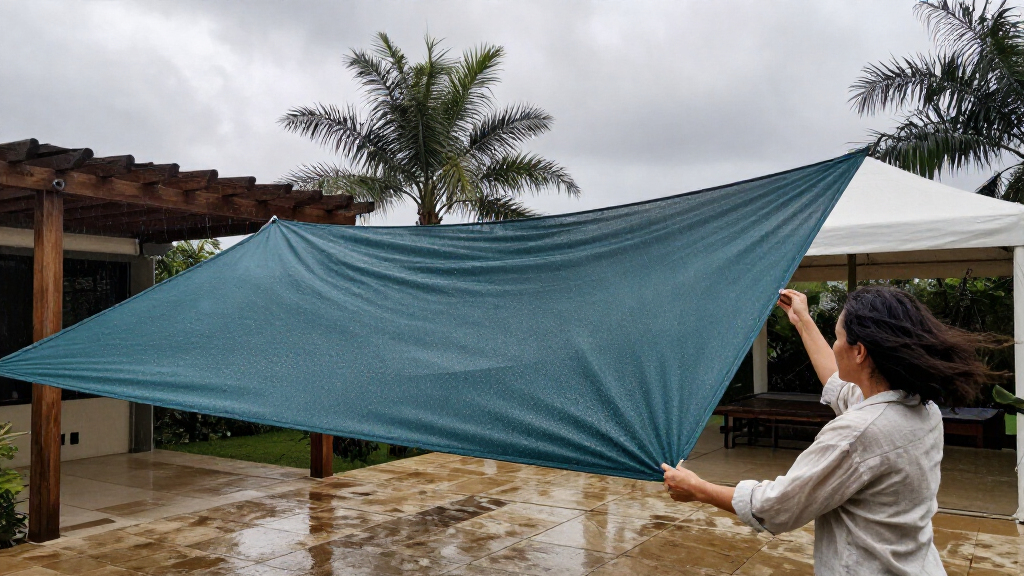
A shade sail is the most vulnerable to wind because it acts like a kite. If you don’t take it down, the tensioners can snap, or the posts can pull out of the ground. However, its biggest advantage is removability. You can unclip it and store it in the garage. This transforms the wind risk from a structural failure into a logistical task. If you are disciplined, the sail is safe; if you are complacent, it is a hazard. A ramada is the opposite. It is heavy and solid. It won’t blow away easily, but the wind trying to lift the roof off the posts is immense. If the roof isn’t tied down correctly, the wind will peel it off like the lid of a sardine can. The implication is that a ramada requires higher upfront engineering costs to mitigate a lower-frequency but higher-severity failure mode.
A pergola sits in the middle. It lets some wind through, which reduces pressure, but the frame still catches drag. If you add screens or louvers, you turn a low-drag structure into a high-drag one. You must know what your structure is designed to handle. The tradeoff here is aesthetic flexibility versus structural integrity. Every time you close a louver or drop a screen, you are changing the wind load calculation. If the structure wasn’t engineered for that closed state, you are effectively overloading it. Understanding this dynamic is crucial: a pergola is only as safe as its most exposed configuration.
Anchoring: The Hidden Safety System
Wind load depends on more than the product. It depends on how well you anchor it. A sturdy-looking frame can still fail if it is poorly anchored or installed in unsuitable soil. Homeowners often assume that a standard kit or generic footing is adequate. This is a dangerous mistake. In monsoon zones, the ground can become saturated, losing its grip on shallow posts. The implication is that soil mechanics are as critical as structural engineering. A strong steel post in loose, wet clay will act like a toothpick in butter.
You need to treat the entire assembly as a system. The fabric, the frame, the brackets, the bolts, the posts, the footings, and the soil must all work together. If one link is weak, the whole chain breaks. Imagine trying to hold a kite in a storm. You can have the strongest string in the world, but if you are standing on loose sand, you will get dragged along. Your posts are your feet. They need to be set in concrete footings that are deep enough to resist overturning moments. The deeper the footing, the greater the resistance to the lever-arm effect created by wind pushing against the top of the structure. Shallow footings rely on friction, which disappears when the soil is saturated.
According to Gardener AZ, local building departments often have specific requirements for wind design criteria. These vary by jurisdiction. You should not guess. For permanent structures, hire a qualified local professional to determine the appropriate foundation details. They will consider your specific site’s exposure, such as whether you are on a hill or in a valley, which changes wind speed and direction. The tradeoff here is cost versus liability. A professional engineer costs money, but a collapsed structure costs far more in repairs, medical bills, or legal fees. Skipping this step is not saving money; it is deferring a much larger expense.
Open vs. Closed: Why ‘Airy’ Isn’t Always Safe
Many people think an open-sided structure is automatically safer in wind. This is a myth. Open designs let some wind pass through, but wind can still load the roof and frame. In fact, wind can create a vacuum effect on the leeward side of an open structure, pulling it apart. Adding screens, curtains, or privacy panels changes the airflow completely. It can turn a low-drag pergola into a high-drag sail. The implication is that openness is not a safety feature unless the structure is specifically designed to handle the turbulence that passes through it.
Consider a pergola with retractable screens. On a calm day, it feels breezy. But if you lower the screens during a gust, you suddenly catch 50% more wind. The force on the posts doubles or triples. If the structure wasn’t engineered for that load, it will fail. You must follow the manufacturer’s instructions for operating positions. If they say “retract screens in winds over 25 mph,” you must do it. Not “maybe.” Not “I’ll wait until I see damage.” The tradeoff is comfort versus safety. You might lose your privacy or sun protection, but you preserve the structure. Ignoring this operational limit is the most common cause of pergola failure in non-hurricane conditions.
A ramada with a solid roof faces different challenges. It creates substantial uplift. The wind tries to lift the roof off. If the roof is not mechanically fastened to the beams, and the beams are not tied to the posts, the roof will blow off. This is why engineered installations are critical. You cannot just nail plywood to 2x4s and hope for the best in a monsoon zone. The implication is that gravity is not enough to hold a roof in place against upward wind pressure. You need positive mechanical connections, such as hurricane straps or hold-downs, to counteract the lift. Without these, a solid roof is a liability, not an asset.
Rain, Debris, and the Maintenance Reality
Monsoon weather brings intense rain and debris, not just wind. Your structure needs to handle water pooling and flying branches. A shade sail is not necessarily a rain shelter. Some fabrics are permeable, letting water through. Waterproof versions can collect water in low spots, adding massive weight that can tear the fabric or bend the posts. You need proper slope and tension to shed water. The implication is that water weight is a hidden dynamic load. A flat sail can hold hundreds of pounds of water, turning a light fabric into a heavy anchor that rips itself from the posts. Proper installation requires a slight pitch, not just tension.
Debris is another killer. A loose branch from a nearby tree can punch through a sail or dent a metal roof. In a monsoon, trees drop limbs unexpectedly. You need to inspect your surroundings. If you have a large mesquite or palo verde over your patio, you are at risk. Regular pruning is part of your shade structure maintenance. The tradeoff is between the shade provided by trees and the risk they pose to your structure. You may need to sacrifice some natural cooling for the safety of your patio cover.
Maintenance is part of safety. Inspect fabric, stitching, tensioners, corrosion, fasteners, posts, and footings regularly. After every severe weather event, check for bent framing, shifted posts, or cracked concrete. Loose hardware or rot can turn into failure points during the next storm. Do not wait for the wind to tell you something is wrong. Walk your structure every month. Tighten bolts. Check for rust. Replace worn fabric. This is not optional in a wind zone. The implication is that maintenance is not a chore; it is a risk-mitigation strategy. A small bolt tightened today prevents a catastrophic collapse next month.
How to Choose the Right Structure for Your Zone
Choosing for monsoon wind zones requires matching your lifestyle to the structure’s limitations. There is no universal “safest” option. It depends on your willingness to maintain and prepare for storms. The key is to be honest about your behavior. If you are forgetful, a removable structure is a danger. If you are meticulous, it is a safe, cost-effective choice.
- Choose a Shade Sail if you want seasonal shade and are disciplined about removal. You must be prepared to take it down when advised or before forecast severe weather. If you forget, it becomes a hazard. The tradeoff is low upfront cost for high operational diligence.
- Choose a Pergola if you want a permanent frame and can specify a design appropriate to local wind exposure. Be careful with add-ons like louvers or screens. Ask the installer for wind-rated documentation. The implication is that you are buying a complex system; verify that the manufacturer’s wind rating accounts for the add-ons you intend to use.
- Choose a Ramada if you need a fixed roof for rain protection and are prepared for the cost and engineering. You must ensure the foundation and roof ties are designed for uplift forces. The tradeoff is high upfront cost for low operational burden. Once built correctly, it requires less daily management, but more rigorous initial engineering.
Avoid choosing by appearance or price alone. Ask how the complete assembly was designed for your site. Ask for product documentation. Ask about permits. If an installer cannot answer these questions, walk away. You are not just buying a patio cover; you are buying a safety system. The implication is that transparency is a proxy for quality. A reputable installer will welcome questions about wind loads and engineering because they have nothing to hide. If they are vague, they are likely cutting corners on the most critical aspects of the build.
Frequently Asked Questions
Which is safest in monsoon winds: a shade sail, pergola, or ramada?
There is no universal winner. Safety depends on design, installation, exposure, and whether removable components are taken down as directed. A well-anchored ramada is safer than a poorly anchored sail, but a sail taken down before a storm is safer than any fixed structure.Should I remove a shade sail before a storm?
Yes, follow the manufacturer’s guidance and local weather alerts. If removal is recommended, do it before dangerous conditions begin—not during high winds. Waiting until the wind is blowing is dangerous and often impossible.Can a pergola stay up during a monsoon?
A properly designed and installed permanent pergola may be intended to remain in place, but that does not mean every pergola—or every attached cover—is suitable for severe wind. Check the wind rating and operating instructions for any add-ons like screens.Are retractable louvers or awnings safer than fixed roofs?
Not automatically. They offer operational flexibility, but the product’s limits, wind-sensing features, installation, and required storm position all matter. If you fail to retract them in time, they can catch wind and tear off.Do I need a permit for my shade structure?
Possibly. Requirements vary by location, size, height, attachment to a home, and other details. Check with the local building department before construction to ensure compliance with wind and safety codes.Conclusion
Choose the shade type that fits both your daily needs and your storm-preparation habits. Treat the entire installation—not just the canopy or frame—as the safety system. If you cannot commit to taking down a sail, buy a ramada. If you cannot afford an engineered ramada, use a sail and take it down. The wind is relentless. Respect it, anchor it, and inspect it.
Next time you look at your patio, don’t just see a place to sit. See a structure fighting the sky. Make sure it’s winning.