
TL;DR

Get garden gear delivered free — and shop member deals
- Fast, free delivery on millions of items
- Access to Prime Big Deal Days deals on October 6–7
- Prime Video, Amazon Music and more included
Fall can suit tree planting when the soil drains, the tree is healthy and roots have time to settle before the ground freezes. Poor drainage, a short establishment window or stressed, root-bound nursery stock are reasons to address the problem or wait until spring.
Poor drainage, too little time before freezing and stressed nursery stock are three warning signs that can make planting a tree in fall a poor choice, according to a report from Planet Natural. The guidance says the decision depends on the tree, the site and the time available for root establishment—not simply whether the ground is still workable.
A planting hole that stays full of water after rain or irrigation points to a drainage problem. Roots need oxygen as well as moisture, and standing water can leave the root ball in persistently soggy soil. The report advises observing the site after a storm and correcting the drainage issue or choosing another location or species. A layer of gravel at the bottom of the hole will not correct poor drainage throughout the surrounding soil.
The second concern is how much mild soil weather remains. A large tree planted late in a short season, at a high elevation or in an exposed location may have little time to begin establishing before a freeze. The report recommends checking the tree’s hardiness for the area and considering local freeze patterns and the site’s microclimate. It gives no dates or temperature thresholds that apply across regions.
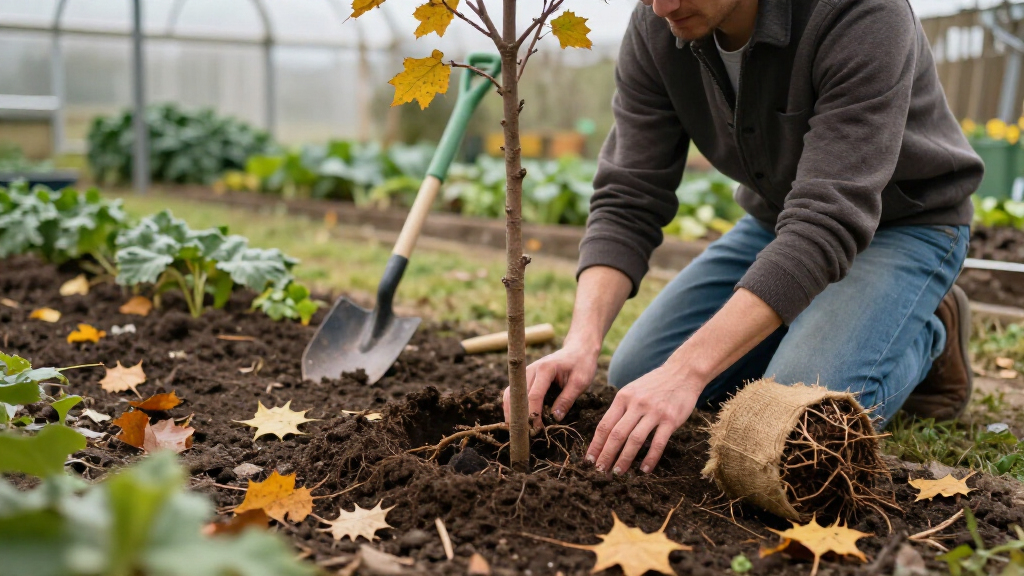
For nursery stock, inspect the trunk, foliage and roots before buying. Circling, black or slimy roots, or roots protruding from drainage holes, can signal a problem. If planting proceeds, remove the container and correct circling roots as appropriate; never plant the tree inside its plastic pot. Set the root flare at or slightly above grade, water deeply, and apply a 2-to-4-inch mulch ring that does not touch the trunk. Keep checking moisture through dry fall weather until the ground freezes, without keeping the root ball saturated.
The Root Zone Sets the Risk
A planting date alone cannot determine whether a new tree will establish well. Waterlogged soil can deprive roots of oxygen, while a late planting may leave little time for roots to settle before freezing conditions. A stressed or root-bound tree begins with additional problems that may persist after it is planted.
That distinction matters for both the tree and the gardener’s investment. The report says establishment commonly takes years, especially for larger trees, so fall planting also requires follow-up care. Checking the root ball separately from surrounding soil can help because container mixes may dry at a different rate than native soil. Readers should use local conditions and advice from a nursery familiar with the species and climate; the source does not quantify success rates or compare fall and spring outcomes.
When Fall Conditions Align
Cooler air and soil that remains workable can make fall a suitable planting season, the report says, because roots may continue growing in soil that has not frozen. It describes a healthy container-grown tree in draining soil as a reasonable candidate for early fall planting when the species fits the site and watering is available.
For a tree that must wait, the report says it can often be kept temporarily outdoors in a protected place, away from drying wind and strong afternoon sun. Check the root ball frequently and water when it begins to dry, while allowing excess water to drain. Container roots face colder temperatures than roots in the ground, so a tree’s hardiness rating alone does not guarantee that its container will survive winter. For a longer delay, the supplying nursery can advise on overwintering options for that species and climate.
Local Freeze Timing Varies
The report does not name a region, tree species, planting date or expected freeze date. It provides no universal cutoff for how late a tree can be planted and no measured comparison of fall versus spring survival. Whether a specific tree has enough time to establish remains site-specific, depending on local weather, elevation, species hardiness and exposure. The source also does not identify a particular tree or nursery whose condition prompted the guidance.
Check the Site Before Planting
Before planting, gardeners can observe how the site drains after rain, inspect the tree and its roots, and check whether local conditions leave time for establishment before a freeze. If drainage is poor, the tree appears compromised or cold is close, the report advises addressing the site or considering spring planting. Anyone holding a container-grown tree should keep its root ball protected and evenly moist, without waterlogging it, and seek species-specific overwintering advice from the nursery.
Key Questions
When is fall planting a reasonable option?
The report says it can make sense when the tree is healthy, soil drains and remains workable, the species suits the site, and time and water are available before freezing conditions.
What does standing water in a planting hole indicate?
It signals a potential drainage problem. Roots need oxygen as well as moisture, and a hole that remains full of water can leave the root ball in soggy soil. The report says to address the drainage issue or choose a more suitable location or species.
Can I plant a tree with circling roots?
Circling roots are a warning sign because they may continue growing in that pattern. The report recommends correcting them before planting, using an approach suited to the tree and root system, or choosing healthier stock.
How should I hold a container tree until spring?
Keep it in a protected outdoor location, out of drying wind and strong afternoon sun. Check the root ball often and water when it begins to dry, while allowing water to drain. Ask the supplying nursery for longer-term, species-specific overwintering advice.
Source: rss
Fall yard work Picks
leaf blowers
As an affiliate, we earn on qualifying purchases.