
TL;DR

Get garden gear delivered free with Prime
- Fast, free delivery on millions of items
- Prime Video, Amazon Music and more included
- Member-only deals all year
A Greenhouse Grower report explains how growers can improve branching in spring bedding plants through pinching or plant growth regulators. It identifies benzyladenine (BA) as a potential alternative that may save labor and avoid removing developing flower buds, while ethephon can delay flowering. The report recommends in-house trials because responses vary by crop and cultivar.
Greenhouse Grower has published guidance on improving branching in spring bedding crops, describing benzyladenine (BA) as a possible alternative to labor-intensive pinching. The report says BA may encourage fuller plants without removing flower buds, while warning that crop responses vary and ethephon can delay flowering.
Fullness is a market-quality consideration for bedding plants alongside flowering, healthy foliage and freedom from visible pest damage or nutrient deficiencies, the report says. More branches can increase foliage coverage over the growing medium and create additional stems for flowers. The approach applies not only to hanging baskets and larger planters, but also to quarts and 4-inch pots.
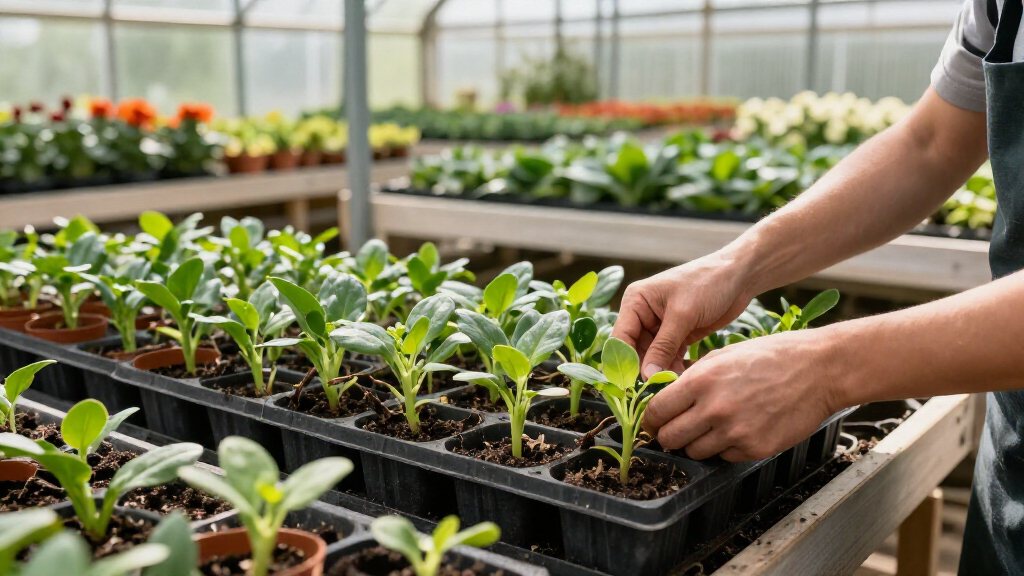
The report explains that branches develop from axillary buds located between a leaf stalk and the stem. A growing shoot tip can suppress those buds through apical dominance. Pinching removes that growing point, reducing the influence of auxin and allowing buds to develop. The method is established and effective, but it adds labor, can spread disease through contaminated tools, and may extend crop time while replacement growth develops.
As an alternative, the report describes BA, a cytokinin sold commercially as Configure, as a branching tool. It cites a foliar spray of 300 parts per million BA applied to scaevola cuttings one week after transplanting into 4-inch containers as an example that enhanced branching without delaying flowering. That example is not presented as a universal rate for other crops. The report suggests growers trial spray concentrations between 50 and 500 ppm to find suitable rates for their own species and cultivars.
Branching Without Extra Pinching
The production choice affects both crop appearance and the time and handling required to finish plants. Pinching can help produce a fuller plant, but each manual or mechanical pass adds a labor cost and creates another opportunity for pathogens to move between plants if equipment is not properly sanitized. The report says BA applications may cost less than the labor needed to pinch, though it does not provide a cost comparison or guarantee savings for every operation.
BA may also allow existing flower buds to continue developing because, unlike pinching, it does not remove the shoot tip and its buds. That distinction matters for annual bedding crops sold in bloom, where a delay can affect readiness for the market. The report presents BA as a tool with potential, not a one-size-fits-all replacement: growers need to evaluate the response of the particular crop and cultivar they produce.
Ethephon presents a different trade-off. It can promote branching, but the ethylene it generates also inhibits stem elongation and flowering. The report says applications should stop six to eight weeks before the intended sale date to allow flowers time to develop. That restriction may make ethephon poorly suited to short-cycle crops in small containers.
benzyladenine plant growth regulator
As an affiliate, we earn on qualifying purchases.
As an affiliate, we earn on qualifying purchases.
How Branching Methods Differ
Pinching works by physically removing the growing point, a source of auxin involved in maintaining apical dominance. BA acts as a cytokinin and shifts the hormonal balance in a way that can support axillary-bud growth. Ethephon works by generating ethylene after uptake by the plant. These methods all aim to increase branching, but they affect the plant differently and carry distinct timing and handling considerations.
The report notes that BA can be taken up by both shoots and roots, so sprays and drenches may work. For annual bedding plants, it favors sprays as a practical starting point because responses across different species are not yet widely characterized. If using a drench, the source gives example volumes proportional to pot size: 2 fluid ounces for a 4-inch pot and 4 fluid ounces for a 6-inch pot. Its stated spray volume is 2 quarts per 100 square feet of growing area.
Applications are generally made after transplant, once plugs or rooted cuttings have established in their containers. The report also identifies possible treatment windows near the end of liner or plug production, including before transplant. For mechanical shearing, it advises sterilizing blades between crops to reduce the risk of mechanically transmitting disease.
“Automated shearing can be a great way to reduce some of the labor costs associated with pinching, but be sure to sterilize blades between crops to reduce mechanical transmission of problematic diseases.”
— Christopher Currey, Iowa State University, as quoted in Greenhouse Grower
As an affiliate, we earn on qualifying purchases.
Crop Responses Need Testing
The report does not establish a single BA rate that works across bedding crops. It says responses among annual species and cultivars are not widely characterized, and recommends in-house trials to identify effective treatments. The scaevola example is a specific crop and application timing, not evidence that the same rate will produce the same result elsewhere.
It also provides no quantified comparison of BA costs against labor savings from pinching, nor does it report results from a broad, controlled trial across annual bedding taxa. The practical cost and crop-time effects will depend on the operation, crop schedule and treatment response. Ethephon sensitivity also differs among genetics, but the report says flowering delay remains a concern across annual crops.
As an affiliate, we earn on qualifying purchases.
Trial Rates Before Wider Use
The report’s recommended next step for growers is to test treatments on a limited scale before applying them across production. Trials can compare BA rates and timing with untreated plants and the operation’s usual pinching practice, while tracking branching, flowering, crop time and application costs. Any results should be evaluated for the specific species and cultivar involved.
For operations considering ethephon, planning must account for the report’s six-to-eight-week interval before the target sale date. Growers using pinching or automated shearing should also maintain equipment sanitation between crops. The source does not announce a new product or regulatory change; it offers production guidance for spring crops, with broader adoption dependent on growers’ own crop trials.
As an affiliate, we earn on qualifying purchases.
Key Questions
Why do bedding-plant growers want more branching?
More branches can help plants look fuller and more filled in, add foliage coverage over the growing medium and provide additional stems for flowers. The report says this can benefit small pots as well as larger containers and hanging baskets.
How does benzyladenine differ from pinching?
Pinching removes the growing point and can release axillary buds from apical dominance. BA is a cytokinin applied as a plant growth regulator to promote branching without physically removing the shoot tip, so existing flower buds are not removed by the treatment.
What BA rate does the report recommend?
The report suggests that 50 to 500 ppm in a spray can serve as a starting range for trials, not as a universal prescription. It gives a 300-ppm spray on scaevola cuttings as one example and advises growers to test rates on their own crops and cultivars.
Why can ethephon be a problem for flowering crops?
Ethephon generates ethylene, which can promote branching but also inhibit flowering. The report says applications should stop six to eight weeks before the planned sale date, a limitation that can make the treatment unsuitable for crops with shorter finishing schedules.
Source: rss
Fall yard work Picks
leaf blowers
As an affiliate, we earn on qualifying purchases.