TL;DR

Get garden gear delivered free with Prime
- Fast, free delivery on millions of items
- Prime Video, Amazon Music and more included
- Member-only deals all year
An Amateur Gardening report argues that pumpkins are worth growing and cooking with beyond Halloween, highlighting culinary varieties such as Crown Prince and Tractor. It says pumpkins harvested in September and October can be stored into the new year, and shares growing guidance and a roasted-pumpkin soup recipe.
An Amateur Gardening report is urging home gardeners and cooks to treat pumpkins as more than Halloween decorations, describing culinary varieties that can be roasted or puréed and stored after harvest. The article says pumpkins gathered in September and October can keep into the new year and beyond when properly cured and stored, extending their use through autumn and winter.
The report distinguishes edible culinary varieties from the large, watery pumpkins commonly grown for carving. It praises ‘Crown Prince’ for its nutty flavour when roasted, and says the variety’s skin can be left on during roasting. It describes ‘Tractor’ as sweet and creamy when puréed, making it suitable for cakes, muffins and other desserts. These are the writer’s taste assessments, not findings from a comparative test.
For gardeners, the article recommends sowing seeds indoors in small pots from mid-April, then planting established seedlings outdoors in June. It says pumpkin plants need a sheltered position, plenty of water and feeding, and substantial room to spread. A piece of wood under developing fruit can keep it off the ground; the writer advises removing smaller fruits that are turning yellow or failing to develop.
The suggested harvest test is a hard rind and a hollow sound when the fruit is tapped, usually around late September or early October. The report advises leaving the pumpkin for about a week before cutting it with roughly three inches of stem attached, then storing it in a cool, dark place. Its accompanying soup recipe uses roasted pumpkin, onions, stock, cumin, garam masala and cinnamon; the flesh is blended before serving, optionally with pumpkin seeds and calendula petals.
Pumpkins Beyond Halloween
The report’s practical point is that pumpkins can be treated as a seasonal kitchen crop, not a short-lived decoration. A harvest that keeps into winter offers home growers more time to use the fruit, while choosing a culinary variety may suit recipes better than relying on a carving pumpkin. The article’s suggestions include both savoury dishes, such as soup and roasted pumpkin, and sweet baking.
That case comes with limits: storage life depends on the condition of the fruit and its storage environment, and the source does not give tested storage durations or compare the nutritional value of different varieties. Its descriptions of flavour are personal recommendations. For readers deciding what to grow, the report is best read as practical gardening and recipe advice rather than independent product testing or nutrition guidance.
As an affiliate, we earn on qualifying purchases.
From Garden to Winter Store
The article’s author traces a growing interest in pumpkins to a visit to Kilduff Farm’s culinary garden in East Lothian in 2019. The report frames that experience as the beginning of a broader interest in pumpkin varieties and recipes, then makes the case for using the crop after the Halloween period.
Its advice follows a seasonal sequence: sow indoors in spring, plant outside in June, harvest in early autumn and store the fruit for later use. The report also identifies pumpkins as members of the gourd family and describes them as fruits. It says they contain vitamins A and C, potassium and fibre, but supplies no quantities, serving sizes or nutrition-source references.
As an affiliate, we earn on qualifying purchases.
Storage and Nutrition Caveats
The report does not specify how long particular varieties will keep, the temperature or humidity range for storage, or how readers should assess fruit damaged during harvest. Its phrase that pumpkins can last into the new year and beyond is general guidance, not a guarantee for every pumpkin or storage setup. It also provides no independent evidence for its nutritional description or detailed nutrient amounts.
The article gives no publication date, and it does not establish whether the growing schedule applies to all climates. Sowing and planting dates may need adjustment to local conditions; the source offers no region-by-region calendar. Its flavour descriptions are attributed to the author, and no side-by-side tasting or variety data are supplied.
As an affiliate, we earn on qualifying purchases.
Using the Harvest After October
For readers following the report’s approach, the next steps are to select a culinary variety, plan for its sprawling growth, and check fruit maturity before harvesting. After cutting, the article recommends keeping the stem attached and storing sound pumpkins in a cool, dark place. The source does not provide a later update or a follow-up test of storage results.
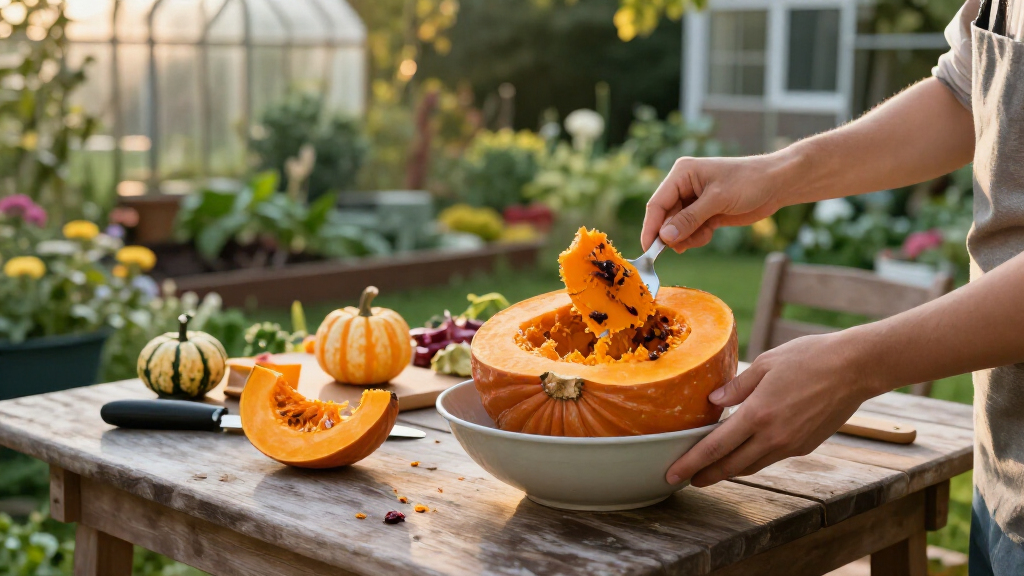
In the kitchen, its featured recipe offers one way to use a medium pumpkin: roast the chunks, cook the onions slowly with cumin, add stock and spices, simmer, then blend. The article leaves choices such as stock type and optional toppings to the cook. Any claims about the recipe’s nutritional benefits or exact storage life remain outside the information provided.
As an affiliate, we earn on qualifying purchases.
Key Questions
Are pumpkins only useful as Halloween decorations?
No. The Amateur Gardening report recommends cooking with pumpkins in autumn and winter, including roasting them or using their purée in soup and baking.
Which pumpkin varieties does the report recommend?
It highlights ‘Crown Prince’ for roasting and ‘Tractor’ for its sweet, creamy purée. These are the author’s preferences, not results from a formal comparison.
When should pumpkins be harvested?
The report says to wait until the pumpkin has a hard rind and sounds hollow when tapped. It gives late September or early October as a typical time, while noting the advice is not tailored to every region.
How does the report recommend storing pumpkins?
It advises leaving the fruit for about a week after it is ready, cutting it with around three inches of stem attached, and keeping it in a cool, dark place. It does not give a guaranteed storage period.
What is in the pumpkin soup recipe?
The recipe combines roasted pumpkin and slowly cooked onions with stock, cumin, garam masala and cinnamon. The mixture is simmered and blended, with pumpkin seeds and calendula petals suggested as optional toppings.
Source: rss
Halloween Picks
halloween
As an affiliate, we earn on qualifying purchases.