
Choosing a water-wise drip irrigation kit is a decision between keeping watering simple and buying more control. A basic timer-based kit typically runs a fixed schedule through tubing and emitters; an expandable smart kit can add moisture or weather inputs, app controls, and extra watering zones. Both can direct water to plant roots and reduce overspray compared with many conventional sprinklers, but neither saves water automatically if it is poorly laid out or left unchecked.

Get garden gear delivered free with Prime
- Fast, free delivery on millions of items
- Prime Video, Amazon Music and more included
- Member-only deals all year
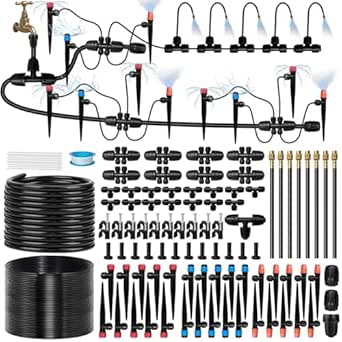
230ft Drip Irrigation System with Adjustable Copper Nozzles and Emitters
- ✔ Total tubing: 230 ft
- ✔ Main line: 33 ft, 1/2 inch
- ✔ Drip line: 197 ft, 1/4 inch

AWUREYIT 240FT Drip Irrigation System Kit with 1/2" Main Tubing and 1/4" Distribution Hoses
- ✔ Total hose length: 240 ft
- ✔ Main tubing: 40 ft, 1/2 inch
- ✔ Distribution hose: 200 ft, 1/4 inch

Kafuzi 230-Foot Quick-Connect Drip Irrigation Kit
- ✔ Total tubing: 230 ft
- ✔ 1/2-inch tubing: 33 ft
- ✔ 1/4-inch tubing: 197 ft
The basic kit is the stronger fit for a small, stable garden where a predictable schedule is enough. The smart kit makes more sense for mixed planting areas, changing weather, or a garden that may expand. Its higher price is justified when its controls prevent unnecessary watering or replace frequent manual adjustments; otherwise, the basic timer offers better value. The comparison below focuses on control, water-use potential, setup, expansion, maintenance, and cost.
At a Glance
| Criteria | Basic timer-based drip irrigation kit | Expandable smart drip irrigation kit | Winner |
|---|---|---|---|
| Watering control | Fixed schedules set at the timer; usually straightforward to adjust | May combine schedules with app controls, sensors, or weather information | B |
| Water-use potential | Can reduce waste through targeted delivery, but does not adapt to rain or soil moisture by itself | Can skip or adjust watering when conditions allow, if sensors and settings are configured well | B |
| Setup and learning | Usually simpler, with fewer controls and compatibility decisions | More setup choices, pairing, calibration, and troubleshooting | A |
| Expansion | Often suited to a single bed or a modest number of lines | Often supports added zones or components, subject to product compatibility | B |
| Maintenance | Timer, filter, tubing, and emitters still need seasonal checks | More components to maintain, including batteries, connectivity, or sensors | A |
| Upfront value | Lower purchase cost; strong value for straightforward layouts | Higher cost can pay off when automation and expansion solve real needs | Depends |
230ft Drip Irrigation System with Adjustable Copper Nozzles and Emitters
This kit earns our top spot by giving us the broadest stated control over how water reaches different plants. Its 38 nozzles span vortex, stream, misting, and bendable copper styles, so one layout can accommodate a raised bed, a greenhouse bench, and containers without relying on a single spray pattern. The copper heads can be aimed around plant placement, while push-to-connect fittings simplify changes when the garden shifts. That range makes it more adaptable than Kafuzi, whose listed package centers on adjustable sprinklers, and more specialized in emitter choice than AWUREYIT’s three stated types.The tradeoff is that choice brings planning work. We need to decide which emitters belong in each zone and arrange the many fittings before the system is easy to manage. Its 230 feet of tubing is slightly shorter than AWUREYIT’s 240 feet, and the 197 feet of narrow 1/4-inch line can clog if the water carries debris. A filter and a deliberate layout are sensible companions. For gardeners prioritizing targeted watering across different plant shapes, this is the most versatile pick; for a simpler large-area run, AWUREYIT may be easier to justify.
Pros:
- Four nozzle styles provide more ways to match water delivery to plant placement.
- Bendable copper nozzles offer 360-degree directional control.
- Push-to-connect fittings support tool-free assembly.
- The 1/2-inch main line is described as compatible with high pressure and multiple zones.
Cons:
- The assortment of parts takes planning to organize into an efficient layout.
- Narrow 1/4-inch lines may clog without filtered water.
Best for: Gardeners combining raised beds, greenhouse plants, and containers that benefit from different spray patterns and directional adjustment.
Not ideal for: Buyers seeking the simplest possible layout, or anyone unable to filter water that may clog narrow distribution lines.
Bottom line: We recommend this as the most adaptable kit for mixed plantings, provided we are willing to plan the layout and protect its small lines from debris.
“We recommend this as the most adaptable kit for mixed plantings, provided we are willing to plan the layout and protect its small lines from debris.”
AWUREYIT 240FT Drip Irrigation System Kit with 1/2" Main Tubing and 1/4" Distribution Hoses
When reach is the priority, AWUREYIT has the clearest advantage in this group: 240 feet of tubing, including 40 feet of 1/2-inch main tubing. That extra main-line length can help when we need to carry water farther before branching into smaller distribution hoses, or when a garden is divided into distinct areas. Its stream, vortex, and misting emitters cover useful watering patterns, though the 230ft copper-nozzle kit offers more variety and directional control for unusual planting arrangements.The manufacturer describes the materials as UV-resistant and corrosion-proof, which is relevant for a system intended to remain outdoors, but the supplied information does not specify a measured service life. We should also note that the kit is not a complete timed watering setup: a separate garden timer is required for fully automatic operation. Its 136 pieces allow customization, but they also need sorting and careful assembly. Choose AWUREYIT when the longer run and main line matter more than having copper heads; choose Kafuzi when simpler flow adjustment and a stated sprinkler capacity are more relevant than maximum tubing length.
Pros:
- The listed 240 feet is the longest total tubing length among these three kits.
- A 40-foot 1/2-inch main line supports longer reaches before branching.
- Stream, vortex, and misting emitters suit different watering patterns.
- Materials are described as UV-resistant and corrosion-proof.
Cons:
- A garden timer must be purchased separately for timed automatic watering.
- The 136-piece assortment can take time to sort and assemble.
Best for: Gardeners laying out a larger garden, greenhouse, or patio system who value a longer main line and three adjustable emitter styles.
Not ideal for: People who want automatic schedules without buying a timer separately, or who prefer a small kit with fewer parts to organize.
Bottom line: AWUREYIT is our choice for longer or divided layouts, as long as we account for the extra assembly and separate timer.
“AWUREYIT is our choice for longer or divided layouts, as long as we account for the extra assembly and separate timer.”
Kafuzi 230-Foot Quick-Connect Drip Irrigation Kit
Kafuzi takes a more focused approach than the two kits above. It combines 230 feet of two-size tubing with quick-connect fittings and sprinklers whose water flow can be adjusted individually. That gives us a useful degree of control when nearby plants need different amounts of water, while the stated capacity of up to 32 sprinklers leaves room for expansion. Compared with the copper-nozzle pick, it offers fewer listed emitter styles; compared with AWUREYIT, it has less tubing and a shorter main-line length in the supplied specifications.We would choose it for a garden where the main goal is a manageable sprinkler layout and control over individual flow, rather than the widest possible range of spray heads. The available details list three adjustable sprinklers in the included kit and a maximum capacity of 32, so we should not mistake capacity for the number included. Its plastic construction and 50 psi maximum pressure also make it less compelling for setups that place a premium on tougher materials or higher pressure compatibility. For a long, branching system AWUREYIT has the stronger tubing numbers; for mixed containers and beds, the copper-nozzle model gives us more ways to direct water.
Pros:
- Quick-connect fittings support flexible setup.
- Individual sprinkler flow can be adjusted.
- The kit combines 1/2-inch and 1/4-inch tubing.
- The stated system capacity is up to 32 sprinklers.
Cons:
- The stated maximum pressure is 50 psi.
- The kit is made of plastic.
- The specifications list three included sprinklers, despite capacity for more.
Best for: Gardeners who want quick-connect assembly, individual flow adjustment, and room to expand a sprinkler-based layout.
Not ideal for: Buyers needing higher pressure tolerance, a stated durable non-plastic build, or the widest range of included nozzle styles.
Bottom line: Kafuzi suits buyers who value adjustable flow in a sprinkler layout, but its pressure limit and plastic construction narrow its fit.
“Kafuzi suits buyers who value adjustable flow in a sprinkler layout, but its pressure limit and plastic construction narrow its fit.”
As an Amazon Associate we earn from qualifying purchases.
Key Differences
The main practical difference is responsiveness. A basic timer follows the schedule you set even if rain has arrived or a cool week has reduced demand. That predictability suits a compact garden with similar plants and a reliable routine, but the owner must make seasonal changes and pause watering when conditions shift. A smart kit can add flexibility through sensors or weather-related controls. That may prevent avoidable cycles, though results depend on sensor placement, settings, and the system’s actual features.
Expansion and cost are linked. Smart kits often offer a clearer path to multiple zones or added controls, which can help when containers, beds, and shrubs have different watering needs. Yet adding hardware can mean more setup and maintenance. For one small bed, the added capability may sit unused. For a larger or changing garden, paying more can be worthwhile if it reduces routine adjustments or supports distinct watering schedules. In either case, water savings depend on sound layout, suitable emitter flow, and regular checks for leaks and clogged outlets.
Detailed Comparison
Watering control (Expandable smart drip irrigation kit wins — moderate)
The basic timer wins on simplicity: set start times and duration, then adjust as the season changes. The smart kit wins on flexibility when its sensors, app, or weather features are compatible and configured correctly. This is a moderate advantage for B in gardens with shifting conditions; for a stable bed, the extra controls may not change daily use much.
Water-use potential (Expandable smart drip irrigation kit wins — moderate)
Both kits can deliver water near roots and limit broad overspray, so the layout matters as much as the controller. The smart option has a moderate edge because it may respond to soil moisture or weather instead of following a fixed schedule. It does not guarantee lower use: inaccurate settings or sensor placement can still lead to overwatering. A basic kit can also be water-wise when users adjust schedules and check soil conditions.
Setup and learning (Basic timer-based drip irrigation kit wins — moderate)
The basic kit wins by a moderate margin for most first-time users. Fewer settings and connected components generally make installation and operation easier. A smart kit can require app pairing, sensor placement, calibration, and decisions about zones. Those steps are manageable for a technically comfortable gardener, but they add friction when the goal is simply to water one bed.
Expansion (Expandable smart drip irrigation kit wins — moderate)
The smart kit usually wins when the garden may grow or needs separate schedules for different areas. Expandable components can support additional lines or zones, though buyers should check compatibility and capacity before adding them. The difference is moderate for evolving layouts and minor for a single small bed that is unlikely to change.
Maintenance (Basic timer-based drip irrigation kit wins — minor)
The basic timer has a minor advantage because there are fewer electronic parts to troubleshoot. Both systems need inspection for leaks, clogged emitters, damaged tubing, and seasonal wear. Smart kits may add batteries, connectivity, sensors, or software settings to check. Their extra maintenance is usually reasonable if the automation is useful, but it is unnecessary overhead for a simple installation.
Upfront value (moderate difference)
There is no universal winner. A basic kit is better value for a compact, uniform garden because it covers the central need at lower cost. The smart kit earns its premium when adaptable control, multiple zones, or future expansion will be used regularly. Paying more solely for a water-saving label is not persuasive: layout, scheduling, and upkeep determine whether the extra features help.
Basic timer-based drip irrigation kit: Pros and Cons
Pros:
- Lower upfront cost
- Simple controls and fewer setup steps
- Good fit for a small garden with a predictable routine
Cons:
- Fixed schedules need manual changes when weather or seasons shift
- Limited suitability for gardens with very different watering needs
- Still requires checks for leaks and clogged emitters
Expandable smart drip irrigation kit: Pros and Cons
Pros:
- More flexible control when sensors or weather features are available
- Better suited to multiple zones and changing layouts
- Can reduce unnecessary scheduled watering when configured well
Cons:
- Higher purchase cost
- More setup and potential troubleshooting
- Sensors and connectivity add components that need attention
Who Should Choose What
Choose Basic timer-based drip irrigation kit if:
- You are watering one small bed or a few containers with similar needs.
- You want a low-cost system with straightforward controls.
- You are comfortable changing the schedule yourself as weather and seasons change.
Choose Expandable smart drip irrigation kit if:
- Your garden has distinct areas that need separate schedules.
- You want sensor or weather-informed adjustments and will configure them carefully.
- You expect to expand and have verified the kit supports compatible added zones.
Skip both if: Your site has no practical water source or pressure for the kit, or you need a professionally designed system for a large or complex landscape.
Value for Money
Pay more for the smart kit when its automation addresses a recurring problem: watering several areas differently, missing schedule changes, or expanding a garden over time. In those cases, convenience and better control can justify the premium, and sensor-informed adjustments may help avoid needless watering. Check the feature list closely; app control alone does not mean the system measures soil moisture or responds to local weather.
For a small, consistent planting area, the basic timer is usually the better value. Its lower cost leaves more room in the budget for appropriate tubing, filters, pressure regulation, and emitters, which affect reliable operation. Neither kit is a sound purchase if its parts do not match the water source, pressure, or layout. Compare included components and expansion compatibility before treating the higher-priced system as a complete solution.
Final Verdict
Choose the basic timer-based kit for a small, stable garden and a low-maintenance routine; it delivers the clearest value for most uncomplicated setups. Choose the expandable smart kit if you will use its sensors, flexible controls, or extra zones to manage changing conditions or a larger layout. The deciding factor is whether you need the system to adapt without frequent manual changes. If you do, the premium can be worthwhile; if you do not, the basic kit is the more sensible buy.
Frequently Asked Questions
Does a smart drip kit always use less water?
No. Sensors or weather features can help avoid unnecessary watering, but only when they are available, set up correctly, and suited to the garden. A basic kit with a sensible schedule and regular checks can also use water efficiently.
Which kit is easier for a beginner to install?
A basic timer-based kit is usually easier because it has fewer controls and connected parts. Follow the kit’s pressure and layout guidance, and check that the included tubing and emitters suit the planting area.
Is the smart kit worth the higher price for containers?
Usually only if you have many containers with different needs, want remote adjustments, or plan to expand. For a few containers watered on a consistent routine, a basic timer is generally better value.
What should I check before buying either kit?
Check compatibility with your water source and pressure, the number of zones and emitters supported, included filtration and pressure regulation, and the availability of compatible replacement parts. These details affect setup and reliable watering more directly than the kit’s marketing label.