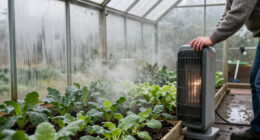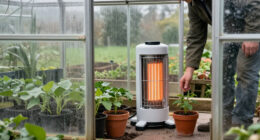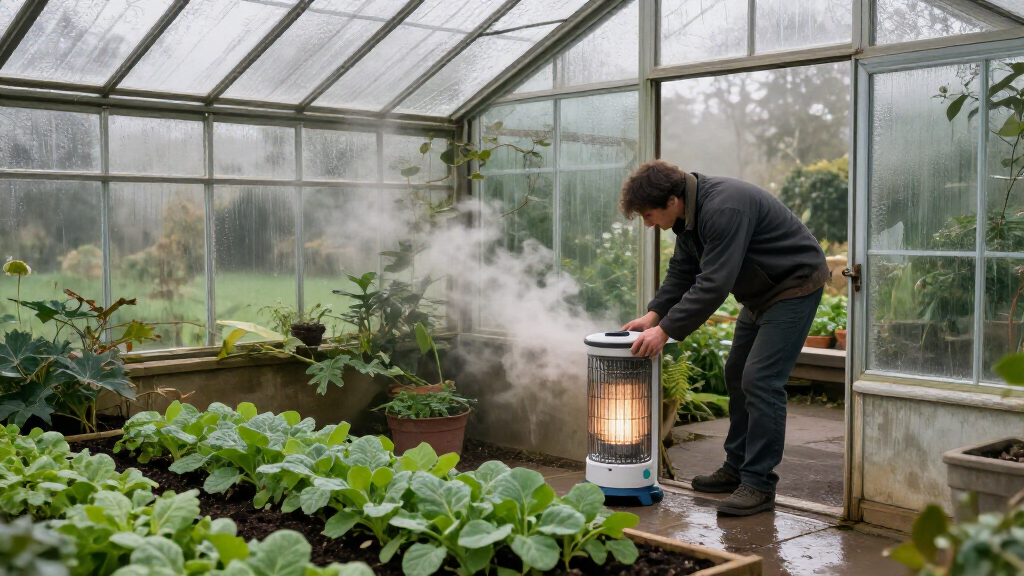

Choosing an electric greenhouse heater is a choice between warming the air throughout the growing space and directing heat toward plants, benches or other exposed areas. A fan-forced heater pushes heated air around the greenhouse; a radiant heater sends heat to objects in its path. That difference affects temperature consistency, placement, noise and how much energy is useful in a particular layout.

Get garden gear delivered free with Prime
- Fast, free delivery on millions of items
- Prime Video, Amazon Music and more included
- Member-only deals all year
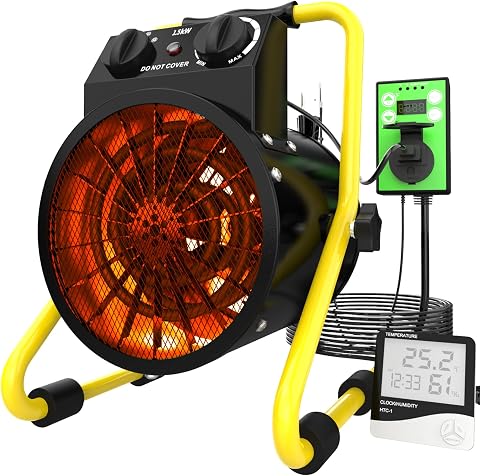
Buyplus Greenhouse Heater with Digital Thermostat, 1500W, Black
- ✔ Power: 1500W heating; 25W fan-only
- ✔ Stated coverage: Up to 215 sq. ft.
- ✔ Temperature range: 40°F–108°F (5°C–42°C)

SmterCon Greenhouse Heater with Digital Thermostat
- ✔ Brand / model: SmterCon MGP-2
- ✔ Power: 1500W
- ✔ Stated coverage: Up to 120 sq. ft.

VEVOR 1500W Greenhouse Heater with Thermostat
- ✔ Brand / model: VEVOR BG-E2A-15
- ✔ Power: 1500 watts
- ✔ Voltage / amperage: 120 volts / 12.5 A
Fan-forced models generally suit enclosed greenhouses where a thermostat can control the overall air temperature. Radiant models make more sense when you need to protect a defined group of plants or a cold corner without heating the entire structure. Neither type can overcome poor insulation or inadequate electrical capacity, and actual running costs depend on the heater’s wattage, operating time and local electricity rate.
At a Glance
| Criteria | Fan-forced electric greenhouse heater | Radiant electric greenhouse heater | Winner |
|---|---|---|---|
| How heat reaches plants | Heats air and circulates it with a fan | Radiates heat toward plants and surfaces in its path | Depends |
| Coverage and temperature consistency | Can distribute warmth across an enclosed space; performance depends on layout and air circulation | Warmth is concentrated near the heater; shaded or distant areas may stay cooler | A |
| Targeted frost protection | Useful for maintaining a general minimum air temperature | Useful for protecting a selected bench or plant group | B |
| Air movement and noise | Moves air and makes fan noise | Typically has no fan, so it does not circulate air | B |
| Installation and positioning | Needs safe placement with unobstructed airflow and suitable clearance | Needs a clear line of exposure and safe distance from plants and materials | Depends |
| Energy value | Best value when whole-space air temperature is the goal | Best value when only a limited area needs warmth | Depends |
| Control and monitoring | Often paired with a thermostat; confirm whether one is included and suitable | May need a separate thermostat or temperature control, depending on the model | A |
Buyplus Greenhouse Heater with Digital Thermostat, 1500W, Black
Among these three, the Buyplus BG-E2 makes the strongest case for a buyer who needs a heater with a clearly stated coverage figure: it is listed for areas up to 215 square feet, more than SmterCon’s stated 120 square feet. Treat that number as a sizing reference rather than a promise that the heater will maintain a target temperature in every greenhouse; drafts, glazing and outside conditions matter. The 1500W rating is shared by all three models, so the larger stated area is the distinguishing claim, not a higher power rating.Its 40°F–108°F adjustable thermostat gives growers a broad setpoint range, while the 25W fan-only mode can circulate air without running the heater. VEVOR also offers a fan mode, and SmterCon lists adjustable ventilation, so Buyplus is not alone in supporting circulation. Its appeal is the combination of that function with the broadest declared area. The 0°–45° adjustable angle, handle and 7.5-foot cord add flexibility for positioning, although the cord length and outlet location still need to suit the greenhouse.The tradeoff is sparse operating detail: only heating and fan-only modes are listed, and the product information does not specify energy efficiency. Buyers who want a clearly described automatic control sequence or more information about performance should compare the listing carefully with SmterCon’s explicit automatic thermostat description. We would also avoid assuming that the coverage figure translates to adequate frost protection without accounting for the greenhouse itself.
Pros:
- Lists coverage up to 215 sq. ft., the largest stated area in this comparison.
- Adjustable thermostat spans 40°F–108°F.
- 25W fan-only mode supports air circulation without heating.
- Portable handle and 0°–45° angle adjustment help with positioning.
Cons:
- Only heating and fan-only modes are listed.
- Product information does not specify energy efficiency.
- The stated coverage does not establish performance in a particular greenhouse or climate.
Best for: Growers comparing 1500W heaters who want the broadest stated coverage in this lineup, plus adjustable temperature and fan-only operation.
Not ideal for: Buyers who need documented efficiency information, more than two listed modes, or a verified heating plan for a drafty or poorly insulated greenhouse.
Bottom line: Buyplus is the most versatile starting point for shoppers prioritizing stated coverage, provided they treat the 215-square-foot figure as a guide and can live with limited operating details.
“Buyplus is the most versatile starting point for shoppers prioritizing stated coverage, provided they treat the 215-square-foot figure as a guide and can live with limited operating details.”
SmterCon Greenhouse Heater with Digital Thermostat
The SmterCon MGP-2 is the most clearly specified pick for growers who want a thermostat to manage heating automatically. Its included digital thermostat is described as controlling the heater to maintain a set temperature. That makes its role distinct from Buyplus, whose adjustable thermostat is listed but whose product details do not describe the same automatic control behavior. For someone tending a smaller growing area, less manual adjustment may be the deciding convenience.SmterCon lists coverage of up to 120 square feet, considerably less than Buyplus’s 215-square-foot figure. That narrower stated limit makes the intended scale easier to understand, but it also rules this model out for some larger greenhouses unless the buyer has a separate heating plan. The heater is described as convection-based and offers adjustable ventilation, temperature and wind speed settings. VEVOR also has a fan mode, but its listing gives no coverage estimate; SmterCon therefore makes a more specific sizing claim.Overheat protection is included, though the information provided does not describe weather resistance or greenhouse-safe placement requirements. We should confirm that the heater and thermostat can be used in the intended environment and follow the manufacturer’s installation guidance. The 120-square-foot ceiling is the main compromise: this is an appealing control-focused choice for a defined smaller area, not the broadest option in the group.
Pros:
- Digital thermostat is described as automatically maintaining a set temperature.
- Lists coverage up to 120 sq. ft., giving a clearer sizing reference than VEVOR.
- Adjustable ventilation and wind speed support air movement.
- Overheat protection is included.
Cons:
- Stated coverage is lower than Buyplus’s 215-square-foot figure.
- Product details do not provide a temperature range or cord length.
- The listing does not establish suitability for every greenhouse environment.
Best for: Growers with a greenhouse or growing area within the stated 120-square-foot limit who value described automatic temperature control.
Not ideal for: Owners of larger spaces who want one heater with a broader stated coverage area, or buyers needing detailed environmental suitability information.
Bottom line: SmterCon is the control-first choice for a smaller space, but its 120-square-foot stated limit makes it less flexible than Buyplus for broader coverage.
“SmterCon is the control-first choice for a smaller space, but its 120-square-foot stated limit makes it less flexible than Buyplus for broader coverage.”
VEVOR 1500W Greenhouse Heater with Thermostat
The VEVOR BG-E2A-15 stands out for a practical combination of portability and dual-purpose operation. It offers two heat settings plus a fan mode, and its separate thermostat is included with the heater. That setup may appeal to growers who want a unit they can move between a greenhouse, grow tent or workspace rather than dedicate to one fixed spot. A carrying handle, stable base and adjustable angle reinforce that portable role.Compared with SmterCon, VEVOR’s listing does not describe automatic temperature maintenance or give a heating-area limit, so we have less information for judging whether it suits a particular greenhouse or how it manages a setpoint. Compared with Buyplus, it specifies a 25° adjustable angle and a temperature range of 40°F–108°F, but Buyplus lists broader 0°–45° adjustment and coverage up to 215 square feet. VEVOR’s two heat settings and fan mode are useful options, though they do not fill the missing coverage detail.Its listed safety features are a stronger point: the product description names overheat shutoff and flame-retardant housing. Those features do not replace careful placement and adherence to the manual, particularly around water, plastic coverings and combustible materials. At 7.1 pounds, it is portable, but the 12.5 A specification also means buyers should check that their intended circuit can support the heater. We would choose it for flexible placement and fan functionality, while recognizing that greenhouse sizing is less certain than with the other two models.
Pros:
- Heating and fan modes provide warmth or air circulation.
- Separate thermostat is included, with a listed 40°F–108°F range.
- Portable 7.1-pound design includes a carrying handle and stable base.
- Overheat shutoff and flame-retardant housing are listed.
Cons:
- No heating-area or coverage figure is provided.
- Automatic thermostat behavior is not described as clearly as SmterCon’s.
- 25° angle adjustment is narrower than Buyplus’s stated 0°–45° range.
Best for: Growers who want a portable heater with an included separate thermostat, fan mode and named housing safety features for flexible indoor use.
Not ideal for: Buyers who need a stated maximum coverage area or explicit documentation of automatic temperature maintenance before choosing a heater.
Bottom line: VEVOR suits buyers who value portability and a fan function, but the absent coverage figure makes it the hardest of the three to size for a greenhouse.
“VEVOR suits buyers who value portability and a fan function, but the absent coverage figure makes it the hardest of the three to size for a greenhouse.”
As an Amazon Associate we earn from qualifying purchases.
Key Differences
The central difference is what each heater warms first. A fan-forced heater raises air temperature and moves that air around, which can help a compact, enclosed greenhouse avoid pronounced cold and warm zones. A radiant unit warms exposed plants and surfaces directly. That can protect a particular bench without paying to warm every cubic metre, but objects outside its path may receive little benefit. The advantage depends on greenhouse shape, heater placement and airflow obstructions.
These designs also solve different temperature problems. If seedlings and other plants need a consistent minimum air temperature overnight, a fan heater with a suitable thermostat is usually the more practical starting point. If the structure is large, leaky or divided into areas with different needs, targeted radiant heat may avoid warming unused space. Neither approach guarantees frost protection: size the heater for the greenhouse and climate, follow its temperature limits and check conditions at plant height.
Running cost follows electricity consumption and runtime, not the heater label alone. A 2,000-watt heater running for one hour uses 2 kilowatt-hours; the bill depends on the electricity rate. A radiant heater can cost less to operate when it serves only a small zone. A fan heater can be better value when the whole greenhouse needs warmth and its thermostat avoids unnecessary operation. Compare wattage, controls, weatherproofing and safe installation alongside purchase price.
Detailed Comparison
How heat reaches plants (major difference)
A fan-forced heater warms the air, then circulates it; a radiant heater warms surfaces and plants that face it. There is no universal winner here, so the gap is major only when the heating goal is clear: choose A to raise air temperature, or B to warm a defined target without relying on broad air circulation.
Coverage and temperature consistency (Fan-forced electric greenhouse heater wins — moderate)
A fan heater has the advantage in a compact, enclosed greenhouse because moving air can spread warmth beyond the heater’s immediate position. The gain is moderate and depends on the layout; shelves and dense foliage can still interrupt circulation. Radiant heat drops off with distance and obstacles, which makes B less suitable as the sole source for an irregular, multi-bench space.
Targeted frost protection (Radiant electric greenhouse heater wins — moderate)
Radiant heat is better when only a propagation bench or a limited plant group needs protection. It directs warmth toward that area instead of heating the whole structure. This is a moderate advantage when the greenhouse has separate warm and cool zones, but A is more useful when the aim is to maintain a general minimum air temperature for all plants.
Air movement and noise (Radiant electric greenhouse heater wins — minor)
A fan heater circulates air, which can reduce stagnant pockets, but it adds airflow and fan noise. A radiant heater typically operates without a fan and does not move air, which may suit a quiet area or plants sensitive to drafts. B wins narrowly on quiet operation; it does not provide ventilation or air circulation as a substitute.
Installation and positioning (moderate difference)
Both heater types need a dry, suitable location, safe electrical supply and clearance from leaves, plastic, water and combustible materials. A needs room for intake and outlet airflow; B needs a clear path toward the plants and a safe distance from them. The result depends on the model’s instructions and greenhouse layout, so neither has a blanket installation advantage.
Energy value (major difference)
Neither technology is inherently cheaper per unit of heat: both consume electricity according to their wattage and runtime. B can offer better value when it serves only a small area; A can offer better value when the entire greenhouse needs warmth and thermostat control limits runtime. The difference is major for a large space with limited heating needs, but slight when both are sized and controlled for the same area.
Control and monitoring (Fan-forced electric greenhouse heater wins — moderate)
Fan-forced greenhouse models commonly support thermostat-based air-temperature control, though buyers should check whether a thermostat is built in and rated for the conditions. Some radiant heaters also have controls, while others need a separate thermostat or timer. A has a moderate convenience edge for maintaining an overall set temperature; whichever type you choose, place a separate thermometer near the plants.
Fan-forced electric greenhouse heater: Pros and Cons
Pros:
- Warms and circulates air, making it suitable for maintaining a general greenhouse temperature.
- Can spread warmth across a compact enclosed space more evenly than a single directional heat source.
- Often easier to pair with thermostat-based temperature control.
Cons:
- Fan noise and moving air may be unwanted around sensitive plants.
- Heating unused greenhouse space can waste electricity when only a small area needs protection.
- Shelves and dense planting can still leave uneven temperatures.
Radiant electric greenhouse heater: Pros and Cons
Pros:
- Directs warmth toward a chosen bench or plant group.
- Can avoid heating large areas that do not need protection.
- Typically operates without fan noise or forced airflow.
Cons:
- Plants outside the heater’s path may remain cold.
- Does not circulate warm air through the greenhouse.
- May require careful placement or separate temperature controls to avoid uneven protection.
Who Should Choose What
Choose Fan-forced electric greenhouse heater if:
- You need to maintain a minimum air temperature across a compact, enclosed greenhouse.
- Your plants occupy several benches and you want warmth circulated beyond one direct line of exposure.
- You want thermostat-based control for general overnight heating.
Choose Radiant electric greenhouse heater if:
- Only a propagation bench or a limited group of plants needs extra warmth.
- You want to avoid heating unused greenhouse space.
- Fan noise or moving air would be unwelcome and the target plants can be placed safely within the heater’s effective range.
Skip both if: Skip both if the greenhouse cannot be supplied safely with the required electrical load, or if its heat loss is so high that an electric heater cannot maintain the temperatures your plants need at a reasonable runtime. Improve insulation and confirm the electrical setup first.
Value for Money
Paying more for a heater is worthwhile only when its capacity, controls, construction and weather rating match the greenhouse. Compare the total cost of running it: wattage multiplied by hours of use gives kilowatt-hours, which you can multiply by your electricity rate. A built-in thermostat may add value when maintaining a whole-space temperature; a lower-cost radiant heater may be better value when only a small area needs warmth.
Do not assume radiant heat always uses less electricity or that a fan heater heats more efficiently. Both convert electricity to heat, while layout and control determine how much of that heat benefits the plants. Check the manufacturer’s greenhouse suitability, thermostat range, electrical requirements and safety clearances before comparing purchase prices. For most growers heating a small, enclosed greenhouse as a whole, A is the stronger value. For a limited warm zone, B can justify its cost through focused use.
Final Verdict
For most owners of a compact greenhouse who need to keep the whole growing space above a minimum temperature, choose the fan-forced electric heater. It addresses the common need for general air heating and can circulate warmth across more than one bench, especially when paired with a suitable thermostat.
Choose the radiant heater when the actual decision is which plants need protection, not how to warm the entire greenhouse. Its targeted output can make better financial sense for a propagation bench or a small group of plants. The deciding factor is coverage: whole-space temperature favors A; localized warmth favors B. If neither can safely meet the required temperature in your greenhouse, address heat loss and electrical capacity before buying.
Frequently Asked Questions
Which electric greenhouse heater is better for preventing frost?
It depends on what must stay above freezing. A fan-forced heater is generally better for maintaining a minimum air temperature throughout a compact enclosed greenhouse. A radiant heater suits a specific bench or plant group. Use a thermometer at plant height and size the heater for the greenhouse’s heat loss and local conditions.
Does a radiant greenhouse heater cost less to run?
Not automatically. Electricity use depends on wattage and runtime. Radiant heat can cost less overall when it warms only the area that needs protection; a fan heater may cost less per useful result when the whole greenhouse needs warmth and thermostat control reduces runtime.
Can a fan-forced heater dry out greenhouse plants?
A fan moves air and can increase evaporation around exposed leaves or soil, but plant moisture needs also depend on temperature, humidity and watering. Avoid directing a strong stream at sensitive plants, monitor conditions and keep adequate spacing between the heater and foliage.
Can either heater be left on overnight?
Only if the manufacturer rates the specific model for the location and continuous operation, and its electrical supply and installation meet the instructions. Use appropriate temperature controls, keep clearances around the heater and do not place ordinary indoor heaters where they may get wet.