
Water-saving drip irrigation systems deliver moisture straight to plant roots, cutting water use by up to 60% compared with sprinklers — but the kits vary widely in flow precision, coverage, and ease of setup. After comparing 15 popular systems, the Rain Bird LNDDRIPKIT stands out as my best overall pick thanks to pressure-compensating emitters that keep flow consistent across long runs, which is the single biggest factor in avoiding waste. For automated watering on a budget, the Raindrip R560DP with its included timer handles containers and hanging baskets without any manual effort, while the Solar Drip Irrigation System with 490 timer modes is the strongest pick for off-grid or hose-free setups. The main tradeoff you’ll face is between adjustable nozzles (flexible but easy to over-water) and fixed emitters (predictable but less forgiving of layout changes). Read on for the full breakdown of all 15 systems and which one fits your garden’s size and watering habits.

Get garden gear delivered free with Prime
- Fast, free delivery on millions of items
- Prime Video, Amazon Music and more included
- Member-only deals all year
Key Takeaways
- Pressure-compensating emitters — found in the Rain Bird LNDDRIPKIT — were the clearest differentiator for actual water savings, because fixed-output emitters waste water at the start of long tubing runs where pressure is highest.
- Adjustable copper nozzles (Bluepro, 230FT kits) offer layout flexibility but are the easiest way to accidentally over-water; kits without flow regulation ranked lower for water conservation despite their versatility.
- Kits over 200FT (Bonviee, 230FT Quick-Connect) almost always include 1/2 inch mainline tubing, which matters if you’re watering more than about 40 emitters — smaller 50FT kits simply can’t sustain consistent flow at scale.
- Timers were the biggest hidden value differentiator: only the Raindrip R560DP and the Solar kit include scheduling, and timed watering alone typically cuts water waste more than any emitter upgrade.
- Budget 50FT kits (Pawfly, 49.21FT bendable kit) are fine for patios and raised beds but nearly all share thin-wall tubing that cracks after a season of UV exposure — spending slightly more on durable tubing pays off.


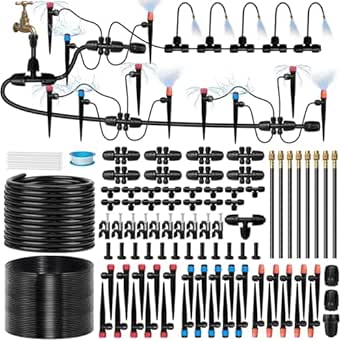


More Details on Our Top Picks
Rain Bird LNDDRIPKIT Drip Irrigation Kit
Best Overall goes to the Rain Bird LNDDRIPKIT because it is the only kit in this lineup built like a scaled-down professional system rather than a hobbyist bundle. The pressure regulator and backflow preventer included here are what separate it from cheaper kits like the 50FT system with misting nozzles — those accessories protect both your plants from pressure spikes and your drinking water from contamination, and most budget kits omit them entirely. Pressure-compensating emitters mean the plant at the end of the line gets the same flow as the one closest to the faucet, which matters if you have a long flower bed on a slope.
The tradeoff is complexity. With 108 pieces across drippers, bubblers, and micro-sprays, setup takes an afternoon and some planning, and automation requires buying the Rain Bird timer separately. Compared with the Raindrip R560DP, which includes a timer out of the box, you are paying more upfront and still buying a controller.
Pros:- Up to 80% water savings with efficient, matched watering devices
- Includes pressure regulator and backflow preventer rarely found in budget kits
- Pressure-compensating emitters deliver even watering across long runs
- Wide variety of fittings supports custom layouts and future expansion
Cons:- Timer sold separately, adding cost if you want automation
- 108-piece setup is time-consuming and may overwhelm first-timers
Best for: Homeowners with established flower beds or landscaped areas who want a permanent, professional-grade system that cuts water use dramatically
Not ideal for: Beginners who want everything in one box with a timer included — the missing controller and 108-piece setup make this a project, not an afternoon plug-and-play job
- Pieces:108
- Tubing:50 ft of 1/2 inch plus 50 ft of 1/4 inch
- Includes:Drippers, micro-bubblers, micro-sprays, fittings, stakes, tools
- Maximum Water Savings:80%
- Pressure Regulator:Yes
- Backflow Preventer:Yes
- Compatible Timer:Rain Bird 1ZEHTMR (sold separately)
Our verdict“If you want one system that behaves like a contractor installation and saves the most water long-term, this is the kit to buy — just budget for the timer.”
Drip Irrigation Kit for Garden, Greenhouse, and Patio
This unbranded kit earns Best Budget Starter Kit by stripping drip irrigation down to its essentials: faucet connector, tubing, and two types of adjustable nozzles. Where the Rain Bird LNDDRIPKIT demands planning and a parts inventory, this one can be running in under an hour without plumbing skills — that simplicity is the entire product. The adjustable nozzles let you dial flow from a trickle for seedlings to a heavier stream for thirsty vegetables, a flexibility you normally give up at this price.
The compromises are real, though. There is no pressure regulator, so emitter performance will vary along the line, and automation requires buying a separate timer. Tubing also tends to stiffen in cold weather; a soak in hot water before assembly solves it, but it adds friction the premium kits avoid. Compared with the Raindrip R560DP, you sacrifice the included timer and plant capacity for a lower entry price.
Pros:- Installs in about an hour with no plumbing experience
- Adjustable nozzles suit different plant watering needs
- Very low entry price for a complete starter system
- Works for garden, greenhouse, patio, and potted setups
Cons:- No timer included, so it cannot run unattended out of the box
- Tubing stiffens in cold weather and needs hot-water treatment to assemble
- No pressure regulation, so flow varies across longer lines
Best for: First-time gardeners with a small vegetable patch or a handful of containers who want to try drip irrigation without a big investment
Not ideal for: Anyone watering more than a small bed — capacity is limited, and the lack of pressure regulation makes it unreliable on longer runs
- Material:Plastic
- Connection:1/4″ tubing with faucet connector
- Nozzles:Adjustable, 2 types
- Suitable For:Garden, greenhouse, flower bed, patio, lawn, vegetables
- Installation:DIY, no plumbing skills required
- Timer:Not included
Our verdict“A low-risk way to test whether drip irrigation fits your routine — just plan to add a timer and eventually graduate to a bigger system if your garden grows.”
Raindrip R560DP Drip Watering System with Timer for Containers and Hanging Baskets
Best for Containers and Hanging Baskets is the only category where the Raindrip R560DP makes sense, and it wins it decisively. Unlike the budget starter kit, this one ships with a battery-powered timer included, so true unattended watering starts working the day it arrives — no extra purchases, no faucet hassles before a vacation. With 75 feet of hose and enough drippers for up to 20 plants, it is sized precisely for a patio of pots and hanging baskets rather than an in-ground bed.
That focused scope is also its ceiling. Next to the Rain Bird LNDDRIPKIT’s 108-piece expansion-friendly system, the R560DP cannot scale much beyond two dozen plants, and its lightweight plastic fittings will not tolerate being reconfigured season after season the way a sturdier system will. Battery replacement is a small but real maintenance chore. Compared with the solar-powered kit later in this roundup, it avoids sunlight dependence but gives up the smart scheduling entirely.
Pros:- Timer included, so automatic watering works out of the box
- 75 ft of hose easily reaches hanging baskets and scattered pots
- Simple installation with all components supplied
- Customizable layout for containers, baskets, and small beds
Cons:- Hard cap of about 20 plants limits expansion
- Plastic components are less durable than metal-fitting kits
- Battery-powered timer requires periodic replacement
Best for: Patio gardeners and frequent travelers with 20 or fewer containers and hanging baskets who want set-and-forget automation in one box
Not ideal for: Gardeners with in-ground beds or expanding plant collections — the 20-plant limit and plastic components will be outgrown quickly
- Capacity:Waters up to 20 plants
- Hose Length:75 feet
- Pieces:20
- Power Source:Battery powered
- Timer:Included
- Material:Plastic
- Dimensions:13.25 x 4 x 8.72 inches
Our verdict“If your garden is a collection of pots rather than a plot of soil, this all-in-one automated kit removes the daily watering chore for a fair price.”
50FT Drip Irrigation System for Garden, Greenhouse, and Outdoor Plants, Includes 11-Piece Sprinkler Kit and Adjustable Misting Nozzles
This 50-foot kit earns Best for Misting and Greenhouses because it is the rare budget option that treats misting as a first-class watering mode rather than an afterthought. The adjustable misting nozzles plus an 11-piece sprinkler set let you switch between fine fog for humidity-loving seedlings and targeted drips at the root zone — a combination the Pawfly and basic adjustable-emitter kits in this roundup cannot match, since those are drip-only. The quick-connect fittings also make repositioning emitters painless when your greenhouse layout changes mid-season.
The weakness sits in what is missing. Like the budget starter kit, there is no pressure regulator, and misting nozzles are more pressure-sensitive than drippers — on inconsistent municipal pressure, droplet size and coverage will drift. Nozzle durability under prolonged sun and frost is also unproven compared with the copper-nozzle kits elsewhere in this guide. Larger gardens will need extra fittings beyond what is boxed.
Pros:- Misting and drip modes in one system for versatile watering
- Quick-connect fittings allow fast layout changes
- Well suited to greenhouses and raised beds
- Directs water to root zones with minimal waste
Cons:- No pressure regulator included, which misting nozzles are sensitive to
- Nozzle durability in harsh weather is unverified
- Additional fittings needed for larger setups
Best for: Greenhouse growers and raised-bed gardeners who need humidity control and gentle misting alongside root-zone drip watering
Not ideal for: Gardeners with unstable water pressure or harsh climates — the plastic nozzles and absent pressure regulator make performance inconsistent over time
- Length:50 ft
- Sprinklers:11-piece set
- Nozzles:Adjustable misting
- Connection:Quick Connect 1/4″
- Includes:Y splitter, irrigation tubing
- Best Use:Gardens, greenhouses, raised beds
Our verdict“The right pick if misting seedlings matters as much as dripping established plants — just add a pressure regulator if your supply fluctuates.”
Solar Drip Irrigation System with 490 Timer Modes, 50FT Kit for Indoor & Outdoor Plants
Best Smart Pick goes to this solar-powered system, which takes automation further than anything else here. Where the Raindrip R560DP offers a basic mechanical timer, this kit delivers 490 programmable modes with durations from 10 seconds to 30 minutes — enough granularity to give a fragile orchid three short sips a day while a thirsty patio tomato gets one long soak. The LED display, IP67 waterproofing, and dual solar/USB charging make it genuinely usable year-round and even indoors, a claim no faucet-tethered kit in this roundup can make.
The tradeoffs center on power and scope. Capacity tops out at 15 potted plants, smaller than the Raindrip’s 20, and the modest 400 ml/min flow rate means it is built for containers, not beds. Setup is the most involved in this batch, and an extended stretch of gray skies leaves you dependent on the USB backup. Compared with the Rain Bird kit, you trade raw coverage and expandability for intelligence.
Pros:- 490 programmable modes with durations from 10 seconds to 30 minutes
- Dual solar and USB charging keeps it running in any season
- IP67 waterproofing and LED display for outdoor durability and monitoring
- Works indoors and outdoors without plumbing or faucet timers
Cons:- Limited to 15 plants with a modest 400 ml/min flow rate
- Setup is more involved than simpler kits in this guide
- Relies on sunlight or USB power, so extended cloud cover matters
Best for: Tech-comfortable plant owners with a collection of up to 15 pots, indoors or out, who want precise programmable watering without wiring or faucet timers
Not ideal for: Anyone watering large in-ground beds — the 15-plant cap and low flow rate are designed for containers, not volume watering
- Timer Modes:490 programmable modes
- Watering Duration:10 seconds to 30 minutes
- Flow Rate:400 ml/min
- Tube Length:50 ft
- Capacity:Up to 15 potted plants
- Waterproof Rating:IP67
- Power:Solar with USB backup
Our verdict“If you want the most precise, self-powered watering control available for a container garden — and don’t mind a longer setup — this is the smartest system on this list.”
Bluepro 200FT Drip Irrigation System with 360° Adjustable Copper Nozzles
This option stands out for its 32 copper nozzles, which resist the lime buildup and corrosion that plague plastic emitters after a season or two. Compared with the Bonviee 230FT kit, which leans on plastic emitters throughout, the Bluepro trades a slightly higher price for hardware that should survive multiple summers without clogging. The four flow modes — from fine mist to steady stream — let a single system serve ferns and tomato beds at once, and the quick-connect fittings make reconfiguring zones a five-minute job rather than an afternoon project.
The tradeoff is upfront effort and cost. Expect a longer initial installation than the simpler 100FT quick-connect kit, and know that replacing a lost copper nozzle costs more than swapping a plastic one.
Pros:- Copper nozzles resist rust, corrosion, and lime buildup far better than plastic
- Four distinct flow modes cover misting through steady drip in one system
- Claims up to 70% water savings versus overhead watering
- Quick-connect fittings make expansion and zone changes easy
Cons:- Initial setup takes noticeably more time and planning than smaller kits
- Replacement copper nozzles cost more than plastic alternatives
Best for: Serious gardeners with established multi-zone beds who want corrosion-resistant hardware that lasts for years
Not ideal for: Budget shoppers or renters — the copper components add cost that only pays off over multiple seasons of use
- Tubing Length:200 feet
- Nozzles:32 copper nozzles
- Nozzle Type:360° adjustable copper
- Flow Modes:Fine Mist, Gentle Drip, Steady Stream, Wide Spray
- Material:Brass, UV-protected PE hose
- Weather Resistance:Rust, corrosion, and lime buildup resistant
Our verdict“Worth the premium if you’re building a permanent, multi-season irrigation setup and hate replacing clogged emitters.”
230FT Drip Irrigation System for Garden with Adjustable Copper Nozzles & Emitters
What separates this kit from the similarly sized Bonviee 230FT system is its 1/2-inch main line, which handles higher water pressure without the sagging flow drops that thinner tubing suffers at the far end of a long run. That makes it the right pick when one faucet feeds an entire greenhouse plus a lawn strip. The mix of vortex, stream, misting, and copper emitters gives you zone-level control that single-emitter kits can’t match — seedlings get mist, shrubs get stream.
Be honest with yourself about setup, though. This is the most configuration-heavy kit in this batch, closer to a small landscaping project than a weekend assembly, and the plastic fittings won’t match the Bluepro’s copper durability.
Pros:- 1/2-inch main line sustains water pressure across long 230-foot runs
- Four emitter types allow genuinely different watering per zone
- Tool-free quick-connect installation
- Design minimizes evaporation and runoff
Cons:- The most complex setup in this lineup — not beginner-friendly
- Plastic components may degrade faster in harsh weather
- Accessory compatibility documentation is thin
Best for: Owners of large properties or greenhouses who need high-pressure capacity and different watering styles across zones
Not ideal for: First-timers with a small raised bed — the emitter variety and zoning complexity will be more frustration than benefit
- Tube Diameter:1/2 inch main line
- Main Line Length:33 ft
- Drip Line Length:197 ft
- Emitters:30 (10 vortex, 10 stream, 10 misting)
- Bendable Nozzles:8
- Nozzle Types:Vortex, stream, misting, copper
- Application:Garden, greenhouse, lawn
Our verdict“The strongest choice when scale and pressure matter more than simplicity, provided you’re comfortable planning zones yourself.”
100FT Drip Irrigation System Kit with Quick Connect Garden Watering
This kit hits a sweet spot between the 50FT brass-nozzle kit and the 200-foot-plus systems: enough tubing and emitters for a real vegetable garden, without the zoning complexity of the big kits. Its quick-connect fittings genuinely tool-free setup means most buyers are watering the same afternoon, and the 16 adjustable emitters split between vortex and stream patterns give useful flexibility for mixed plantings in raised beds or a greenhouse.
Where it falls short is ceiling. Unlike the 230FT kit, you can’t meaningfully extend it — hit 100 feet and you’re done, and larger layouts will need extra connectors the box doesn’t include. Think of it as the right-sized choice, not a grow-into-it choice.
Pros:- Tool-free quick-connect installation with leak-resistant fit
- Vortex and stream emitters suit both delicate and thirsty plants
- Flexible tubing adapts to raised beds, greenhouses, and irregular layouts
- Well-sized for typical backyard gardens without excess hardware
Cons:- Hard 100-foot ceiling with no included expansion parts
- Larger setups will require purchasing additional connectors separately
Best for: Raised-bed gardeners and greenhouse hobbyists who want a complete mid-size system installed in one afternoon
Not ideal for: Anyone planning to expand later — the fixed 100-foot length and limited connector count cap its growth
- Total Length:100 ft
- Main Tubing:25 ft of 1/2″
- Distribution Tubing:75 ft of 1/4″
- Emitters:8 vortex, 8 stream
- Connectors:4 six-way connectors
- Installation:Quick-connect, no tools required
Our verdict“The Goldilocks pick for a standard backyard garden — big enough to matter, small enough to install in a day.”
50FT Drip Irrigation Kit with Adjustable Spray Nozzles for Garden
For a first dip into drip irrigation, this 50-foot kit keeps things simple without the cheap-feeling hardware that plagues many entry-level options. Its 12 brass misting nozzles offer the corrosion resistance of the larger Bluepro system at a fraction of the scale, and the 360° bendable heads make it easy to nudge coverage after you see how water actually lands — a real advantage when you’re learning. Compared with the Pawfly 50ft kit, the brass nozzles here should age better through a hot summer.
The limitations are scale and pressure. There’s no included pressure regulator, so strong municipal pressure can cause misting at the faucet end, and 50 feet simply won’t stretch past a couple of raised beds.
Pros:- Corrosion-resistant brass nozzles outlast typical starter-kit plastic
- 360° bendable spray heads allow easy coverage fine-tuning
- Leak-resistant fittings with everything needed for a basic install
- Three adjustable spray modes support water-efficient watering
Cons:- No pressure regulator included — high-pressure taps may cause overspray
- Fixed 50-foot length with no expansion hardware in the box
Best for: Beginners with a small raised bed, container cluster, or greenhouse shelf who want durable nozzles from day one
Not ideal for: Anyone with more than a couple of beds — the 50-foot reach and 12 nozzles run out fast, and expansion fittings aren’t included
- Length:50 ft
- Nozzles:12 brass misting nozzles
- Spray Modes:3 adjustable modes
- Connectors:12 three-port connectors
- Faucet Connector:Included
- Extras:2 end plugs, 20 hose buckles, 10 cable ties
- Material:Brass, plastic
Our verdict“A sensible first system for a small space, built with nozzles you won’t be replacing next spring.”
Bonviee Drip Irrigation System Kit for Garden Watering, 230FT Quick Connect
This kit’s strongest argument is hose timer compatibility — pair it with a cheap timer and you have genuinely hands-off watering, which puts it in the same automation conversation as the Raindrip R560DP at a lower total cost. The adjustable emitters let you dial back flow for herbs and open it up for thirsty squash, and 230 feet of tubing covers most suburban gardens in one purchase. Compared with the 230FT copper-nozzle system, you give up the 1/2-inch high-pressure main line and premium emitter materials, but you also skip most of the setup headache.
The catch is maintenance: those adjustable emitters need periodic cleaning, especially with hard water, and complex layouts will still demand extra fittings.
Pros:- Works with standard hose timers for fully automated schedules
- 230 feet of tubing plus stakes and connectors in one affordable box
- Per-emitter flow adjustment handles mixed plant needs
- Tool-free quick-connect installation
Cons:- Adjustable emitters require regular cleaning to avoid clogs
- Additional fittings needed for intricate layouts
Best for: Budget-minded gardeners who want timer-driven automatic watering across a large area without buying a premium kit
Not ideal for: Gardeners with hard water or very high pressure — the plastic emitters clog and the thinner tubing can’t match the 1/2-inch kits’ flow
- Total Length:230 ft
- Tubing Sizes:197 ft 1/4″, 33 ft 5/16″
- Includes:Adjustable emitters, connectors, stakes
- Key Features:Quick-connect fittings, adjustable water flow
- Automation:Compatible with hose timers
- Installation:Tool-free setup
Our verdict“The most cost-effective path to set-it-and-forget-it watering on a big garden, if you’ll commit to occasional emitter maintenance.”
Pawfly 50ft Drip Irrigation System Kit with 1/4″ Tubing and Adjustable Emitters
For a first dip into drip irrigation without much cash on the line, this Pawfly kit keeps things simple: 50 feet of UV-resistant tubing, 12 adjustable sprinklers, and push-to-fit fittings that go together in an afternoon. The PTFE tape included for threaded joints is a nice touch most competitors skip at this price. Compared with the Carpathen kit, you get fewer emitters (12 versus 30), but the leakproof fitting design makes it more forgiving for someone assembling their first system. The tradeoff is scale and longevity — 1/4-inch tubing throughout limits you to small beds and containers, and the plastic parts will likely weather faster than brass-equipped kits like the 100ft copper-nozzle option. This pick makes the most sense for a small patio or raised bed, not a sprawling vegetable plot.
Pros:- Push-to-fit fittings make first-time installation nearly foolproof
- Adjustable sprinklers let you tune flow per plant
- PTFE tape included for sealed threaded connections
- UV-resistant tubing holds up better than bargain kits in direct sun
Cons:- Only 12 emitters — among the smallest capacities in this roundup
- All-plastic construction degrades faster than brass or copper alternatives
- 1/4-inch tubing limits flow and future expansion
Best for: First-time gardeners with a small patio, greenhouse shelf, or single raised bed who want a cheap, low-commitment setup
Not ideal for: Anyone watering more than a few beds — 50 feet of 1/4-inch line and 12 emitters will run out fast, and the 50 psi ceiling caps expansion
- Tubing Length:50 ft
- Tube Diameter:1/4 inch
- Sprinklers:12 adjustable
- Maximum Pressure:50 psi
- Material:Plastic (UV-resistant)
- Pieces Included:77
- Fittings:Push-to-fit, leakproof
Our verdict“Buy this if you want an inexpensive, low-risk way to water one small garden zone; skip it if you’re planning anything multi-bed.”
Drip Irrigation System 230FT Quick-Connect Kit with 1/4″ and 1/2″ Tubing
This is the kit to get when one raised bed has become five. With 230 feet of tubing split between a 1/2-inch mainline and 1/4-inch distribution lines, it mirrors the two-line architecture of the Carpathen kit but at more than double the coverage. The 1/2-inch mainline matters more than it sounds: it maintains pressure across long runs, which is why micro drop, spray, and watering modes stay consistent at the far end of the garden. Compared with the Pawfly 50ft kit, the jump in scale is dramatic, though you’ll still want extra fittings for very ambitious layouts. The main gap is no timer or automation — unlike the Raindrip R560DP, you’re turning the faucet on and off yourself every day unless you add a controller separately.
Pros:- 1/2-inch mainline plus 1/4-inch distribution preserves pressure over long runs
- Three irrigation modes cover seedlings through established plants
- Quick-connect fittings scale easily across multiple zones
- Enough tubing for most suburban gardens in one purchase
Cons:- No timer or automation included
- Large layouts may still need additional fittings beyond what’s boxed
- Fixed tubing lengths force you to plan your layout around the kit
Best for: Owners of large or multi-zone vegetable gardens and greenhouses who need long tubing runs and varied watering styles
Not ideal for: Small-space or container gardeners — the extra 150+ feet of tubing is wasted money, and there’s no timer for hands-off convenience
- Total Tubing Length:230 ft
- Mainline Tubing:33 ft (1/2 inch)
- Distribution Tubing:197 ft (1/4 inch)
- Irrigation Modes:Micro drop, spray, watering
- Components:Connectors, tees, emitters, nozzles, faucet connector
- Compatibility:Garden, greenhouse, raised beds
- Fittings:Quick-connect
Our verdict“The right choice for bigger plots where smaller kits run out of line, provided you’re willing to add a timer yourself.”
Drip Irrigation System, 100Ft 1/4″ Garden Watering Kit with 24 Adjustable Copper Nozzles
Sitting between the small Pawfly kit and the sprawling 230FT system, this option hits a practical middle ground: 100 feet of tubing with 24 adjustable copper nozzles, stakes, ties, and end caps all in the box. The 360° rotating copper nozzles are the selling point — they direct water exactly where roots need it and resist clogging better than plastic sprayers, which is where most water waste actually happens. Compared with the Bluepro 200FT kit, you trade total coverage for a tighter, easier-to-manage layout. The tradeoffs are real, though: copper can corrode over seasons, and 1/4-inch-only tubing means pressure drops if you push the 24 nozzles across a very wide area. For a medium vegetable garden or greenhouse bench, the balance of coverage and control is hard to beat at this size.
Pros:- 360° adjustable copper nozzles deliver targeted, clog-resistant watering
- Complete kit includes stakes, ties, and end caps — no supplementary purchases
- Tool-free quick-connect fittings speed up layout changes
- 100 ft of tubing covers a genuine mid-size garden
Cons:- Copper nozzles may corrode over multiple seasons
- Plastic tubing is vulnerable in extreme heat or freeze cycles
- Single tubing diameter limits large-scale expansion
Best for: Medium-garden growers who want precise per-plant targeting with copper nozzles and a complete accessory package in one box
Not ideal for: Very large or spread-out gardens — 1/4-inch line alone can’t maintain even pressure across 24 nozzles at distance
- Tubing Length:100 ft
- Tube Diameter:1/4 inch
- Nozzles:24 adjustable copper
- Nozzle Rotation:360°
- Material:Plastic, copper
- Fittings:Quick-connect, tool-free
- Included Accessories:Connectors, stakes, ties, end caps
Our verdict“A strong middleweight pick for gardeners who outgrew a 50-foot kit but don’t need 200+ feet of line.”
49.21Ft Drip Irrigation Kit System, 360° Bendable Garden Irrigation System
Not every plant wants a soaking — seedlings, ferns, and propagation benches want mist, and this is the kit built for that. Its brass misting nozzles and three adjustable modes (small, medium, large) let you dial from a fine fog to a wider spray, something no other kit in this lineup matches as directly. The 360° bendable tubing holds its shape around pots and shelving, which the stiffer Pawfly lines can’t do. Compared with the copper-nozzle 100ft kit, you give up coverage for precision — this is gentle watering for a small, controlled space. Be prepared to cut tubing to length yourself, and connections need care to avoid drips. There’s also no automation, so daily misting stays a manual chore unless you pair it with a separate timer.
Pros:- Brass misting nozzles produce fine, even mist that plastic sprayers can’t match
- Three water-saving modes tune output from fog to spray
- Bendable tubing holds shape around shelves and pots without stakes
- Includes 1/2 and 3/4 inch faucet adapters with filter net
Cons:- Requires manual cutting to customize length
- No timer or automation features
- Connections can leak if not seated carefully
Best for: Plant collectors and propagators who need gentle, adjustable misting for seedlings, humidity-loving plants, or greenhouse benches
Not ideal for: Vegetable gardeners wanting deep root watering — misting wastes water on large beds and demands daily manual operation
- Length:49.21 ft
- Tubing Diameter:5/16 inch (8 mm)
- Nozzle Type:Brass misting, 360° bendable
- Adjustable Modes:3 (small, medium, large)
- Faucet Adapter:1/2 inch and 3/4 inch with filter net
- Installation:DIY, manual cutting required
Our verdict“The specialist’s choice for misting delicate plants — niche, but better at its job than any general-purpose kit here.”
Carpathen Drip Irrigation System Kit for Garden Watering, 100 ft
The Carpathen kit is engineered around a specific promise — up to three raised beds from one box — and its architecture backs that up. A 50-foot mainline plus 50 feet of drip tubing mirrors the two-tier design of the 230FT quick-connect kit at half the scale, and the emitter selection is more thoughtful than most: 10 vortex emitters for deep-root watering and 20 spray emitters for broader coverage. The clog-resistant, easy-to-clean emitters address the single most common drip-system failure, which is why this kit earns the raised-bed slot over the similarly sized 100ft copper-nozzle option. Limits are clear: you’re capped at 30 emitters, setup is manual with real adjustment required, and at 45 psi maximum it won’t feed a large market garden. For a typical backyard vegetable setup, it’s the most coherent package here.
Pros:- Vortex plus spray emitter mix handles deep roots and surface watering in one system
- Clog-resistant emitters are easy to clean, extending system life
- UV-resistant tubing rated for year-round outdoor use
- Designed around the exact geometry of raised-bed gardens
Cons:- Hard cap of 30 emitters per system
- Manual setup and ongoing adjustment take real effort
- Lower 45 psi ceiling than competing kits
Best for: Backyard vegetable growers with two to three raised beds who want reliable, low-maintenance deep watering
Not ideal for: Large-scale or commercial gardeners — the 30-emitter cap and 45 psi ceiling make expansion impractical
- Mainline Tubing:50 ft
- Drip Tubing:50 ft
- Emitters:10 vortex + 20 spray (30 total)
- Maximum Pressure:45 psi
- Max Output per Emitter:60 gallons/hour
- Capacity:Up to 3 raised garden beds
- Tubing Rating:UV-resistant, year-round use
Our verdict“The most complete raised-bed package in this lineup — buy it if your garden fits within its three-bed ceiling, look elsewhere beyond that.”
How We Picked
My ranking prioritized actual water efficiency over raw kit size, because a 230-foot system that dumps water at uneven rates saves less than a well-regulated 50-foot one. I evaluated each kit on emitter consistency (pressure-compensating vs. adjustable), tubing quality and UV resistance, included automation, quick-connect fitting reliability, and real cost per foot of coverage. Kits with timers ranked higher when the timer offered multiple daily cycles, since deep, infrequent watering is more water-efficient than frequent shallow sessions.
I also weighed setup friction heavily. A water-saving system that’s confusing to install tends to get abandoned or misadjusted, which defeats the purpose entirely. Finally, I factored in expandability — whether a kit uses standard 1/4 inch and 1/2 inch fittings determines whether you can extend or repair it with off-the-shelf parts, or whether you’re locked into proprietary components. Products that scored well across efficiency, durability, and flexibility placed at the top; cheap kits with thin tubing and unregulated nozzles ranked lower even when their coverage numbers looked impressive on paper.
Factors to Consider When Choosing Water-saving Drip Irrigation Systems
Choosing a drip system is really about matching water delivery to your plants, pressure, and schedule — not just buying the longest tubing you can find. These are the factors that separate a genuinely water-saving setup from one that just looks efficient.Emitter Type: Adjustable Looks Tempting, Fixed Saves More
The biggest mistake buyers make is assuming adjustable nozzles equal better water control. Adjustable emitters and copper misting nozzles let you dial flow from a trickle to a spray, but they rely on you to balance every outlet by hand — and most people set them once, forget them, and over-water half their garden all summer. Pressure-compensating emitters deliver a fixed gallon-per-hour rate regardless of pressure, which means the plant at the end of the line gets the same water as the one at the start. If your garden has mixed plant types, a hybrid approach works best: fixed emitters for consistent drinkers like tomatoes, and a handful of adjustable outlets for pots and newly planted seedlings. Also check the emitter’s GPH rating against your climate — 1 GPH suits most vegetable gardens, while arid regions may need 2 GPH on thirsty plants.
Tubing Size and Pressure: Why Long Kits Behave Differently
Most entry-level kits use only 1/4 inch tubing, which is fine up to roughly 30–40 emitters before friction starves the far end of the line. Larger kits that pair a 1/2 inch mainline with 1/4 inch branches maintain pressure across 200+ feet, which is why the big Bonvieh and 230FT kits punch above their weight for large gardens. Household water pressure also matters: kits with cheap barbed fittings blow apart above 60 PSI, so a pressure regulator is cheap insurance if your supply runs strong. If you’re on a well or gravity-fed tank, look for low-pressure emitters rated to work below 20 PSI — many adjustable nozzles simply stop functioning at low pressure. Buying a kit sized one tier above your current garden also leaves room to expand without re-plumbing everything.
Automation: The Single Biggest Water Saver
An emitter upgrade might save you 10–15% on water; a timer can save 30% or more by watering at dawn when evaporation is lowest and stopping before runoff. Only a couple of kits in this roundup include timers, but any system with standard fittings can accept an add-on hose timer for $25–40 — I’d call that the highest-value upgrade for most buyers. Look for timers that support at least two start times per day and interval-based scheduling, since watering every other day deeply beats a shallow daily sprinkle. Solar-powered timer kits suit gardens far from an outlet or spigot, though their pumps move less water than line-pressure systems, so match the kit to your garden’s actual demand. Battery timer models are more reliable in cold climates where solar charging gets weak in shoulder seasons.
Tubing Durability and UV Resistance
Tubing is the part of the system that fails first, and failure means leaks — the opposite of water-saving. Budget kits almost universally use thin-wall 1/4 inch vinyl that becomes brittle after one or two seasons of sun exposure, while mid-tier kits use polyethylene that holds up for five years or more. Check whether replacement tubing and fittings are standard sizes; proprietary connectors can turn a $5 repair into a $30 order from one vendor. Burying tubing under mulch dramatically extends its life by blocking UV, and it also reduces evaporation losses at the soil surface. Stakes and risers matter too: kits with flimsy plastic stakes lose positioning after wind and foot traffic, pushing emitters away from root zones where the water actually does good.
Coverage Math: Match Kit Size to Your Real Garden
Manufacturers quote tubing length, but what you actually need to count is emitters and plants. A 50FT kit with 20 emitters waters about 20 plants; doubling tubing length doesn’t double capacity if the emitter count stays flat. Sketch your garden first and mark where each plant needs an outlet, then buy the kit whose emitter count — not footage — covers that with 20% spares for mistakes and expansion. Overbuying has its own cost: coiled excess tubing in the sun degrades faster and creates pressure inconsistencies. For containers and hanging baskets specifically, look for kits that include stakes, risers, and a timer, since potted plants dry out faster and benefit most from automated, frequent-but-light schedules.
Cost Per Season, Not Cost Per Box
The cheapest kit on the shelf often costs the most over three years once you factor in replacement tubing, blown fittings, and water wasted by unregulated emitters. A reasonable way to compare is total cost divided by emitter count, then adjusted for whether a timer, pressure regulator, and spare fittings are included. Premium kits justify their price mainly through fittings that don’t leak and tubing that survives winters, not through fancier nozzles. If you plan to winterize by draining and storing the system, mid-range kits perform nearly as well as premium ones. And if your water is metered, calculate your savings: a timer-driven drip system on a 400-square-foot vegetable garden commonly pays for itself within two seasons in water bills alone.
Frequently Asked Questions
Do adjustable nozzles or fixed emitters save more water?
Fixed pressure-compensating emitters almost always save more water in practice, even though adjustable nozzles seem like the more precise choice. Adjustable outlets depend on manual balancing — if one nozzle is dialed wider than needed, that plant gets over-watered every single cycle until someone notices. Pressure-compensating emitters deliver a fixed flow regardless of where they sit on the line, so the whole system stays balanced automatically. Adjustable nozzles still have a place for containers, seedlings, and plants with changing needs, which is why the best setups mix both. If you can only pick one, start with fixed emitters for the main garden and add a handful of adjustable outlets where flexibility genuinely helps.
Can a 50FT kit water my whole vegetable garden?
It depends entirely on plant count rather than square footage. A 50FT kit typically supports 20–30 emitters, which covers a modest raised-bed garden of roughly 20 plants with a few spares. Once you exceed about 35–40 emitters on 1/4 inch tubing alone, friction causes the end of the line to receive noticeably less water, and plants there will struggle. For larger gardens, choose a kit that includes a 1/2 inch mainline — the mainline carries pressure the length of the garden while short 1/4 inch branches feed individual plants. The 200FT-plus kits in this roundup are built exactly this way, and the difference in end-of-line performance is obvious at scale.
Is a solar-powered drip system worth it without an outdoor spigot?
Solar kits make sense when your garden is far from a faucet, a rain barrel is your water source, or you’re renting and can’t tap into plumbing. They pair a small pump with a solar-charged battery and timer, so they run independently of line pressure. The tradeoff is flow: solar pumps move much less water than municipal pressure, which limits them to roughly 20–30 low-flow emitters and rules out misting nozzles entirely. They also struggle on heavily overcast stretches unless the battery has reserve capacity, so check reviews for cloudy-day reliability. If you have a working spigot within hose distance, a conventional system with a battery timer will water more consistently for less money.
How much water does drip irrigation actually save compared to sprinklers?
Drip systems typically cut outdoor water use by 40–60% versus overhead sprinklers, and the savings come from three mechanisms working together. First, water goes directly to root zones instead of wetting leaves, paths, and fences. Second, drip loses almost nothing to evaporation because it’s applied at the soil surface rather than sprayed through the air — sprinklers can lose 20–30% on a hot, windy afternoon. Third, drip pairs naturally with timers, enabling dawn watering when evaporation is lowest and soil absorption is best. The exact savings depend on how well emitters are sized to your plants; an over-dialed adjustable system can erode much of that advantage, which is another argument for regulated emitters.
Do I need a filter and pressure regulator, even if the kit doesn’t include them?
Yes to both in most cases, and their absence is one of the quietest downsides of budget kits. A 120-mesh filter costs around $10 and prevents the fine sediment in household water from clogging emitters — a clogged emitter is invisible until the plant it feeds starts dying, and unclogging dozens of tiny outlets is tedious. A pressure regulator matters if your supply runs above about 60 PSI, which is common in many municipalities; excess pressure forces connections apart, creates micro-leaks, and pushes more water through emitters than their rating. Both parts install in seconds at the spigot and work with any standard-fitting kit. If your kit uses proprietary connectors, verify compatibility before ordering, since a few budget systems don’t accept standard thread-on accessories.
Conclusion
The right pick here depends less on garden size than on how you water. For best overall, the Rain Bird LNDDRIPKIT pairs pressure-compensating emitters with expandable standard fittings, making it the most reliable platform for genuine water savings across a mixed garden. The Raindrip R560DP is my best value for containers and hanging baskets, since its included timer automates watering at a price where most competitors give you tubing and nothing else. On the premium end, the Solar Drip Irrigation System with 490 timer modes justifies its cost for off-grid, rain-barrel, or spigot-free setups that simpler kits simply can’t serve. Beginners should start with the Pawfly 50ft kit — its quick-connect fittings and modest scope make first-time installation nearly error-proof, and it’s cheap enough that mistakes don’t hurt. For large gardens over roughly 40 plants, the Bonvieh 230FT Quick-Connect and the 230FT kit with 1/2 inch mainline deliver the pressure consistency smaller kits can’t, while the Bluepro 200FT with copper nozzles suits gardeners who want maximum layout flexibility and are willing to manage flow settings carefully. Whatever you choose, add a timer if your kit lacks one — it’s the single upgrade that turns a drip system into a genuinely water-saving one.
Halloween Picks
halloween
As an affiliate, we earn on qualifying purchases.