
TL;DR

Get garden gear delivered free with Prime
- Fast, free delivery on millions of items
- Prime Video, Amazon Music and more included
- Member-only deals all year
Rock dust is finely ground mineral material that may supply selected nutrients or trace elements, depending on its source and product analysis. The report advises testing soil first, following the product’s directions and not treating rock dust as a replacement for compost or balanced fertilizer.
A Grow Organic report on garden rock dust advises gardeners to check soil-test results and product composition before applying the finely ground mineral amendment. The guidance matters because rock dust can contain different minerals depending on its source, is not a complete fertilizer, and cannot replace compost or other amendments selected for a specific soil need.
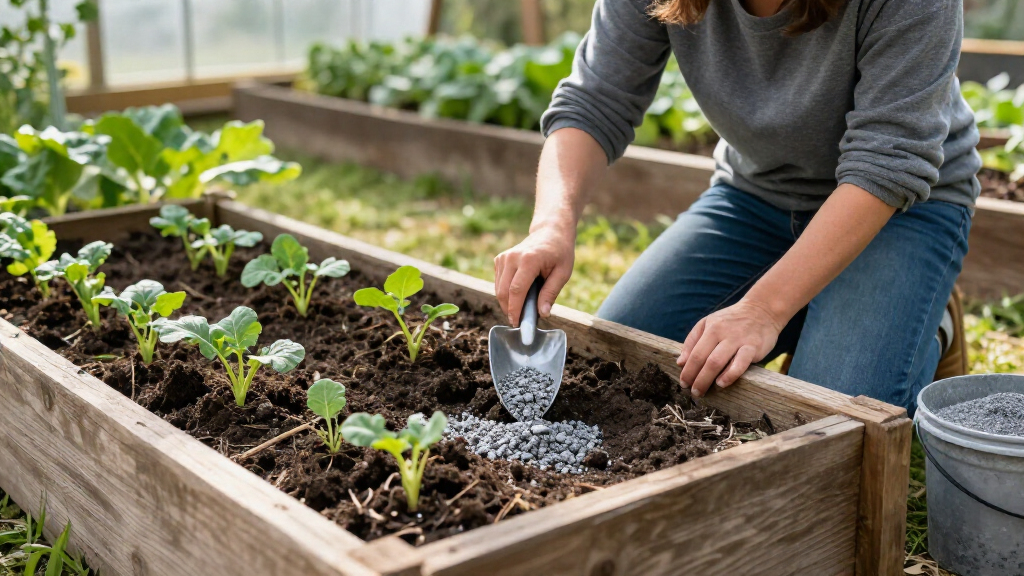
Rock dust is rock that has been crushed or milled into fine particles. Its mineral content depends on the original rock, while particle size and soil conditions affect how readily minerals weather and become available. The report says some products may supply selected nutrients or trace elements, but not every product has the same composition or effect.
The report describes glacial rock dust, made from material ground and moved by glaciers, as potentially containing a mixture of minerals. Volcanic rock dust, including basalt products, can contain elements such as calcium, magnesium, iron and silicon, but the exact analysis varies. AZOMITE is identified as a mined mineral product from Utah; the report directs gardeners to follow its current product instructions rather than assume a universal rate.
Before applying any of these materials, gardeners should test the soil and review the product label and analysis. Application rates differ, and products may be mixed into soil or potting mixes or spread on the surface, depending on their directions. The report also cautions against breathing airborne powder during application. Construction stone dust should not be assumed suitable for gardens; choose a product intended for soil or plant use.
Why Soil Tests Should Guide Mineral Additions
The practical issue is not whether a product contains minerals, but whether those minerals address a documented soil need. Adding an amendment without checking soil conditions can waste money and may contribute to nutrient imbalances. The report points to University Extension guidance that mineral amendments should be supported by soil-test results and product information.
Rock dust also does not supply the organic matter found in compost. For soil structure, aggregation and water management, the report says organic matter is often more useful than adding mineral powder. Gardeners with hard or compacted soil should not assume rock dust alone will solve the problem. A soil test can help distinguish a mineral deficiency from a structural issue or another fertility need.
That distinction is especially relevant for rock phosphate, which is primarily a phosphorus source rather than a general mineral amendment. The report cites Oregon State Extension guidance to apply it according to soil phosphorus test results and not to use it when phosphorus is already high. Excess phosphorus can contribute to nutrient imbalances and water pollution, according to the report’s FAQ.
glacial rock dust mineral soil amendment
As an affiliate, we earn on qualifying purchases.
As an affiliate, we earn on qualifying purchases.
Rock Dust, Compost and Rock Phosphate
Rock dust is sometimes marketed or described as a kind of rock powder fertilizer, but the report cautions that most products are not complete fertilizers. A product may contain certain elements without supplying the full range of nutrients plants need. Its usefulness depends on the source rock, the product’s analysis, soil conditions and the crop being grown.
Rock phosphate is a separate material with a more specific role as a phosphorus source. The report says it may be useful when phosphorus is needed, particularly in acidic soils where it can dissolve more readily. It is not interchangeable with general rock dust, and its use should follow soil-test guidance. The report also distinguishes mineral amendments from compost: minerals do not provide compost’s organic matter.
Because rock composition and particle size vary, claims about benefits cannot be applied uniformly to every product or garden. The supplied report does not provide independent trial results or a single rate that applies across brands and soil types. It instead points readers to product-specific directions and soil testing.
“Rock dust for garden use is not a cure-all and does not replace compost, fertilizer, or a soil test.”
— Grow Organic report
volcanic basalt rock dust for gardens
As an affiliate, we earn on qualifying purchases.
As an affiliate, we earn on qualifying purchases.
What Product Labels Cannot Settle
The supplied report does not establish that rock dust improves growth in every garden, nor does it give a universal application rate. Mineral content and release vary by source material, particle size, product and soil conditions, so the effect on pH or plant nutrition cannot be predicted from the name “rock dust” alone.
The material also does not provide a specific date for the report, detailed test results for the named products, or a comparison of their effectiveness. Gardeners should consult current product analyses and directions and use a soil test to assess their own conditions. Whether a given amendment is needed remains dependent on those details.
AZOMITE mineral supplement for soil
As an affiliate, we earn on qualifying purchases.
As an affiliate, we earn on qualifying purchases.
Check Soil Before Applying
Gardeners considering rock dust should start with a soil test, then compare its results with the product’s composition and current label directions. If a test identifies a need that the product can address, apply it only at the recommended rate and using the method specified for that product. Avoid creating airborne dust during handling.
For soil structure or water management, consider whether compost or another organic matter amendment is more appropriate. For phosphorus needs, consult soil-test guidance on rock phosphate rather than treating it as a substitute for general rock dust. The next step for any garden is to match the amendment to the measured need; the supplied report does not identify a single product or rate for all gardens.
soil test kit for garden nutrients
As an affiliate, we earn on qualifying purchases.
As an affiliate, we earn on qualifying purchases.
Key Questions
How much rock dust should I add to garden soil?
There is no universal rate in the report. Check your soil-test results and the product’s current analysis and instructions before applying it.
Can rock dust replace compost or fertilizer?
No. The report says rock dust may supply selected minerals but is not generally a complete fertilizer and does not provide compost’s organic matter. Choose amendments according to the soil’s needs.
Is rock phosphate the same as rock dust?
No. Rock phosphate is mainly a phosphorus source; general rock dust varies with its source rock. The report cites guidance to base rock phosphate use on soil phosphorus results and avoid it when phosphorus is already high.
Can rock dust change soil pH?
It can, but the effect depends on the rock’s chemistry, particle size, application rate and soil conditions. The report does not give a single pH effect that applies to every product.
Is construction stone dust suitable for plants?
Not automatically. The report advises choosing a product intended for soil or plant use, checking its composition and following its directions. Avoid breathing airborne dust when applying fine material.
Source: rss
Fall yard work Picks
leaf blowers
As an affiliate, we earn on qualifying purchases.