TL;DR
Open a free Amazon Business account
Business pricing, bulk buying and tax-exempt orders.
Create a free accountAs an affiliate, we earn on qualifying purchases.
On slopes, standard emitters struggle with uneven watering due to pressure variations, while pressure-compensating emitters maintain flow consistency. Investing in the right type improves water use, plant health, and saves money in the long run.
On steep slopes, pressure-compensating emitters keep water flow steady, preventing over- and underwatering.
Standard emitters are cheaper upfront but often lead to uneven watering and higher long-term water costs.
Proper system design—including pressure regulation and emitter selection—maximizes water efficiency in desert landscapes.
Regular cleaning and filter maintenance are essential to prevent clogging, especially in dusty desert air.
On slopes over 10 degrees, investing in pressure-compensating emitters pays off in healthier plants and water savings.
Why Slopes Make Water Distribution a Challenge
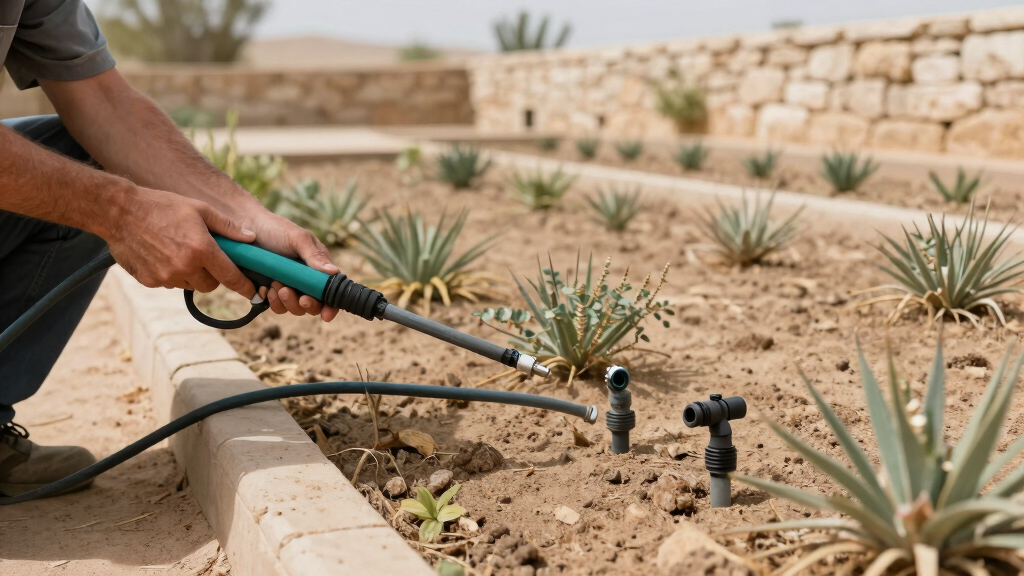
When you irrigate a sloped lot, water pressure varies along the length of your tubing. At the top, pressure is higher; at the bottom, it’s lower. Standard emitters don’t adjust for these changes, so they deliver inconsistent watering—often overwatering plants at the top and starving those below. Imagine watering your hillside garden: some plants get drenched, others barely get a sprinkle. That’s a recipe for uneven growth and wasted water.
In contrast, pressure-compensating emitters are designed to handle these pressure swings, ensuring each plant gets its fair share. This consistent flow leads to healthier plants, less runoff, and a lot less watering guesswork. If your lot slopes more than a gentle incline, this difference matters a lot.
Choosing the right emitter impacts not just water distribution but also your overall garden health. Uneven watering can cause stress, disease, and uneven growth, which might require more maintenance and fertilizers to correct. The implications are clear: investing in pressure regulation technology can lead to a more resilient and sustainable landscape.

MXIC 24 Pack Push-to-Fit Drip Irrigation Emitters, Leak-Proof Pressure Compensating Drip Emitters, Constant Water Flow 1gph Drip Emitters for 1/4 Inch Tubing
- Push-to-Fit Design: Easy, tool-free tubing connection
- Multi-Pack Versatility: Includes 30 emitters for various gardens
- Consistent 1 GPH Flow: Provides uniform watering for plants
As an affiliate, we earn on qualifying purchases.
As an affiliate, we earn on qualifying purchases.
Standard vs Pressure-Compensating Emitters: The Real Difference
| Feature | Standard Emitters | Pressure-Compensating Emitters |
|---|---|---|
| Flow Rate Consistency | Varies with pressure; can be uneven on slopes | Maintains steady flow despite pressure changes |
| Cost | Lower upfront, but possible water waste | Higher upfront, but saves water |
| Installation | Simpler, cheaper | Slightly more complex, but worth it on slopes |
| Durability | Prone to clogging, uneven performance | Better filtration, clog-resistant |
| Best Use | Flat terrain or gentle slopes | Steep slopes or variable pressure zones |
Think of standard emitters as a simple faucet—they deliver water at a fixed rate, but if your hose is uphill or downhill, the flow shifts. Pressure-compensating emitters are like a smart faucet that adjusts itself to keep flow steady, no matter how steep the slope.
However, this difference in technology has deeper implications. Standard emitters might initially seem more economical, but the uneven watering they produce can lead to overwatering certain plants and under-watering others. This imbalance can cause plant stress, increase disease susceptibility, and lead to higher long-term water costs due to runoff and inefficiency. Pressure-compensating emitters, while more expensive initially, help maintain a uniform watering pattern, reducing these risks and promoting healthier, more resilient plants. The tradeoff is clear: investing upfront in better technology can pay dividends through healthier landscapes and conservation of resources.

NRWRTY 50pcs 1 GPH Pressure Compensating Drippers for Drip Irrigation
- Standard Daily Flow: Delivers 1 GPH for daily watering
- Reliable Pressure Compensation: Maintains consistent flow regardless of pressure
- Outdoor Durable Anti-Clog: Self-cleaning, wear-resistant, anti-corrosion
As an affiliate, we earn on qualifying purchases.
As an affiliate, we earn on qualifying purchases.
How Slope Degree Changes Your Watering Strategy
The steeper your slope, the trickier water distribution gets. On a gentle hillside—say, less than 10 degrees—standard emitters might do okay if your pressure is stable. But once you hit slopes over 15 degrees, uneven watering becomes a real problem.
For a backyard hillside with a 20-degree incline, pressure differences can cause top plants to receive 50% more water than those below. This disparity not only wastes water but can also lead to erosion, soil instability, and stressed plants that are more susceptible to pests and disease. The long-term health of your landscape hinges on how well you can manage these pressure imbalances.
In those cases, pressure-compensating emitters can cut that disparity by half or more. They maintain a steady flow regardless of slope, ensuring each plant receives its fair share. This consistency reduces runoff, prevents soil erosion, and promotes healthier root systems, ultimately leading to a more sustainable and low-maintenance garden. The tradeoff is that on very steep slopes, the initial investment in pressure regulation and quality emitters can significantly improve your landscape’s resilience and water efficiency.

CARPATHEN Drip Irrigation System Kit for Garden Watering, Sprinkler, 100 ft
- Complete Drip Irrigation Kit: Includes emitters, tubing, connectors, and guides
- Easy DIY Garden System: Connects to water source with simple setup
- Adjustable Spray Emitters: High-quality, clog-resistant, and easy to clean
As an affiliate, we earn on qualifying purchases.
As an affiliate, we earn on qualifying purchases.
Frequently Asked Questions
Can I retrofit my existing system with pressure-compensating emitters?
Yes, but you’ll need to check your system’s pressure regulation and possibly adjust or add pressure regulators. Upgrading can significantly improve water uniformity on slopes.Are pressure-compensating emitters suitable for very steep slopes?
Absolutely. They are designed to handle larger pressure variations, making them ideal for slopes over 20 degrees or uneven terrains.What’s the best way to prevent clogging in desert water?
Install filters at the system’s beginning, regularly clean emitters, and consider using pressure regulators to keep pressure steady, reducing debris buildup.How much more do pressure-compensating emitters cost compared to standard ones?
Typically, they cost about 20-30% more per emitter, but the savings in water and healthier plants often outweigh the initial expense.How do I know if my system pressure is stable enough for standard emitters?
Use a pressure gauge during system operation. If pressure fluctuates more than 10 psi across your slope, pressure-compensating emitters are a better choice.
100 Pack – Netafim Woodpecker Drip Irrigation Emitters – Sturdy, Reliable, and Clog-Resistant Emitters for Precision Watering | Pressure Compensating | (1 GPH (Black))
- Inlet and Outlet Size: 1/4 inch
- Flow Path Design: Widest flow path reduces clogging
- Filtration Recommendation: Minimum 120 mesh filtration
As an affiliate, we earn on qualifying purchases.
As an affiliate, we earn on qualifying purchases.
Conclusion
In desert gardening, a little extra investment in pressure-compensating emitters can make a world of difference. They turn slope challenges into opportunities for smarter, more efficient watering. Think of your irrigation system as the backbone of your landscape—make it steady, and your garden will thrive with less water and less fuss.Pool season Picks
robotic pool cleaners
As an affiliate, we earn on qualifying purchases.