TL;DR

Get garden gear delivered free with Prime
- Fast, free delivery on millions of items
- Prime Video, Amazon Music and more included
- Member-only deals all year
Bare-root ocotillo typically needs two years to fully establish. This slow process is normal, driven by root regeneration, soil conditions, and plant resilience. Patience and proper care make all the difference.
If you’ve ever planted an ocotillo from a bare root, you know it’s not an instant fix. It can sit leafless for months, then suddenly leaf out after a rare rain. That slow, almost stubborn pace is part of its desert resilience. Understanding why it takes two years—or even longer—to truly settle in can save you frustration and help you care for your plant better.
This isn’t about failure or impatience. It’s about respecting what ocotillo needs to thrive: patience, proper planting, and the right conditions. Here’s what’s really happening during those first couple of years, and how to tell if your plant is on the right track.
Bare-root ocotillo usually takes 1-2 years to fully establish, with patience being essential.
Signs of root development include stable canes, swelling buds, and sustained leafing over multiple seasons.
Proper planting—depth, drainage, orientation—significantly influences survival and speed of establishment.
Water deeply but intermittently, adjusting to soil conditions and avoiding overwatering, especially in the first two years.
Large, stressed, or cold-planted ocotillos may take longer to settle in; don’t rush to judge death too early.
Ocotillo Establishment: Why Bare-Root Canes Take Two Years
A leafless ocotillo is not necessarily a failed ocotillo. Beneath the surface, Fouquieria splendens may be rebuilding the fine-root network that makes desert survival possible.
Why establishment moves at desert speed
Transplanting removes most water-absorbing roots. The plant must rebuild belowground before it can reliably support growth aboveground.
The uptake system is missing
Bare-root plants retain little of the fine-root network responsible for absorbing water and nutrients. Regenerating it is the first priority.
Canes buy time
Stored water and carbohydrates keep canes alive during recovery. They can even power a brief flush of leaves before roots are functional.
Growth arrives in pulses
Warm-season moisture can trigger rapid leafing. When soil dries, leaves may drop again—a normal water-saving response, not automatic failure.
Two years is a practical window, not a biological deadline.
Large, stressed, cold-planted, or severely root-damaged specimens can take longer. Visible foliage is only one part of the story.
What happens after planting
Ocotillo prioritizes survival over appearance. Most meaningful progress occurs before the plant looks vigorous.
Root loss
Fine absorbing roots are removed or damaged during lifting and transport.
Reserve mode
Canes use stored water and carbohydrates to maintain living tissue.
Root initiation
Warm, aerated soil and intermittent moisture support new root growth.
Anchoring
Expanding roots stabilize the canes and explore surrounding soil.
Sustained growth
Longer leaf retention, shoots, and flowering eventually become possible.
Signs your ocotillo is coming back
Look for a pattern of structural and seasonal progress. A single rain-triggered leaf flush is encouraging, but not conclusive.
Firm canes
Canes remain solid instead of becoming progressively hollow, brittle, or collapsed.
Green tissue
A tiny, shallow scratch reveals pale green living tissue beneath the outer bark.
Swelling buds
Bud movement after warm-season moisture indicates an active response.
Longer leaf retention
Leaves persist longer over successive growth periods as roots improve water supply.
Increasing stability
The plant moves less in wind as new roots anchor it into surrounding soil.
New shoots or flowers
Later-stage shoot growth or flowering signals a stronger, functioning root system.
Give new roots fewer problems to solve
Correct depth, drainage, orientation, and support can reduce transplant stress and improve the odds of successful establishment.
Choose responsibly
Use nursery-grown or legally collected plants. Permits or tags may be required in some jurisdictions.
Preserve the north side
Replant in the original orientation when possible to reduce sunburn on previously shaded cane surfaces.
Match the old soil line
Deep planting buries cane tissue, limits oxygen, and increases the risk of decay.
Keep water moving
Choose sandy or gravelly soil where water cannot collect around the base.
Skip rich amendments
Native desert soil and drainage usually matter more than fertilizer or organic enrichment.
Avoid a wet basin
Keep the hole relatively narrow and avoid deep pockets of loose, water-retentive material.
Brace temporarily
Guy large plants without damaging the canes, then remove supports once roots provide stability.
Let clean cuts dry
Avoid paint or tar. Sealing wounds can trap moisture and encourage decay.
Moisten deeply. Then let oxygen return.
The goal is to encourage roots outward without keeping damaged tissue continuously wet.
The moisture balance
Water the root zone thoroughly, allow substantial drying, and adjust for season, temperature, rainfall, plant size, and soil texture.
Intermittent moisture + drainage + soil oxygen
Conceptual comparison—not a fixed watering calendar
What helps—and what sets roots back
There is no universal schedule. Check how quickly the surrounding soil drains and dries before irrigating again.
| Practice | Root-zone effect | Verdict | Better approach |
|---|---|---|---|
| Deep, intermittent irrigation | Moistens a wider soil volume while allowing oxygen to return | ✓ Helpful | Soak, drain, and wait for substantial drying |
| Daily shallow watering | Keeps moisture near the surface and may discourage outward root growth | ✗ Avoid | Use less frequent, more thorough irrigation |
| Constant drip at the trunk | Creates a persistently wet zone around vulnerable cane bases | ✗ High risk | Distribute water through the surrounding root zone |
| Fixed calendar watering | Ignores rainfall, soil texture, temperature, and season | ~ Adjust | Use soil drying—not the calendar—as the guide |
| Moving irrigation outward | Encourages expanding roots to explore beyond the original hole | ✓ Helpful | Increase the watering radius as anchorage improves |
| Cool-season overwatering | Leaves cold soil wet while root activity and water use are low | ✗ Avoid | Water less during cool or dormant periods |
Overwatering is especially dangerous because a root-damaged plant cannot use water efficiently.
Why the wait can exceed two years
Slow establishment becomes even slower when root growth, drainage, or stored reserves are compromised.
Cold planting
Low soil temperatures suppress root activity and prolong the reserve-dependent phase.
Severe root loss
A plant with very few viable roots must rebuild more infrastructure from scratch.
Large specimens
More cane mass must be supported while the absorbing root system remains limited.
Poor drainage
Saturated soil reduces oxygen and increases the chance of decay and root rot.
Long exposure
Extended time out of the ground depletes moisture reserves and increases transplant stress.
Protects cane tissue
Preserves soil oxygen
Support root initiation
Shows root expansion
Confirms progress
The right response is patient observation.
Protect drainage, water thoughtfully, watch cane condition and anchorage, and evaluate progress across seasons—not days.
Why Your Bare-Root Ocotillo Takes So Long to Settle In
When you plant a bare-root ocotillo, you’re cutting off most of its water-absorbing roots. That’s like trying to run a marathon with only a few fingers on your hand. The plant has to regrow its root system from scratch, which depends on soil warmth, oxygen, and moisture pulses. This process is crucial because the roots are the plant’s primary means of absorbing water and nutrients, especially in arid environments where every drop counts.
During this time, the canes draw on stored water and carbs, keeping alive but often shedding leaves and appearing dormant. The plant is prioritizing survival, not rapid growth or lush foliage. It might leaf out briefly after rain but then shed leaves when the soil dries again. This slow, opportunistic response is normal—just frustrating if you expect quick results.
For example, if you plant a new ocotillo in late spring, it may take several months before you see any new growth, because the soil needs to warm up sufficiently for roots to start expanding. The tradeoff here is that rushing the process by overwatering or planting too deep can lead to root rot or stunted growth, which prolongs recovery. Understanding that the roots need time to establish helps you avoid these pitfalls and focus on creating optimal conditions for root regrowth.
According to desert botanical experts, the entire establishment process can stretch from one to two years. Some plants, especially larger or more stressed ones, may take longer. Patience is key.
As an affiliate, we earn on qualifying purchases.
How to Spot That Your Ocotillo Is Actually Coming Back
It’s easy to mistake a leafless, seemingly dead ocotillo for a lost cause. But there are signs of life that don’t involve lush foliage. Firm canes, with no hollowness or brittleness, suggest the plant is stable. Just beneath the bark, a tiny, pale green tissue might be visible if you scratch lightly—a good sign of living tissue.
For instance, if after a few months you notice swelling at the base of the canes or small green shoots emerging from the tips, these are promising signs that roots are developing. Even if leaves fall off again, successive seasons of leafing and subtle growth indicate roots are slowly forming. Over time, the plant becomes more anchored and less likely to topple in wind, much like a young tree gradually establishing its stability.
Remember, leafing alone isn’t proof of full establishment. Stored reserves can support brief leafing, but the real breakthrough is when roots start anchoring it in place and supporting sustained growth. For example, a plant might leaf out after a rain, then drop its leaves again, but if you see swelling buds or new growth the following season, it’s a sign of ongoing root development.
By recognizing these signs, you can avoid prematurely giving up on a plant that’s simply taking its time to settle in, much like a seedling or a young tree that needs several years to become fully established.
As an affiliate, we earn on qualifying purchases.
Practical Steps to Help Your Ocotillo Survive and Thrive
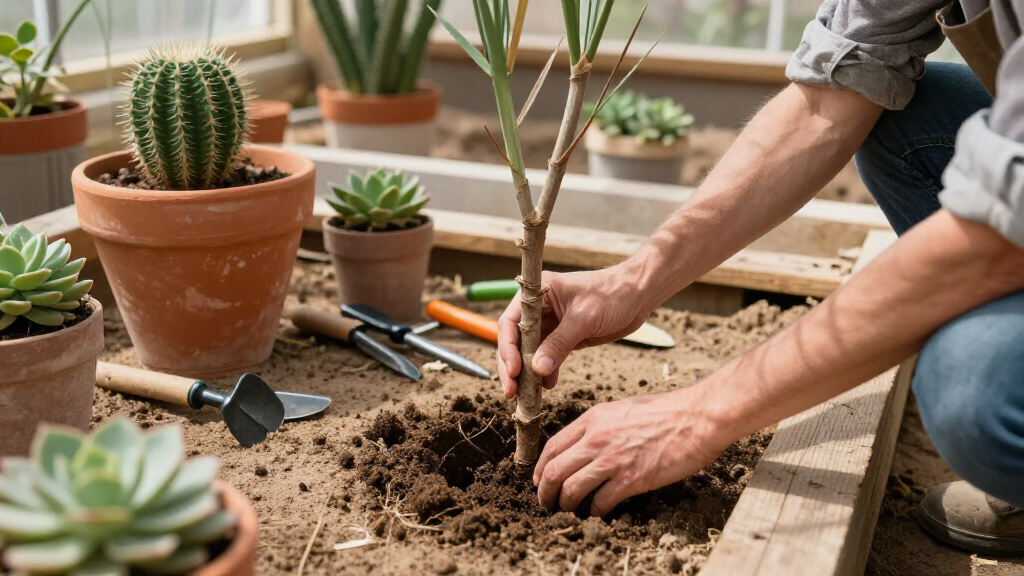
Proper planting practices are your best tools for speeding up establishment and reducing stress on the plant. Here are key tips:
- Use native, responsibly sourced plants. Avoid illegal collection. Look for nursery-grown or container plants.
- Mark the original orientation. Replant in the same direction to prevent sunburn on shaded sides.
- Plant at the right depth. Keep the cane tips at the same soil level they grew in. Deep planting can suffocate roots or cause rot.
- Choose well-draining soil. Ocotillo hates sitting in water. Use sandy or gravelly soil that drains fast.
- Minimize organic amendments. Native desert soil is best. Don’t over-fertilize; it can promote weak, tender growth.
- Support large plants temporarily. Use stakes to prevent wind damage, but remove supports once roots stabilize.
- Don’t seal wounds with paint or tar. Let cuts dry naturally to prevent decay.
Implementing these steps ensures the plant’s roots face minimal stress during transplantation, which is critical because the initial root growth phase is the most vulnerable. For example, planting in well-draining, sandy soil prevents water from pooling around the roots—a common cause of rot. Using stakes for larger plants can prevent wind from toppling them before their roots are strong enough to hold them upright, much like training wheels on a bicycle. These practices, combined with patience, significantly increase the chances of successful establishment.
As an affiliate, we earn on qualifying purchases.
Watering Smartly During Those Critical First Years
Water is a delicate balance with ocotillo. Too much and you drown the roots; too little and they can dry out. During establishment, your goal is to encourage roots to grow outward, not to keep the root zone constantly wet. For example, watering once every two to three weeks during hot, dry months allows the soil to dry out between waterings, encouraging roots to extend deeper into search for moisture—much like a person digging deeper for water during a drought.
Deep watering helps establish a strong root system, but overdoing it can lead to soggy soil and root rot, especially in poorly drained areas. If you water too frequently, the roots may stay in an oxygen-deprived environment, weakening the plant and slowing development. Conversely, if you water too infrequently, the roots may dry out before they can grow and anchor the plant. Adjust watering based on soil texture: sandy soils drain quickly, so they may need more frequent watering; clay soils retain moisture longer, requiring less frequent watering.
For example, in a sandy desert soil, watering deeply once every two weeks during peak summer can simulate natural rain patterns, encouraging roots to grow downward and outward. Moving water away from the base as roots develop prevents shallow root systems that are vulnerable to wind and drought. Remember, overwatering is a common mistake that can lead to root rot and plant death, so err on the side of caution and observe soil moisture carefully.
As an affiliate, we earn on qualifying purchases.
What Can Extend the Wait Beyond Two Years?
Sometimes, your ocotillo just doesn’t cooperate. Several factors can push the establishment timeline well past two years:
- Planting during cold weather or in unsuitable climates with high humidity, which can slow root development or cause stress.
- Severe root damage or long periods out of the ground, such as transplanting salvaged plants or root loss during handling.
- Large, old salvaged plants with extensive root loss, which need more time to rebuild their root system.
- Poor drainage or planting too deep, leading to waterlogged roots that rot or fail to grow.
- Repeated overwatering or lack of moisture during dry spells, which hampers root growth and can cause root rot.
- Damaged or sunburned canes, which delay recovery as energy is diverted to healing.
- Windy conditions before roots are established, which can topple weak plants or cause stress that delays rooting.
For example, a plant transplanted in winter or in a humid climate may take longer to establish than one planted in the desert summer. Recognizing these factors helps set realistic expectations and avoid unnecessary frustration. Patience, combined with proper care tailored to these conditions, can still lead to successful establishment even after extended delays.
Why Nursery-Grown Plants Usually Establish Faster and Safer
Nursery-grown ocotillos with intact root balls tend to settle in quicker than salvaged bare roots. Their roots are less damaged, and they often come with a healthy, balanced root system ready to grow. This means less waiting, fewer surprises, and usually a higher success rate.
In contrast, salvaged plants often have a rougher start—they’ve lost many roots and need more time to rebuild. Proper handling and planting are critical, but patience remains key regardless of origin.
In some cases, buying container-grown or nursery-rooted ocotillos is a smart move—especially if you want quicker results and less risk of failure.
For example, a nursery-grown ocotillo purchased in spring will typically show signs of new growth within the first year—such as swelling buds or small leaf shoots—whereas a salvaged plant might take two or even three years before similar signs appear. This difference is due to the healthier, more intact root system of nursery plants, which can support faster establishment. The tradeoff is that nursery plants may be more expensive, but they often save you time and reduce the risk of failure, especially in challenging environments.
Frequently Asked Questions
How long does a bare-root ocotillo take to establish?
Most bare-root ocotillos need between one and two years to develop a strong root system. Larger or stressed plants may take longer, but patience and proper care speed things up.
Is my leafless ocotillo dead?
Not necessarily. Ocotillo naturally sheds leaves during drought. Check if canes are firm, see if green tissue appears beneath the bark, and look for swelling buds after rain. These are signs it’s still alive.
Why did it leaf out then lose all its leaves?
This is normal during drought cycles. The plant’s stored reserves can support brief leafing, but if roots aren’t established, leaves drop as soil dries. Repeated cycles are typical during early growth.
Does leafing mean it has rooted?
Not quite. Leafing can come from stored water and energy. It’s a promising sign, but true rooting means roots are growing and anchoring the plant, which takes longer.
How often should I water during establishment?
Water deeply and infrequently—every couple of weeks in hot weather—allowing soil to dry out between watering. Adjust based on soil type, weather, and plant size. Overwatering is a common mistake that can kill roots.
Conclusion
Patience is your best tool when establishing bare-root ocotillo. Expect it to take up to two years for roots to fully develop—and don’t rush to conclusions if it stays leafless or looks dead.
Instead, focus on proper planting, smart watering, and giving it time. Your desert-adapted plant will reward your patience with steadfast resilience, thriving in its natural home.
FALL Fall Picks
fall essentialsfall essentials
As an affiliate, we earn on qualifying purchases.