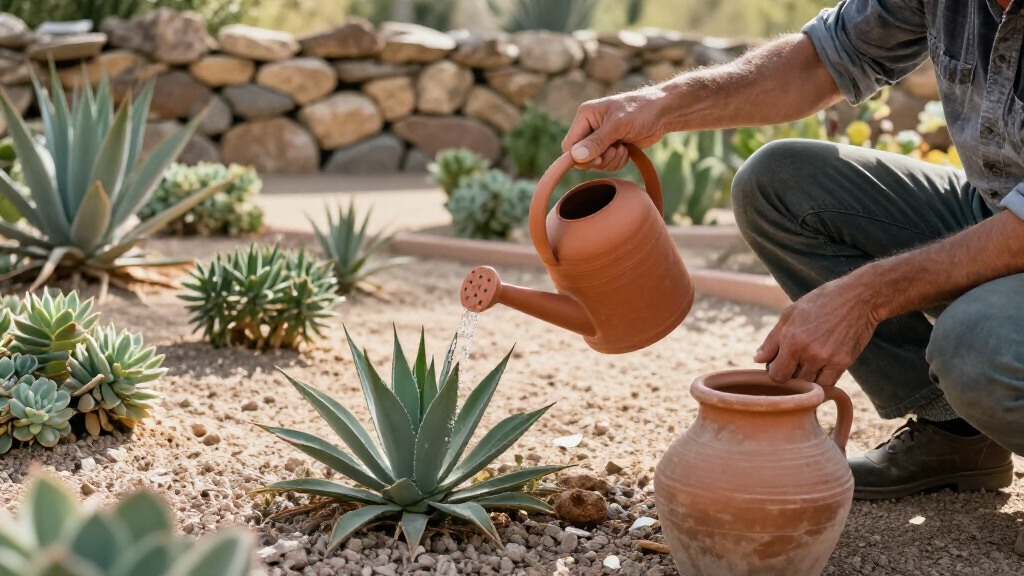
Use this guide to choose a watering can and water desert garden plants slowly at the root zone. It is for beginners caring for succulents, cacti, native plants, or other drought-adapted plants in garden beds or containers. You will learn how to check the soil, control the pour, and tell whether water reached the roots. Allow 30-60 minutes for choosing or preparing the can and completing a first watering; later sessions usually take less time.

Get garden gear delivered free with Prime
- Fast, free delivery on millions of items
- Prime Video, Amazon Music and more included
- Member-only deals all year

Root & Vessel Classic 2-Gallon Watering Can, Hunter Green
- ✔ Capacity: 2 gallons
- ✔ Material: UV-resistant plastic
- ✔ Nozzle: Detachable

Nakaya Japanese Long-Spout Watering Can, 850 ml
- ✔ Capacity: 850 ml (28 oz)
- ✔ Material: Plastic
- ✔ Spout: Long spout

Chapin 48000 1/2-Gallon Watering Can
- ✔ Capacity: 0.5 gallons
- ✔ Material: 100% recycled HDPE
- ✔ Handles: Two
Difficulty: Beginner | Time: 30-60 minutes for setup and first watering
What You’ll Need
Tools & Materials:
- Watering can with a comfortable handle and a spout that reaches the soil near plant roots
- Water source with water suitable for garden use
- Finger, wooden skewer, or small trowel for checking soil moisture
- Optional: removable rose or watering wand attachment for controlling the flow
Knowledge:
- Basic ability to identify which plants are in the bed or containers
- Willingness to check soil moisture before watering
Plant water needs vary by species, season, container size, soil, and local weather. Look up care guidance for unfamiliar plants, especially newly planted specimens. A watering can controls delivery; it does not set a schedule. Do not assume every desert plant needs water just because the surface soil looks dry.
Root & Vessel Classic 2-Gallon Watering Can, Hunter Green
When our watering route includes several outdoor plants, two gallons of capacity gives the Root & Vessel a clear advantage over both smaller cans here. Fewer refill trips can make a routine across a garden bed more manageable, while the built-in measurement markings help us keep track of how much water we are applying. That combination is especially useful when we want to water deliberately rather than pour without a sense of volume.The detachable nozzle adds flexibility: we can remove it for a more direct flow or take it off for easier cleaning. Its wide spout and sloping handle are intended to support pouring, and the thick-walled, UV-resistant plastic is a practical fit for outdoor storage and use. Compared with the Nakaya, this can sacrifices the compact reach of a long indoor spout; compared with the Chapin, it carries substantially more but takes up more room and may feel less nimble when nearly full.Its limitation is the same design choice that makes it useful outdoors: this is a large plastic can, not a small, metal-feeling precision tool. We should skip it if storage space is tight or if we mostly water a few indoor pots. For mixed use and regular outdoor rounds, though, its capacity and adjustable delivery make it the most versatile pick in this group.
Pros:
- Two-gallon capacity reduces refills during outdoor watering.
- Measurement markings support controlled water portions.
- Detachable nozzle allows flow adjustment and easier cleaning.
- UV-resistant, thick-walled plastic is designed for outdoor durability.
Cons:
- Larger size is less convenient to store than the Chapin or Nakaya.
- Plastic construction will not suit buyers seeking a metal can.
Best for: Gardeners watering multiple outdoor desert plants who want fewer refill trips and measured pours.
Not ideal for: People with only a few small indoor plants, limited storage, or a strong preference for metal construction.
Bottom line: Choose the Root & Vessel for the broadest mix of capacity and pour control when outdoor desert plants make up most of our watering.
“Choose the Root & Vessel for the broadest mix of capacity and pour control when outdoor desert plants make up most of our watering.”
Nakaya Japanese Long-Spout Watering Can, 850 ml
For a windowsill of succulents or cacti, reach and flow control matter more than carrying a garden’s worth of water. The Nakaya’s long spout is designed to help us direct a pour into a particular pot, which can be easier than maneuvering a broad, high-capacity can around crowded containers. Its compact form also fits indoor plant care better than the two-gallon Root & Vessel.That precision comes with a firm boundary: at 850 ml, it is the smallest option in the lineup. We will refill it often for multiple pots, and it is explicitly intended for indoor use, so it is not the natural choice for covering outdoor beds. The Chapin also stays compact, but its half-gallon capacity and large top opening emphasize convenient filling and carrying; the Nakaya instead earns its place through the long spout and a stated focus on succulents and cacti.We would choose it for careful, occasional watering of indoor desert plants, especially where pots sit close together. Buyers who need one can for a patio collection or garden should move up to the Chapin at minimum, and to the Root & Vessel for repeated outdoor rounds. The small reservoir is the tradeoff for a can built around controlled placement rather than coverage.
Pros:
- Long spout helps direct water into individual pots.
- Compact form is suited to indoor storage and handling.
- Designed for houseplants, succulents, and cacti.
- Made in Japan.
Cons:
- 850 ml capacity requires frequent refilling for larger tasks.
- Indoor focus makes it a limited choice for outdoor desert gardens.
Best for: Indoor plant owners who need to reach into crowded arrangements of succulents, cacti, and small houseplants.
Not ideal for: Gardeners watering outdoor beds or anyone who wants to complete many pots between refills.
Bottom line: Pick the Nakaya when precise indoor pours around small desert plants matter more than capacity or outdoor range.
“Pick the Nakaya when precise indoor pours around small desert plants matter more than capacity or outdoor range.”
Chapin 48000 1/2-Gallon Watering Can
The Chapin 48000 is a practical middle ground for someone who needs a can that is easy to fill, carry, and put away but wants more capacity than the Nakaya’s 850 ml. Its half-gallon reservoir still falls well short of the Root & Vessel’s two gallons, so it makes the most sense for a handful of containers, a small patio setup, or quick touch-ups—not a full round through a larger garden.A large top opening makes refilling straightforward, while the two handles give us options for carrying and pouring. Made from 100% recycled HDPE, it is rust-resistant, and its compact dimensions are described as easy to fit under a cupboard or in a closet. Compared with the Nakaya, the Chapin prioritizes easy filling and two-handed handling over a specifically long spout for reaching into crowded pots. Compared with the Root & Vessel, it is easier to tuck away but requires more trips outdoors.The supplied details do not identify a detachable nozzle or measurement marks, so buyers who want those features should look to the Root & Vessel. The Chapin’s limited capacity is its main constraint; the recycled material and storage-friendly shape do not change that. Choose it when compactness and simple handling outweigh the need to water many plants in one pass.
Pros:
- Half-gallon capacity is larger than the Nakaya’s 850 ml.
- Large top opening makes filling convenient.
- Two handles offer flexible carrying and pouring.
- Made from recycled HDPE and described as rust-resistant.
Cons:
- Half-gallon capacity can mean frequent refills outdoors.
- No measurement markings or detachable nozzle are listed.
Best for: People with a few indoor or small outdoor plants who value a lightweight can that is easy to fill and store.
Not ideal for: Gardeners covering larger desert beds or anyone who wants fewer refills and measured water portions.
Bottom line: The Chapin is the easiest compact all-purpose choice here, provided our watering route is small enough to tolerate frequent refills.
“The Chapin is the easiest compact all-purpose choice here, provided our watering route is small enough to tolerate frequent refills.”
As an Amazon Associate we earn from qualifying purchases.
Before You Start
Check the weather and the soil before filling the can. Water early in the day when possible, so plants can take up water before peak heat and foliage can dry. Avoid watering during strong winds, which can scatter water. If your water is very hard or salty, check whether your plants tolerate it and follow local gardening guidance. Keep water away from electrical equipment and avoid standing on hot, unstable, or slippery surfaces.
For a mixed garden, separate plants with different needs into groups. Many established desert plants prefer the soil to dry between thorough waterings, while new plantings may need more frequent checks as their roots establish. Follow species-specific guidance where available.
Step-by-Step Instructions
Step 1: Group plants by watering needs
Identify the plants you plan to water and group together those with similar needs. Keep cacti and succulents separate from plants that need more frequent moisture, such as some young native plants or leafy desert-adapted shrubs. Check labels or a trusted local plant guide if you do not know a plant’s requirements.
Tip: Do not use one schedule for every plant in a mixed bed. Sun exposure, soil, and plant age also affect how quickly roots use water.
Check: You can identify which plants belong in the same watering group and which need separate checks.
Step 2: Check the soil before watering
Test the soil near the root zone, not just the surface. For a garden bed, push a finger or wooden skewer a few inches into the soil near, but not against, the plant. For a container, check through a drainage hole or insert a finger or skewer into the potting mix. If the soil is still moist at the depth of the roots, wait and check again later. If it is dry, proceed according to the plant’s care needs.
Tip: Avoid digging close to stems or shallow roots. A skewer can reach deeper soil with less disturbance.
Check: You have a clear indication of moisture in the root zone and have chosen whether to water or wait.
Step 3: Choose a can that suits the planting
Use a can you can carry when full without straining. Choose a narrow spout for directing water into tight spaces and a removable rose when a gentler, broader flow is useful. For large beds, a small can may require many refills; for delicate pots, a heavy, high-capacity can may be difficult to control. Check that the handle feels secure and the spout does not leak.
Tip: A rose can reduce the force of the pour, but it may wet foliage. For plants prone to rot, remove it and water the soil directly.
Check: The filled can is manageable, reaches the intended soil, and pours without leaking.
Step 4: Fill the can and plan your route
Fill the can to a level you can lift and pour steadily. If it has a fill line, follow it. Start with the driest plants that are ready for water, and work through one group at a time. Keep a clear path so you can carry the can without stepping on plants or tripping over hoses and pots.
Tip: A partially filled can is easier to control than a full one. Refill as needed instead of rushing or spilling.
Check: You can lift the can comfortably and reach each plant without brushing or crushing nearby growth.
Step 5: Pour slowly at the root zone
Position the spout close to the soil and aim around the plant’s root zone. Pour slowly enough for the soil to absorb the water. For a shrub or larger plant, distribute the water around the area beneath its outer branches rather than pouring only against the stem. For a small pot, pour gently until water begins to drain from the bottom, then stop and let it drain fully.
Tip: Do not direct a strong stream at a plant’s crown, cactus body, or exposed roots. If water starts running across the surface, pause and let it soak in before continuing.
Check: Water enters the soil near the roots with little runoff, and container drainage is not left sitting in a saucer.
Step 6: Pause and check for runoff
Watch the soil while you pour. If water pools or runs downhill, stop and wait for it to soak in. Resume with a smaller pour, moving the spout around the root zone. On sloped ground or compacted soil, several slow passes may work better than one large pour.
Tip: Do not keep pouring into a puddle. Excess water may flow away from roots or carry soil downhill.
Check: The water is soaking into the intended area instead of flowing across the bed or spilling over a pot.
Step 7: Confirm moisture below the surface
After watering, wait several minutes, then check the soil again near the root zone. In a container, make sure excess water has drained freely. If the soil is still dry below the surface and the plant’s care guidance calls for a thorough watering, add a little more slowly. If the root zone is moist, stop.
Tip: Do not judge by surface color alone. Mulch, coarse soil, and strong sun can make the surface look dry even when deeper soil remains moist.
Check: The root-zone soil is moist to the depth appropriate for that plant, without prolonged standing water.
Step 8: Empty and store the can
Pour out leftover water if it has been sitting in the can, then rinse the can if it contains sediment or fertilizer residue. Let it drain and store it out of direct sun where it will not be damaged or become a tripping hazard. Check the spout and handle occasionally for cracks or leaks.
Tip: If you add fertilizer to a watering can, follow the product label and rinse the can afterward. Do not use that can for drinking water.
Check: The can is clean, dry enough for storage, and ready for the next use.
Common Mistakes to Avoid
- Leaving a pot standing in drained water. — Let the pot drain completely and empty its saucer so roots are not left in standing water.
Troubleshooting
Problem: The plant looks wilted even though the soil is wet.
Solution: Do not add more water automatically. Check for poor drainage, root problems, or heat stress, and consult a reliable guide for the plant species. Move a potted plant only if its care guidance supports a change in exposure.
What Success Looks Like
The can is comfortable to handle and delivers a controlled stream. You water only plants whose root-zone soil is ready, apply water slowly near their roots, and see little runoff. Container water drains freely, while the soil below the surface reaches the moisture level appropriate for each plant. You record what you watered and when, then base the next session on soil checks and plant care guidance rather than a fixed blanket schedule.
Next Steps
Note the date, plant group, and any runoff or drainage issues. Check the soil again before the next watering, with more frequent checks for new plantings, small containers, or periods of extreme heat. Clean the can after fertilizer use and replace it if the spout, seams, or handle become unsafe. If a plant repeatedly wilts or shows signs of rot, identify the species and review its care requirements before changing how much you water.
Frequently Asked Questions
How often should I water a desert garden with a watering can?
There is no single schedule for all desert gardens. Check soil moisture at the root zone and follow guidance for each plant. Weather, season, soil, shade, and whether a plant is newly planted all change how quickly it needs water.
Should I use a watering-can rose on cacti and succulents?
A rose can soften the flow, but it may wet the plant body or crown. A narrow spout aimed at the soil is often easier for directing water to the roots. Let the soil dry according to the plant’s care needs between waterings.
How much water should I put in the can?
Fill only as much as you can carry and pour steadily. Apply water in controlled amounts and pause if it runs off. For a container, water slowly until moisture reaches the root zone and excess water drains from the bottom.
Can I water desert plants during the hottest part of the day?
Water early when practical, especially in windy or very hot conditions. If a plant needs water urgently, direct it to the soil and avoid splashing sensitive foliage or crowns. Follow local and species-specific care guidance.
What size watering can should I buy?
Choose a size you can lift comfortably when full. A narrow spout helps with close planting, while a removable rose provides a gentler spread. For many small pots, a lighter can may be easier to control; for a large bed, a higher capacity reduces refills if you can still handle it safely.